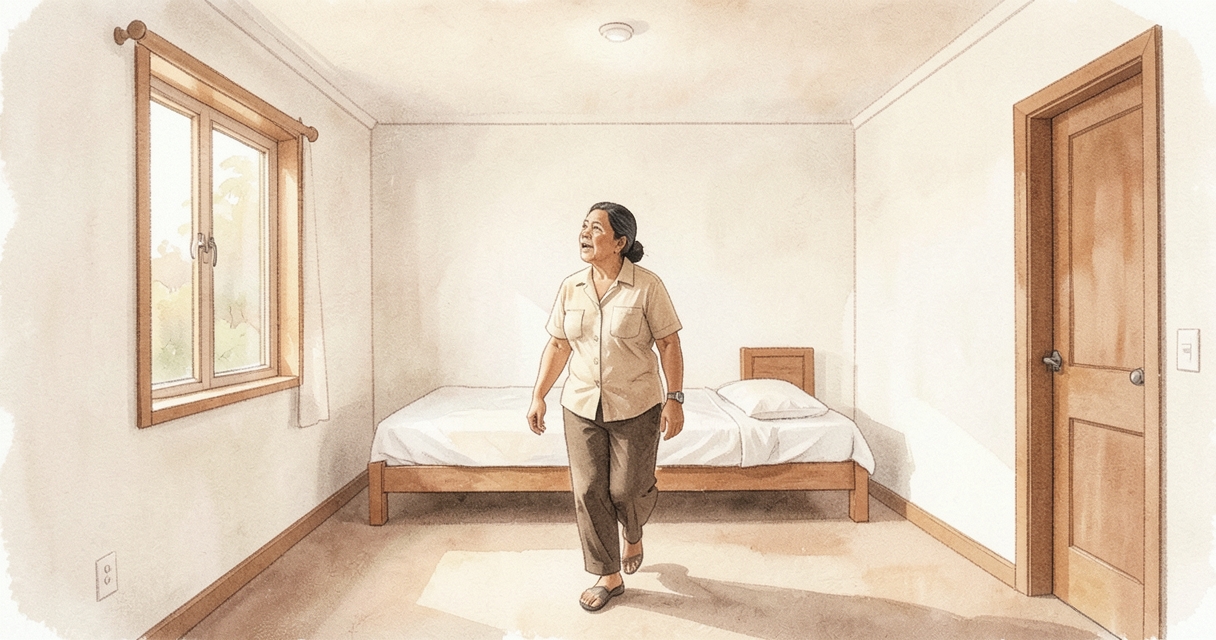
You arrive somewhere for an overnight stay. There is a perfectly good chair, yet one person refuses to remain in it.
They check the window. The bathroom. The hallway. They put down their bag, stand up again, walk around the room, then do another lap ten minutes later.
From the outside, it can look remarkably dog-like.
It is tempting to joke that they are “establishing territory.” But unless they start scent-marking the corners, a better explanation is usually simpler: they are gathering information about an unfamiliar place and trying to feel safe enough to settle.
1. The short answer: less “territory,” more “exploration + vigilance + restlessness”
Dogs may pace, spin, scratch, or perform other repetitive actions when stressed, frustrated, or highly aroused. Veterinary references describe some of these as displacement behaviors that can help the animal return toward emotional balance.[1]
But pacing does not have one universal meaning. A dog may also be looking for a cooler spot, reacting to a sound or smell, needing to eliminate, wanting activity, or feeling unwell.
Humans also stand up and walk when they feel unsettled. That does not mean the human and canine behaviors are driven by an identical biological mechanism. The useful similarity is narrower: when a place is unfamiliar, moving through it can be a way to collect missing information.
Dog: new place, better inspect it.
Human: new place, better inspect it.
The visual resemblance is doing a lot of work here.
2. Why overnight stays make this especially obvious
At home, dozens of questions have already been answered automatically. You know where the bathroom is, what noises happen at night, where the light switches are, which chair feels right, and what is behind each door.
In a new room, that automatic map disappears.
Sleep research shows that humans often sleep differently on the first night in a new setting. This is known as the “first-night effect.” A 2022 meta-analysis covering 53 studies and 1,422 healthy participants found that the first night was associated with longer sleep onset, more wakefulness after sleep onset, and lower total sleep time and sleep efficiency than the second night.[2]
A 2024 study also found first-night changes in sleep onset, wakefulness after sleep onset, and total sleep time.[3]
A well-known 2016 experiment suggested that part of the brain may remain more vigilant to unusual sounds during a first night in a novel environment.[4] Later work, however, has not found a fully consistent hemispheric pattern, so the exact mechanism remains unsettled.[3]
The safe conclusion is not “half your brain becomes a night guard.” It is simply that humans do not always switch into full rest mode instantly when the environment changes.
3. What if the same person also looks uncomfortable in an upscale or highly formal place?
Imagine someone who looks visibly uncomfortable in a formal, expensive bar, then later paces around during an overnight stay somewhere unfamiliar.
It is reasonable to wonder whether both situations share a common ingredient: unfamiliarity.
A formal venue creates uncertainty about social rules: How loud can I speak? Am I dressed appropriately? What should I order? Am I behaving correctly?
A new room creates uncertainty about the physical environment: Where is the exit? What is that noise? Where do I sleep? Where should I put my things?
Different content, similar problem: the usual autopilot is unavailable.
Two anecdotes cannot diagnose a personality trait or disorder. But as a working description, “this person becomes more activated when the environment or its rules are unfamiliar” is coherent.
4. What should the person do? Let the first exploration happen
Telling someone to “just relax” is not very useful if their brain still feels that basic information is missing.
A practical approach is to do one deliberate inspection at the start.
Check the bathroom, shower, entrance, sleeping area, windows, charging points, water, and where your belongings will go.
Then create a base: put down the bag, plug in the phone, place a drink nearby, change into familiar clothes, and put familiar items where you can see them.
In other words, install a tiny piece of home inside the unfamiliar room.
For dogs, bringing a familiar bed, blanket, or toy is commonly recommended when they are adapting to a new environment. For humans, the principle is not identical science, but the practical idea is similar: familiar cues reduce the amount of uncertainty you have to keep processing.
5. So should you “explore as much as you want”? One lap, yes; endless checking, no
The first round of exploration does not need to be suppressed.
Spend a few minutes learning the layout. Then move on.
The pattern changes when checking becomes a loop:
“I checked the lock.”
“But what if…”
“I will check again.”
“One more time, just in case.”
Research on anxiety disorders has examined “safety behaviors”—actions used to reduce anxiety that can, in some situations, help maintain it when they prevent a person from learning that they can cope without constant checking.[5]
That does not mean normal room-checking is pathological. It means there is a useful boundary.
Explore → build a mental map → make a base → start a normal activity.
You do not need to patrol the hotel corridor thirty times like you are capturing checkpoints in an open-world game.
6. What can other people do?
Repeatedly saying “sit down” or “calm down” may make the person more aware of the fact that they are not calm.
It may work better to reduce uncertainty directly: “Bathroom is there.” “Exit is this way.” “You can leave your bag here.” “Go have a look around if you want.”
Once they come back, start something ordinary: have a drink, eat, play a game, talk, watch something. That shifts the mode from inspecting the environment to living in it.
Calling them “basically a dog” depends on the relationship.
Thinking it privately is free.
Patting their head and saying “good job exploring” is probably one step too far.
7. Is it ever actually territorial behavior?
Dogs do use urine and scent marking for social communication, so pacing plus repeated small urinations can involve marking.
But pacing alone does not automatically equal territorial behavior.
For humans, the distinction is easier. Walking around a hotel room, checking the window and bed, and finding the bathroom is not generally a declaration of sovereignty.
If a human starts scent-marking all four corners, the relevant reading material is no longer behavioral science. It is the hotel policy.
8. When not to dismiss it as ordinary exploration
For dogs, persistent circling in one direction, behavior that suddenly appears, an inability to stop, abnormal responsiveness, severe panting, shaking, vomiting, or other symptoms can point beyond ordinary adjustment and deserve veterinary attention.[1]
For humans, consider professional help if unfamiliar places reliably trigger intense distress, checking lasts for hours, sleep disruption continues for days, or the problem begins to restrict work, travel, or daily life.
This article is mainly about the much more ordinary situation in which someone functions normally but becomes temporarily restless in an unfamiliar place.
Bottom line: humans really can patrol a room like dogs
Seeing someone pace around a new room and thinking, “You look like a dog inspecting a new house,” is not a terrible observation.
The more accurate version is not “they are claiming territory,” but:
explore the unknown place → check that it is safe → build a personal base → finally settle down.
Dogs sniff.
Humans check the bathroom, outlets, windows, and Wi‑Fi.
Civilization changed the equipment.
The patrol remains surprisingly recognizable.
Sources
- Merck Veterinary Manual. “Behavior Problems of Dogs.” Stress displacement behaviors may include spinning and pacing, and persistent repetitive behavior can also have medical or neurologic causes merckvetmanual.com
- Ding L, Chen B, Dai Y, Li Y. (2022). “A meta-analysis of the first-night effect in healthy individuals for the full age spectrum.” Sleep Medicine, 89, 159–165. PMID: 34998093 pubmed.ncbi.nlm.nih.gov
- Wick AZ, Combertaldi SL, Rasch B. (2024). “The first-night effect of sleep occurs over nonconsecutive nights in unfamiliar and familiar environments.” SLEEP, 47(10), zsae179. PMCID: PMC11467056 pmc.ncbi.nlm.nih.gov
- Tamaki M, Bang JW, Watanabe T, Sasaki Y. (2016). “Night Watch in One Brain Hemisphere during Sleep Associated with the First-Night Effect in Humans.” Current Biology, 26(9), 1190–1194. PMID: 27112296 pubmed.ncbi.nlm.nih.gov
- Helbig-Lang S, Petermann F. (2010). “Tolerate or Eliminate? A Systematic Review on the Effects of Safety Behavior Across Anxiety Disorders.” Clinical Psychology: Science and Practice, 17, 218–233 onlinelibrary.wiley.com