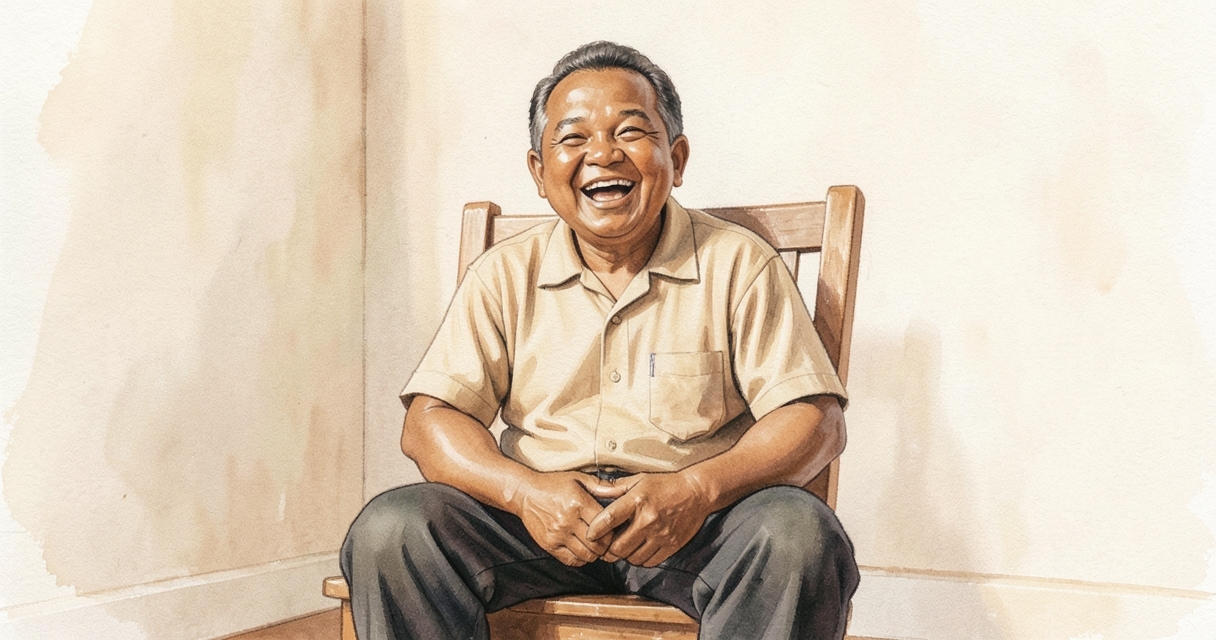
On the dohyo, he is an East Sekiwake officially listed at 185 cm and 198 kg.
Then he smiles, and some part of the viewer’s brain seems to announce:
“Baby.”
The scale is obviously wrong.
As of September 2026, the Japan Sumo Association lists Atamifuji Sakutaro as 24 years old, 185 cm tall, 198 kg, and East Sekiwake. His profile also lists sushi, ochazuke and pudding among his favorite foods, and back number, Saucy Dog and CreepHyp among his favorite music.[1]
The “cute” reaction is not just an online meme. At a regional tour, fans described him as cute, and a reporter directly asked him about the many women who call him cute. He replied that he was happy if that brought more people to his sumo, while also saying that as a man he wanted to be seen as cool.[2] In another interview, his sister also agreed that he looks cute when he smiles.[3]
So the public verdict has a funny mismatch:
Atamifuji: I want to be a cool man.
Everyone else: adorable.
The five-second answer
- Research on baby schema shows that infant-like facial configurations tend to increase perceived cuteness and caretaking motivation.[4]
- Those responses can generalize to adults with baby-like facial structure, a phenomenon called babyface overgeneralization.[5]
- In four studies with 1,235 participants, stronger smiles could increase perceived babyfacedness, which in one key analysis mediated younger age estimates.[6]
- But another research line finds that smiling can make a face look older in direct age estimation, partly because smile-related wrinkles around the eyes become age cues.[7][8][9]
- So “looks baby-like when smiling” is not the same claim as “always looks chronologically younger when smiling.”
- No study has scientifically measured Atamifuji’s own face for babyfacedness. The explanation here combines general face-perception research with documented public reactions.
1. What is a baby face, scientifically?
Infant faces differ from adult faces in proportions: relatively large heads, rounder faces, high foreheads, large eyes, small noses and mouths, and fuller cheeks are among the classic features associated with Kindchenschema, or baby schema.
Glocker and colleagues experimentally manipulated baby-schema features in photographs of infants. Among 122 participants, faces with stronger baby-schema features were rated as cuter and elicited stronger reported motivation to care for the infant.[4]
The important point is that cuteness is not simply another word for conventional attractiveness.
A person can strongly trigger “cute” while not matching the viewer’s category of “handsome,” “mature” or “intimidating.” Those judgments can coexist.
That is why someone can sincerely want to look cool while observers keep landing on cute.
2. The system is not baby-only: it can spill over to adults
This is where babyface overgeneralization becomes useful.
The idea is that perceptual and social responses that evolved or developed to detect infants can partly generalize to adults who possess infant-like facial structure.
In an fMRI study, Zebrowitz and colleagues compared responses to babies, babyfaced young men and maturefaced young men. Activity in the amygdala and fusiform face area showed stronger similarities between babies and babyfaced men than between babies and maturefaced men.[5]
That does not mean the brain literally mistakes an adult man for an infant.
It means that some of the perceptual machinery and social impressions recruited by infant-like facial structure can also be recruited by adult faces.
So “he is an adult, but somehow looks baby-like” has a real home in face-perception research.
3. Why does the smile make the baby effect stronger?
This is the key part.
Wang, He and Liu examined smile intensity and age perception across four studies totaling 1,235 participants. In Study 1, involving 646 participants, a maximal smile produced younger age estimates than a neutral expression, and the effect was mediated by perceived babyfacedness.[6]
In simplified form:
stronger smile → more babyfacedness → younger impression
That makes the everyday observation “he looks like a normal adult until he smiles, then suddenly turns into a baby” surprisingly compatible with experimental research.
Atamifuji himself was not a stimulus in those experiments, so the study does not “prove Atamifuji is a baby face.”
But it supplies a plausible general mechanism for why a smile can amplify an already baby-like impression.
4. The counterevidence: smiling can also make faces look older
Science, helpfully, makes the story messier.
Ganel found that when observers directly estimated the ages of the same people smiling versus neutral, the smiling photos were consistently judged older. A leading explanation is that smiling creates or accentuates wrinkles around the eyes, which observers use as age cues.[7]
Ganel and Goodale later showed an intriguing dissociation: people directly judged smiling faces as older while still believing that smiling makes people look younger.[8]
A cross-cultural replication using Japanese and Swedish participants found a similar pattern: direct judgments tended to make smiling faces older, while retrospective impressions favored the belief that smiles look younger.[9]
This does not necessarily destroy the babyfacedness result, because the judgments are not identical.
Looking baby-like, innocent, warm or playful is not the same task as assigning a numerical age to a photograph.
When someone says Atamifuji’s smile is “like a baby,” they are usually not claiming that a 24-year-old literally looks 18.
The “baby” signal can rise even when numeric age estimation moves differently.
5. Why is the effect so strong at 185 cm and 198 kg?
There is no Atamifuji-specific experiment testing this contrast, so this part should be treated as a perceptual interpretation rather than a direct scientific finding.
The category “baby” normally comes with an expectation of smallness.
Atamifuji is officially 185 cm and 198 kg.[1]
He is not small.
He is, in technical terms, an absurdly large candidate for the baby category.
That is exactly why the contrast works. A massive elite sumo wrestler and a soft, baby-like smile occupy very different expectation spaces. When both cues arrive together, “cute” is intensified by incongruity.
The phrase “giant baby” becomes an extremely efficient compression algorithm.
The claim is not that being large makes him look young. It is that the distance between his physical scale and his social facial impression makes the latter more memorable.
A 198-kg Sekiwake smiling like that is simply more cognitively surprising than an ordinary adult doing the same thing.
6. He sings too: the cute impression is not only facial geometry
An official 2024 preview for Sanma no Manma described Sanma reacting to Atamifuji’s natural, pure-seeming comments with “cute,” and noted Atamifuji saying he could sing karaoke songs by artists including Kenshi Yonezu and Masaki Suda.[10]
This should not be turned into a personality diagnosis. A television appearance is not a psychological assessment.
But social impressions are also not built from facial geometry alone.
Smile, voice, conversational style, shyness, unexpected hobbies and contrast with body size can all point in the same direction and strengthen a single impression.
185 cm.
198 kg.
Sekiwake.
Pushes elite wrestlers out of a ring for a living.
Likes pudding.
Sings karaoke.
Smiles.
Brain: “…baby?”
No. A 24-year-old Sekiwake.
But the confusion is understandable.
7. What the research can and cannot say
It can support these claims
- Infant-like facial configurations can increase cuteness and caretaking responses.[4]
- Some responses to infantile facial structure generalize to babyfaced adults.[5]
- Smile intensity can increase perceived babyfacedness in experimental settings.[6]
- Atamifuji is publicly and repeatedly described as cute in documented media contexts.[2][3][10]
It cannot support these claims
- That Atamifuji has a scientifically measured “baby-face score.”
- That a cute face proves a childish, innocent or harmless personality.
- That smiling always makes a person look chronologically younger.[7][8][9]
- That intelligence, maturity, development or personality can be read from facial appearance.
Faces generate social impressions, but an impression is not a measurement of the person.
Even the Giant Baby Research Society must have standards.
8. So is he the real giant baby?
Biologically, obviously not.
Officially, he is a 24-year-old adult man and East Sekiwake.[1]
Perceptually, however, the metaphor is unusually well engineered:
massive body × potentially baby-like facial cues × smile-amplified babyfacedness × repeated public “cute” reactions.
The usual insult “giant baby” refers to an adult behaving immaturely.
That is not what this article means.
Here the joke is much more literal:
the giant part is actually giant.
So the final verdict is:
“He’s literally a giant baby.” Not literally, of course—but as metaphors go, suspiciously close.
The face-recognition system is probably not broken.
It is doing what human face-recognition systems do.
Sources
- 日本相撲協会 — 熱海富士 朔太郎 力士プロフィール(2026年9月時点) sumo.or.jp
- LOOK 静岡朝日テレビ — 大相撲焼津場所、熱海富士への「かわいい」評価と本人コメント(2023-10-14) look.satv.co.jp
- LOOK 静岡朝日テレビ — 妹が語る熱海富士の素顔、「笑うとかわいい」への反応(2023-12-26) look.satv.co.jp
- Glocker, M. L., et al. — Baby Schema in Infant Faces Induces Cuteness Perception and Motivation for Caretaking in Adults. Ethology (2009) pmc.ncbi.nlm.nih.gov
- Zebrowitz, L. A., et al. — Neural activation to babyfaced men matches activation to babies. Social Neuroscience (2009) pmc.ncbi.nlm.nih.gov
- Wang, Z., He, X., & Liu, F. — Examining the Effect of Smile Intensity on Age Perceptions. Psychological Reports (2015) pubmed.ncbi.nlm.nih.gov
- Ganel, T. — Smiling makes you look older. Psychonomic Bulletin & Review (2015) pubmed.ncbi.nlm.nih.gov
- Ganel, T., & Goodale, M. A. — The effects of smiling on perceived age defy belief. Psychonomic Bulletin & Review (2018) pubmed.ncbi.nlm.nih.gov
- Yoshimura, N., et al. — Age of smile: a cross-cultural replication report of Ganel and Goodale (2018). Journal of Cultural Cognitive Science (2021) pmc.ncbi.nlm.nih.gov
- 関西テレビ — 『さんまのまんま 39年目も昇り調子SP』熱海富士・伊勢ヶ濱親方出演紹介(2024-01-02) ktv.jp