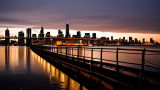
Trams, Sakurajima, ash bags, ferries, and the mysterious “Sougo” credit union
You do not need to enter a major attraction to notice that Kagoshima City runs on a slightly different set of rules.
A tram rolls down the middle of the road. Grass grows between the rails. An active volcano sits behind office buildings. The city hands out special bags for volcanic ash. A ferry leaves from the edge of downtown as if it were just another bus route. Then a bank-like sign says “Kagoshima Sougo Shinkin Bank,” and visitors from central Japan may wonder whether “Sougo” is a place name.
It is not.
The fun of Kagoshima is not one spectacular landmark. It is the way volcanoes, port transport, trams, southern Japanese culture and local finance all appear in ordinary daily life.
Facts below were checked as of October 4, 2026.
0. The short version: the whole city behaves like an exhibit
Kagoshima’s unusual features rarely present themselves as “special attractions.”
The tram is normal public transport. Sakurajima is the everyday skyline. Volcanic ash has its own municipal collection system. The ferry is a practical way to cross the bay.
That is what makes the city interesting.
The strange thing is not that Kagoshima has a volcano or a tram. The strange thing is how calmly those things are integrated into the city’s operating system.
1. “A private railway!” — not quite. It is a municipal tram
Kagoshima’s streetcars are operated by the Kagoshima City Transportation Bureau, not a private railway company.
Route 1 runs Kagoshima-Ekimae–Kishaba–Taniyama, while Route 2 runs Kagoshima-Ekimae–Kagoshima-Chuo-Ekimae–Korimoto.[1]
This is especially striking for visitors from the Tokai region of central Japan, where Toyohashi is currently the only city with a streetcar system.[2]
So the reaction “I thought trams were basically a Toyohashi thing” is understandable.
Kagoshima then adds another twist: grass.
Since fiscal 2006, the city has greened roughly 8.9 km of street-running track, covering about 35,000 square meters. The base even uses water-retaining blocks made with shirasu, volcanic deposits common in southern Kyushu.[3]
Tram. Grass. Volcanic material.
That combination already feels very Kagoshima.
2. The mountain in the background is an active volcano right now
Many Japanese cities have mountains in the distance.
Kagoshima has Sakurajima sitting across Kinko Bay, appearing between buildings, intersections, port facilities and tram wires.
And it is not simply a volcano from the history books.
The Japan Meteorological Agency continuously monitors Sakurajima. Its October 2, 2026 report maintained Volcanic Alert Level 3 and recorded 12 eruptions at Minamidake’s summit crater between September 28 and 3 p.m. on October 2.[4]
That creates a very Kagoshima contradiction:
the same mountain is both scenery and a disaster-management subject.
You photograph it, but you also check wind direction and official volcano information.
3. Volcanic ash is part of normal municipal administration
Kagoshima City provides special “kokuhai” bags for ash that accumulates on residential property.[5]
The city also maintains about 5,620 designated ash collection points. Residents bag the ash and place it at these sites for municipal collection and transport.[6]
For an outsider, this is one of the clearest signs that the volcano is not decorative.
The city does not stop at “ash fell.”
It has already implemented the next step:
“Put it in this bag and leave it here.”
In other words, ash removal is part of the city’s routine operating manual.
4. The ferry feels more like public transport than a sightseeing cruise
The Sakurajima Ferry links Kagoshima Port and Sakurajima Port in about 15 minutes.
Since the 24-hour schedule was revised in October 2025, service runs from 4:00 a.m. to 11:30 p.m. every day. The regular timetable lists 94 trips on weekdays and 104 on weekends and holidays. Cars, buses and motorcycles can board as well.[7][8]
Ferries exist in the Tokai region too.
What feels different in Kagoshima is how naturally the ferry connects to the central city. You can ride a tram, continue to the waterfront and then cross the bay by ship.
Rail-to-ship transfer is not an exotic excursion here. It is simply another layer of urban transport.
5. The city center is not concentrated around one giant station
Visitors often assume the largest railway station equals the entire downtown.
Kagoshima is more distributed.
The city’s official central-area plan describes the Kagoshima-Chuo Station area as the land gateway, the Izuro–Tenmonkan area as the central shopping district, and the Kamimachi–waterfront area around Kagoshima Port as the sea gateway.[9]
Tenmonkan itself is promoted as one of southern Kyushu’s largest entertainment and shopping districts and contains 12 shopping streets.[10]
So the city has several centers with different jobs:
Kagoshima-Chuo for Shinkansen and JR access. Tenmonkan for dense shopping, food and nightlife. The waterfront for sea access. Kagoshima Station toward the north.
The tram and walking routes stitch them together.
Seeing only the station front and declaring “Kagoshima complete” is premature.
6. Even the ground is volcanic, and the culture opens southward
Shirasu covers about 60 percent of mainland Kagoshima Prefecture. It consists of deposits from pyroclastic flows, pumice and ash. Because the soil drains easily and is relatively poor, drought-resistant crops such as sweet potatoes became historically important.[11]
So Kagoshima’s sweet-potato identity is not merely souvenir branding. It is tied to the land itself.
Southern Kyushu also preserves folk practices that are uncommon in Tokai.
Stone statues of the rice-field deity, called Tanokansaa, are characteristic of Satsuma, Osumi and southern Hyuga, areas connected historically with the Satsuma domain.[12]
Sekiganto stones, placed at places such as the ends of T-junctions to ward off evil, are also especially common in southern Kyushu and the southern islands and are said to have arrived through cultural routes from China via the islands.[13]
You will not necessarily find one on every downtown corner.
The point is broader: Kagoshima’s cultural geography faces not only north toward the Japanese mainland, but south toward the islands and Ryukyu as well.
Reimeikan, the prefectural history and art center, works well as a giant answer key after you notice these differences outside.
7. Then Tokai suddenly reappears: the Kiso River
This is the historical plot twist for visitors from central Japan.
In 1753, the Tokugawa shogunate ordered the Satsuma domain to assist with major flood-control works on the Kiso River system. Satsuma sent roughly 1,000 people under Hirata Yukie. The work took about one year and three months, cost roughly 400,000 ryo, and more than 80 people died through illness, suicide and other causes according to the Reimeikan account.[14]
So you travel all the way to Kagoshima and suddenly encounter the rivers of Gifu and Aichi.
Local history does not stop neatly at prefectural borders.
Kagoshima and Tokai were linked by a brutally expensive public-works project more than 250 years ago.
8. “Kagoshima Sougo Shinkin Bank”: Sougo is not a town
This name catches the eye.
In Tokai, many credit unions are named very directly after places: Toyohashi, Okazaki, Gifu and so on.
Then Kagoshima presents:
Kagoshima Sougo Shinkin Bank.
Is Sougo a city? Is it different from Kagoshima Shinkin Bank? Is “Sougo Shinkin” a separate type of financial institution?
No.
Kagoshima Sougo Shinkin Bank is a current regional credit union with 56 offices as of March 2026. Its service area covers most of Kagoshima Prefecture except Amami City and Oshima District, plus Miyakonojo in Miyazaki Prefecture.[15]
Its history explains the name.
It was founded in 1931 as the Limited Liability Kagoshima Seed Credit and Utilization Cooperative. In 1935 the word “Sougo,” meaning mutual or reciprocal in ordinary Japanese, entered the institution’s name. It became Kagoshima Sougo Credit Cooperative in 1950 and Kagoshima Sougo Shinkin Bank in 1951 under the Shinkin Bank Act.[16]
So “Sougo” is part of a historical proper name. It is not a separate category of bank.
Kagoshima Prefecture currently has three shinkin banks: Kagoshima, Kagoshima Sougo and Amami Oshima.[17]
The naming pattern is not unique to Kagoshima either. Tochigi Prefecture still has Kanuma Sougo Shinkin Bank.[18]
So the simplest answer is:
There is no “Sougo City.”
One caution: the official historical documents confirm when the word entered the name, but they do not fully explain the founders’ detailed reason for choosing it. It is better not to invent a heroic origin story.
9. The best way to explore Kagoshima is to collect small anomalies
Instead of treating the city as a checklist, try asking questions while walking.
Why is a tram in the middle of the road? Why is the track covered with grass? Why is the skyline an active volcano? Why does the city distribute ash bags? Why does a ferry leave beside downtown? Why are the station, shopping district and port separate but connected? Why does a credit union say “Sougo”? Why does Kagoshima history suddenly mention the Kiso River?
Those questions turn the city itself into the attraction.
You are no longer just “seeing Sakurajima.”
You are seeing how a city operates when a volcano, a bay, old regional culture and modern transport all have to coexist.
10. Quick myth-busting
Is the Kagoshima tram a private railway? No. It is run by Kagoshima City.
Does Tokai still have a tram? Yes. Toyohashi is currently the only tram city in the Tokai region.
Is Sakurajima only scenery? No. It is an actively monitored volcano and was at Alert Level 3 in early October 2026.
Does volcanic ash go out with ordinary trash? Kagoshima City has a dedicated bag and designated ash collection system.
Is Kagoshima Station the whole downtown? No. The central city stretches through Kagoshima-Chuo, Tenmonkan, the waterfront and toward Kagoshima Station.
Is “Sougo Shinkin” a special banking category? No. “Sougo” is part of the institution’s name.
Is Kagoshima Sougo the only shinkin bank in the prefecture? No. Kagoshima and Amami Oshima shinkin banks also operate there.
Conclusion: Kagoshima is a city where unusual things behave normally
A municipal tram. Grass-covered rails. An active volcano. Ash bags. A ferry. Tenmonkan. Volcanic soil. Southern folk beliefs. A Kiso River connection. A credit union name that makes outsiders ask, “Where is Sougo?”
Each item can be explained individually.
Put them together, and the result is unmistakably Kagoshima.
For travelers from Tokai, comparing the two regions turns Kagoshima from “another regional city with a famous volcano” into something much more interesting:
a city built around a completely different set of everyday assumptions.
References (18)
- Kagoshima City Transportation Bureau kotsu-city-kagoshima.jp
- Toyohashi Tourism and Convention Association honokuni.or.jp
- Kagoshima City, tram-track greening city.kagoshima.lg.jp
- Japan Meteorological Agency, Sakurajima report No. 89 data.jma.go.jp
- Kagoshima City, ash bags city.kagoshima.lg.jp
- Kagoshima City, designated ash collection points city.kagoshima.lg.jp
- Sakurajima Ferry, first-time passengers city.kagoshima.lg.jp
- Sakurajima Ferry timetable city.kagoshima.lg.jp
- Kagoshima City central-area plan city.kagoshima.lg.jp
- Kagoshima official tourism site, Tenmonkan kagoshima-yokanavi.jp
- Reimeikan, life with shirasu pref.kagoshima.jp
- Reimeikan, Tanokami stone statues pref.kagoshima.jp
- Reimeikan, Sekiganto pref.kagoshima.jp
- Reimeikan, Kiso River flood control pref.kagoshima.jp
- Kagoshima Sougo Shinkin Bank profile shinkin.co.jp
- Kagoshima Sougo Shinkin Bank disclosure/history shinkin.co.jp
- Shinkin Central Bank national directory shinkin-central-bank.jp
- Kanuma Sougo Shinkin Bank profile shinkin.co.jp