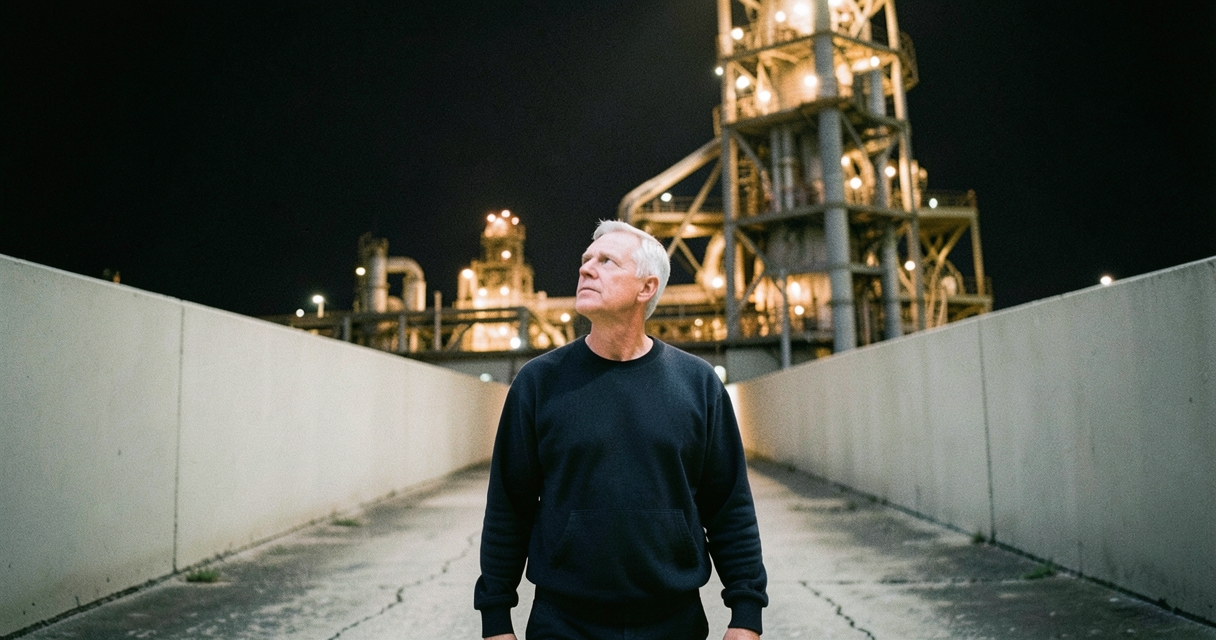
Yokkaichi’s nightscape is striking for more than the simple fact that factories have lights. Urban streets, rivers, canals, the port, pipe racks, tanks, stacks, towers and red aviation lights overlap in layers.
The industrial complex is not isolated from ordinary life. You can be moving through a normal Japanese city and then head toward the waterfront, where the background abruptly becomes science fiction.
The official factory-night-view guide highlights three reasons the scenery works so well: relatively few large obstacles allow deep views across the complex; dense plants make the light feel intense; and canals, rivers and river mouths create reflections on the water.
Yokkaichi also promotes the area as a “3D night view” because the plants can be seen from a 100-meter observation building, bridges, embankments, hills and sightseeing boats. The scenery changes as you move.
2. Are the lights on 24 hours?
Not in the sense of a tourist illumination program operating 24/7.
Much of what visitors see comes from the practical lighting of an operating industrial and port area: plant operations, safety, access routes, port facilities and aviation obstruction lights. That is why a surprising amount of light can remain late into the night.
However, individual plants and equipment have different operating and maintenance conditions. Official tourism information does not promise that every light remains on at the same brightness all day and all night. A better description is: many industrial lights remain visible through the night, but the scene is not a fixed light show.
The observation facility has separate hours. As checked on September 24, 2026, Umi-Terasu 14 is open 10:00–17:00, extended to 21:00 on Saturdays, Sundays and public holidays, with regular closure rules.
3. Is the inside of the complex beautiful?
For people who enjoy industrial structures, probably yes. Distillation towers, pipe racks, tanks, stairs, steel frames and stacks create dense three-dimensional engineering scenery.
But this does not make the plant grounds a walking attraction. The official Yokkaichi factory-night-view map explicitly warns visitors not to enter prohibited industrial premises, including restricted parking areas. Heavy trucks and forklifts also operate nearby.
Enjoy the secret-base look from legal public viewpoints. Do not turn “that looks incredible” into “I should go inside.”
4. Three useful walking styles
A. Downtown easy walk
Start around Kintetsu Yokkaichi Station and link Citizens Park, Soranpo Yokkaichi, Suwa Park and Suwa Park Exchange Hall. This is the easiest everyday evening walk, with more shops, people and ordinary street lighting than the port district.
B. Old Port retro walk
The official Yokkaichi Old Port walking map provides a “JR casual loop” from JR Yokkaichi Station through the old port: about 4.1 km and roughly 1 hour 45 minutes on foot.
The area includes Minato Park, a boardwalk and mural, the old-port promenade and Suehiro Bridge. This is less “giant factory in your face” and more historical port, water, bridges, warehouses and industrial heritage.
C. Factory-night-view walk
For a first visit, combine Yokkaichi Port Building, Umi-Terasu 14, Kasumi Minato Park and Sydney Port Park.
The official night-view map also lists Taisho Bridge, the area in front of Yokkaichi Dome, Tarusaka Park, Umiyamichi overpass, Nanbu Kyuryo Park and Isozu Pier among viewing locations.
Do not force all of them into one long walk. Industrial roads carry logistics traffic. Walking inside parks and promenades, then driving between separated viewpoints, is often the more sensible pattern.
5. Parking
Yokkaichi Port Building: the official page explicitly states 76 spaces and free parking. This is the clearest base for a factory-night-view visit.
Kasumi Minato Park: the port authority lists 30 spaces. Current external facility listings describe them as free; follow current on-site signs and conditions.
Sydney Port Park: the official page lists 34 spaces. It connects to Kasumi Minato Park by the pedestrian Sispa Bridge; current external listings also describe the parking as free.
Fuso Green Space: the official page lists 171 spaces, including 34 for large vehicles. A past Ministry of Land, Infrastructure, Transport and Tourism document called it free parking, and current facility information still describes it as free. It is especially useful when the goal is a waterfront walk rather than a single photo stop.
Hamazono Green Space: 20 spaces on the official page; JR Tomidahama Station is about a seven-minute walk away.
Park parking is for park users. It should not be treated as a free substitute for leaving a car all night while going somewhere unrelated.
6. Night-walk safety
A bright industrial skyline can make the whole area look illuminated, but the route to a viewpoint may still be dark. Logistics traffic, large trucks and strong sea wind are real concerns.
The official guide warns about restricted areas, heavy vehicles, illegal parking and nighttime noise, and recommends bringing a light.
Do not step into roads for photos, stop on industrial roads, or enter private plant grounds. The background may look like a game map; collision physics remain real.
7. Bottom line
Yokkaichi is interesting because the city itself is working while becoming scenery. Industrial equipment built for production turns into a huge nightscape through functional lighting, stacks, pipes, tanks and reflections.
For a first visit: Umi-Terasu 14 → Kasumi Minato Park and Sydney Port Park → drive to another official viewpoint if desired.
For an actual long walk: JR Yokkaichi → the official 4.1 km Old Port loop.
For a spacious waterfront base, Fuso Green Space has the largest parking capacity among the nearby parks checked here.