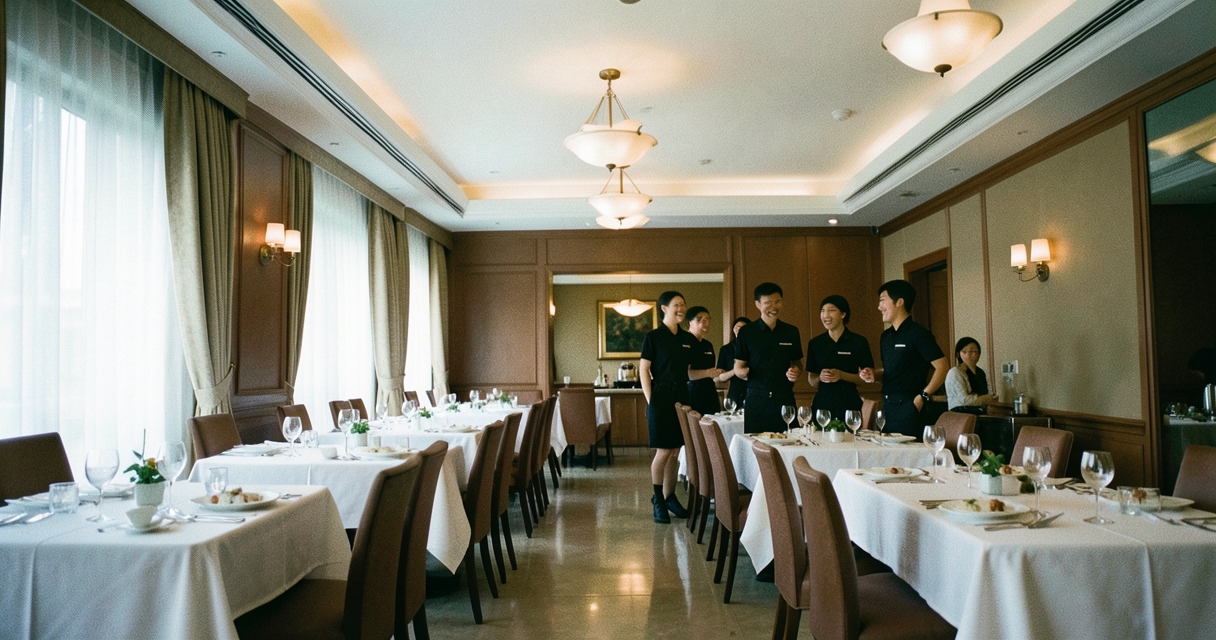
I walked into Suiren expecting the usual luxury-hotel Japanese restaurant experience: quiet tables, polished service, elegant plates, and a serious atmosphere.
Then I noticed the staff.
A lot of the servers looked surprisingly young, while the dining room seemed to skew older. The age contrast alone was funny. But the food was not casual at all.
At SHIROYAMA HOTEL Kagoshima's Suiren, I ordered the Kagoshima Kuroge Wagyu set, officially priced at ¥8,800. It includes appetizers, sashimi, chawanmushi, Kagoshima wagyu grilled on a ceramic plate, rice, pickles, red miso soup, and dessert.[1]
The wagyu sounds like the obvious star.
It was not.
The chawanmushi won.
1. SHIROYAMA is much more than a place to sleep
Walking through the hotel, you see people who clearly are not just checking in for the night.
There are weddings, receptions, family gatherings, banquets, meetings and parties.
The official hotel site confirms that the property handles weddings, engagement and family meetings, banquets, conferences, anniversary events, memorial gatherings, parties and even a karaoke plan for after-parties.[2][3]
So this is less like “a hotel with a restaurant” and more like a giant place where Kagoshima's special occasions happen.
People are bathing, eating, getting married, having meetings and singing after the party, all in the same complex.
Life events are basically stacked on top of each other.
2. An ¥8,800 dinner can start looking like the price of the room
The Kagoshima Kuroge Wagyu set costs ¥8,800.[1]
With a heavily discounted hotel stay, that creates a ridiculous moment where you look at dinner and think, “Wait, is this almost the same price as one night?”
The room rate and the dinner bill suddenly belong in the same weight class.
On this visit, payment also became a small adventure because the usual cards had been left behind. The hotel staff helped work out a way to settle the bill as a guest. That was a one-off experience, not a universal policy, so anyone in the same situation should ask the hotel directly.
3. “Hakata Amaou Syrup” sounds suspiciously like a VTuber name
For a drink, I chose the Amaou sour from the Kyushu fruit cocktail selection.
The official menu says it uses Hakata Amaou strawberry syrup and costs ¥1,150. The non-alcoholic Amaou soda is ¥900.[4]
Then the name broke my brain.
Amaou syrup.
Amau syrup.
Amau Syrup.
That sounds exactly like the name of a VTuber.
And, conveniently, Amau Syrup is actually the English name used for the VTuber 天羽しろっぷ on YouTube.[5]
From that point on, the drink was no longer “the Amaou sour” in my head.
It was “the VTuber drink.”
The joke worked.
The drink also tasted good.
4. Fine dining in front, young staff laughing in the back
At the table, service was polite and careful.
From farther inside the restaurant, though, you could occasionally hear the staff laughing and chatting with the energy of young coworkers having a good shift.
The contrast was excellent.
Front: refined Japanese dining.
Back: people being people.
One evening cannot tell you what a workplace is always like, but at least during that service, the room did not feel tense or robotic.
The restaurant still felt high-end. It just did not feel lifeless.
5. The chawanmushi was basically broth with just enough egg to hold it together
Then came the chawanmushi.
The first impression was almost absurd: it felt like eating really good dashi that had barely been persuaded to become solid.
The flavor was not aggressively salty or heavy. The broth simply kept coming through.
There was also a piece of meat inside, so tender that it almost disappeared in the mouth.
At that point the verdict was simple:
This might be the best chawanmushi I have had.
Remember, this is supposed to be a wagyu set.
The side dish stole the title belt before the beef even had a chance.
6. You grill the Kagoshima wagyu yourself
The beef is served for ceramic-plate grilling, as listed on the official menu.[1]
You cook it at the table and stop exactly where you want.
That means the final few seconds are your responsibility.
There is something slightly ridiculous about paying for premium wagyu and then thinking, “Please do not let me overcook my own expensive meat.”
Fortunately, it was excellent.
Sweet fat, rich flavor, and enough control to eat it before it went too far.
The chawanmushi still won, but the wagyu did its job.
Even better, on this visit the rice was offered with free refills. Great meat plus great rice, with no need to ration the rice.
At that point my brain produced the name Kando no Niku to Kome—literally “Moving Meat and Rice,” the name of an actual steak chain in Japan that also puts meat and rice at the center of the experience.[6]
So this is “Kando no Niku to Kome-chan”?
Of course, this was still Suiren.
Meat → rice → meat → rice.
Once that loop starts, ceramic-grilled wagyu becomes a dangerous rice thief.
Suiren’s official dinner page confirms that rice is included in the set, but I could not find an official statement guaranteeing unlimited free refills.[1] So this article records the free-refill part as what was offered during this visit, not as a permanent policy.
7. Even the rice became a main character: Kagoshima Hinohikari
The plain rice was absurdly good with the wagyu.
And on this visit, refills were free. Before long, I was on bowl number three.
At that point I had to ask:
“What variety is this rice?”
The server did not know immediately and went to check.
In my head, the scene turned into a rice-version parody of the Beast Titan from Attack on Titan politely investigating something unfamiliar.
The answer came back: Hinohikari grown in Kagoshima.
JA Kagoshima describes Hinohikari as a slightly small, rounded grain with a good balance of moderate stickiness, chewiness, aroma and sweetness.[7] Kagoshima Prefecture identifies it as a major regular-season rice variety; in the 2024 crop it accounted for about 81% of the prefecture’s regular-season rice acreage. Major production areas include Kagoshima, Hioki, Satsumasendai, Isa, Kirishima, Aira and Soo.[8]
I also thought I heard a mountain or smaller area name, but my memory was uncertain—something like Asama or Aso. Rather than inventing a location, the confirmed fact here is simply Kagoshima-grown Hinohikari. Kirishima really is one of the production areas, but that does not mean the server definitely said “Kirishima.”
The price was surprisingly normal. Japan’s national supermarket average for rice was ¥2,971 per 5 kg during September 7–13, 2026.[9] One current retail example of Isa-grown Hinohikari in Kagoshima was ¥3,980 for 5 kg.[10]
That is roughly ¥1,000, or a little over 30%, above the supermarket average—not some mythical ¥10,000 hotel-only bag.
A rice you can actually buy became ridiculous in a high-end restaurant.
Hinohikari is not limited to Kyushu either. Mie Prefecture in Tokai lists Hinohikari among its recognized production varieties.[11]
Buying the same variety at home still would not guarantee the same taste. Origin, milling, water, soaking, cooking, resting and serving time all matter.
Even so, this was on another level compared with rice I had eaten at restaurants before.
Then I asked the server an even more unnecessary question:
“Which tastes better: the rice here, or the rice at your parents’ home?”
After a moment:
“Well… probably the rice here.”
Of course.
But thinking about it, this was also an extremely awkward question to answer honestly.
Even if the server secretly preferred the rice at home, saying “Actually, my family’s rice is better 😁” while working at a luxury hotel would take some nerve. So that answer cannot be treated as proof that ordinary households cannot match Suiren’s rice.
What I really wanted to know was not whether one employee’s family could beat the restaurant. It was:
“Does Hinohikari taste this good in an ordinary Kagoshima household too?”
The variety itself is easy enough to buy for home use, so it can absolutely be delicious at home. But reproducing the “this is on another level” effect from Suiren is a different question. The result probably depends not only on the rice itself, but also on origin, milling, water, soaking, cooking, resting and when it is served.
In other words: Hinohikari can be excellent at home, but matching this particular bowl is a separate contest that includes the cooking.
Do not make a luxury-hotel kitchen fight someone’s family rice head-on.
Brown sugar gives direct sweetness. Hinohikari gives sweetness as you chew. Wagyu fat has another kind of sweetness. The Amaou sour brings fruit sweetness.
Kagoshima had assembled an entire sweetness squad.
And because rice refills were free that night, after three bowls the only logical escalation was:
“Then I’ll have 1,000 tons, please.”
Free refills do not mean “destroy the prefecture’s rice logistics.”
8. The best part was the mix of serious food and very human atmosphere
What stayed with me was not simply that Suiren was expensive or luxurious.
It was the contrast.
An older-looking dining room and young servers.
A hotel simultaneously running weddings, banquets, meetings, baths, rooms and restaurants.
A strawberry drink whose name turned into a VTuber joke.
An ¥8,800 wagyu set where the chawanmushi became the main character.
And underneath all of that, the important part:
The food was genuinely good, and the atmosphere was not painfully stiff.
Sometimes the most memorable thing in a wagyu dinner is not the wagyu.
Sometimes it is a bowl of almost-pure dashi disguised as chawanmushi.
Practical details
- Restaurant: Suiren, SHIROYAMA HOTEL Kagoshima
- Kagoshima Kuroge Wagyu set: ¥8,800
- Includes appetizers, sashimi, chawanmushi, ceramic-grilled Kagoshima wagyu, rice, pickles, red miso soup and dessert
- Amaou sour: ¥1,150
- Non-alcoholic Amaou soda: ¥900
- Prices and menu items can change, so check the official site before visiting
References (11)
- SHIROYAMA HOTEL Kagoshima, Suiren dinner menu shiroyama-g.co.jp
- SHIROYAMA HOTEL Kagoshima official site shiroyama-g.co.jp
- SHIROYAMA HOTEL Kagoshima weddings shiroyama-g.co.jp
- Suiren Kyushu fruit cocktail selection shiroyama-g.co.jp
- Amau Syrup on YouTube youtube.com
- 感動の肉と米 公式ブランドページ amiyakitei.co.jp
- JA鹿児島県経済連「お米」 karen-ja.or.jp
- 鹿児島県「ヒノヒカリ 本県水稲の主力品種」 pref.kagoshima.jp
- 農林水産省 2026-09-25大臣会見(米5kg平均2,971円) maff.go.jp
- かごしま特産品市場「令和8年産 伊佐のお米ひのひかり 5kg」 yoka-mall.com
- 三重県「令和6年産産地品種銘柄」 pref.mie.lg.jp