Locale: en
Meta description: Why the Isewangan Expressway looks so good at night and around sunrise: factory lights, port scenery, high bridges, giant ships, Steel Dragon 2000, and how a road that once felt terrifying can become part of the trip itself.
Drive the Isewangan Expressway around sunrise and the whole horizon starts to open up.
The sky brightens over the water. The bridges, port, factories and distant buildings stop looking like separate objects and turn into one huge scene.
At night, it works in the opposite direction. Artificial lights take over.
The strange part is that the very same road can feel completely different depending on when you first knew it.
As a kid, it can be terrifying: a giant roller coaster, a highway high above the ground, and ships that look absurdly large.
As a university student, add a newly licensed friend driving a rental car a little too fast on those high bridges and the fear level goes straight to maximum.
Years later, the same person can be driving alone, singing, looking at the morning sea and thinking, “This is ridiculously nice.”
Same road. Different meaning.
1. The drive itself becomes part of the attraction
Most trips have a destination.
A theme park. A shopping mall. Another city.
But around Nagoya Port, Nagashima and the route toward Mie, the Isewangan Expressway keeps throwing scenery at you before you arrive anywhere.
Huge bridges. Open water. Ports. Ships. Factories. Tall stacks. The Nagashima amusement park skyline. Night lights. Morning light.
You can still be “on the way” and already feel like the sightseeing has started.
2. What are all those lights at night?
There is probably no single answer.
From the road, several kinds of light overlap:
- road and bridge lighting;
- lighting around port facilities;
- factory and industrial facility lighting;
- city and commercial lights;
- red aviation obstruction lights on tall structures;
- reflections on the water.
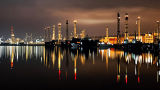
Yokkaichi officially promotes its factory nightscape as a local attraction. The local tourism association also highlights scenes where industrial lights and bridge lighting reflect across the water.
So when you think, “What exactly is glowing over there?” the answer may be: several things at once.
The water makes the effect even bigger.
Japan’s Ministry of Land, Infrastructure, Transport and Tourism explains that flashing red lights on tall buildings and structures are aviation obstruction lights designed to show aircraft that a high structure is present.
3. Around sunrise, the main light source changes completely
At night, artificial light wins.
Around sunrise, the sun takes the whole stage.
On a morning when you pass around 6 a.m., depending on the season, the dark blue sky can turn pale and the water begins reflecting a much broader light.
It is not just the sun itself.
The sky is wide. The water is wide. The bridge opens the view. Low morning light hits the surface, buildings and industrial structures.
That is why the light can feel “huge.”
Sunrise time changes throughout the year, so 6 a.m. is not always sunrise. The point is the transition: if you pass while night is turning into morning, the same road can look like a completely different place.
4. Childhood fear No. 1: Steel Dragon 2000 is enormous
One of the biggest objects around Nagashima is Steel Dragon 2000 at Nagashima Spa Land.
Its official maximum height is 97 meters.
For a child, that number is almost irrelevant.
The brain first says: “Why is that thing so huge?”
Seeing a giant coaster rising into the sky from a highway can make the whole landscape feel oversized.
5. Childhood fear No. 2: the road itself is high
The Isewangan Road section around the Meiko Triton bridges uses continuous bridge and elevated structures.
That gives you a view that an ordinary ground-level road does not.
Sky beside you. Water below. Ports in the distance.
An adult may translate that into “great view.”
A child may translate it into “why are we this high?”
Both reactions make sense.
6. Childhood fear No. 3: the ships are too big
Ports break your normal sense of scale.
A ship can be far away and still look enormous.
Then you notice the containers, cranes and surrounding facilities are huge too.
At that point, the landscape stops using normal everyday measurements.
Giant ride. High road. Giant ship.
That is a three-stage fear combo.
7. Then a newly licensed friend completes the horror setup
Years later, imagine riding with a university friend who has just gotten a driver’s license.
Rental car. Nagashima trip. High bridge.
And the friend is moving a little faster than your nervous system would prefer.
Now the problem is no longer just the scenery.
You are not controlling the car.
High place + speed + someone else holding the wheel is a very different experience.
The soul leaves the body somewhere around the toll gate.
Sightseeing?
No.
You are busy conducting a live survival audit.
8. Years later, you are singing on the same road
Then experience accumulates.
You get used to driving. You know roughly where the bridges are. You know what the route feels like.
The fear spot starts turning into a scenic route.
At night: “Those lights are beautiful.”
In the morning: “The sea feels amazing.”
Same place.
The relationship with the place has changed.
That does not mean the old fear was stupid. It was real at the time.
Familiarity and being the person in control can change how the same scene is experienced.
It hits different now.
9. A destination is not the only part of a trip
The Isewangan Expressway is technically transport infrastructure.
But the sequence of bridges, sea, ports, factories, ships, theme-park structures, night lights and sunrise makes the movement itself memorable.
Sometimes the strongest travel memory is not inside the destination.
It is the bridge on the way there. The sea at dawn. The factory lights at night. The giant ship you did not expect. The roller coaster that scared you as a child.
It’s part of the journey.
10. Beautiful view, eyes on the road
One thing matters more than the scenery.
If you are driving, drive.
The better the view, the more tempting it is to stare.
Let passengers enjoy it properly. Use safe stopping places when you want to look for longer. The driver keeps attention on the road and traffic.
And yes, any “blasting down the highway” joke here is a joke.
Literal blasting is how a scenic drive turns into paperwork.
11. Conclusion: a scary place can become a favorite view
At night, the Isewangan area is built from layers of artificial light.
Around sunrise, natural light takes over the entire scene.
And over the years, the person looking at it changes too.
First: “That coaster is huge.” “This road is too high.” “That ship is enormous.”
Later: “Please do not drive this fast up here.”
And eventually: “The night view is great.” “The morning sea feels incredible.” “Just passing through is fun.”
A tourist attraction does not always need a ticket gate.
Sometimes a road you once feared becomes one of the best parts of the trip.
References (6)
- Central Nippon Expressway Company, Isewangan Road overview
https://www.c-nexco.co.jp/corporate/operation/stock_effect/pdf/180306_stock_isewangan.pdf - Central Nippon Expressway Company, 20th anniversary of the Isewangan Road
https://www.c-nexco.co.jp/corporate/pressroom/news_release/4209.html - Nagashima Spa Land, Steel Dragon 2000
https://www.nagashima-onsen.co.jp/spaland/attraction/thrill/dragon.html - Yokkaichi City, Factory Night View
https://www.city.yokkaichi.lg.jp/city_promotion/page01.html - Yokkaichi Tourism Association, night-view drive feature
https://kanko-yokkaichi.com/focus/f-821/ - MLIT Japan, aviation obstruction lights
https://www.mlit.go.jp/koku/15_bf_000725.html