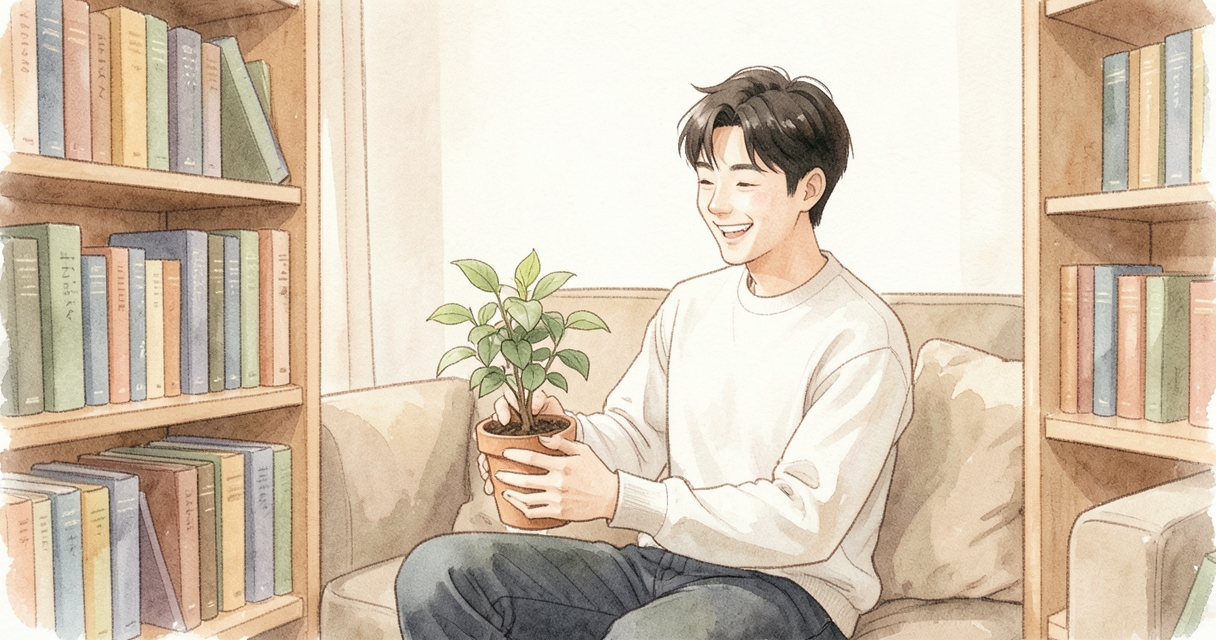
Weekdays are a loop between home and work.
Weekends have no real plans. There are few friends around. Going to restaurants alone, traveling alone, or exploring somewhere new feels difficult. YouTube fills the day almost by accident.
Then comes the line:
“I want to get married and be happy.”
That combination can sound strange. If you barely steer your life now, why would marriage suddenly make the whole thing interesting by itself?
But the opposite conclusion is also too crude. “No hobbies means something is wrong with you” or “a day on YouTube is wasted” does not follow.
If someone watches YouTube all day and finishes the day thinking, “That was great,” that is still leisure. Travel, books, sports, and a huge friend group are not a premium subscription to a superior life.
The more useful question is not what the person does. It is whether they chose the life they have, whether they are satisfied with it, and whether they expect a partner to become the only machine generating fun, comfort, plans, and meaning.
1. “I have no hobbies” often does not mean “I do literally nothing”
The idea that most people have absolutely no hobbies is probably exaggerated.
Japan’s 2021 Survey on Time Use and Leisure Activities found that 86.3% of people had participated in some form of “hobbies and amusements” during the previous year.
The category is broad. It includes listening to music, watching films outside a cinema, and playing smartphone or console games. Participation rates included 53.5% for music, 52.7% for watching films outside cinemas, and 42.9% for games.
So a person who says “I don’t really have a hobby” may still spend plenty of time on videos, games, music, food, or social media.
“No hobby” and “I do not label my leisure as a hobby” are different things.
The people who get closest to a genuine “work and nothing else” life may be those whose jobs and commutes consume most of their time and energy. That is not evidence that they are empty people. Their available bandwidth may simply be eaten by work.
2. The risky combination is: can’t do anything alone + no other relationships + marriage as the only exit
Having no close friends is not automatically a failure.
Someone can eat out alone, watch a movie alone, walk, play games at home, and occasionally talk to family or acquaintances—and be perfectly content. That life can be highly self-directed.
On the other hand, someone can have ten friends yet be unable to do anything unless another person is available.
So friend count is less informative than a simpler question: what happens on a free day when nobody is available?
If all of these stack together—
- I do not want to do anything alone
- I have almost no friends
- I have no particular hobby
- free days feel painfully empty
- I expect marriage to make life fun
—then a spouse can become less like a partner and more like life infrastructure.
Entertainment, conversation, reassurance, validation, weekend planning, reasons to leave the house, and major life events all get loaded onto one person.
Marriage is not the problem. The structural problem is running your entire happiness system on one server. If that server goes down, everything goes down.
3. Marriage can improve well-being. It is not an all-inclusive happiness package
Marriage and close relationships can clearly matter for well-being.
Self-determination theory emphasizes autonomy, competence, and relatedness as basic psychological needs. A large 2024 meta-analysis combining 881 independent samples and more than 443,000 people found that interpersonal support for these needs was strongly positively related to subjective well-being.
A spouse can be a major source of relatedness. But simply having a spouse does not automatically create autonomy or the feeling that you can run your own life.
A 15-year longitudinal study of more than 24,000 people found that, on average, people reacted to marital transitions and then tended to move back toward their previous level of life satisfaction. Individual differences were substantial; some people changed for much longer.
In other words, marriage can work. It is not a guaranteed permanent buff.
Research on married adults also suggests that well-being is not always carried by the spouse alone. In one study examining spouses, family, and best friends, people with multiple high-quality relationships tended to report greater well-being; when no best friend was present, the spousal relationship became especially important.
That does not mean “you must make friends before marrying.” It means the fewer alternative sources of connection you have, the more weight ends up on the spouse.
4. Is spending the entire weekend on YouTube bad? Not necessarily—if you enjoy it
This is the central distinction.
A whole day on YouTube is not enough evidence to declare a life failed.
A meta-analysis on leisure and subjective well-being found a moderate association between leisure engagement and well-being, and leisure satisfaction played an important role. Measures of frequency and diversity were more strongly related to well-being than simple time spent in leisure.
So the better question is:
Not “How many hours did you spend?” but “Did that leisure actually satisfy you?”
Screen leisure is also more complicated than the usual moral panic. A 2024 longitudinal study using data from 11,085 New Zealand adults examined combined time spent online, on social media, news, videos, and games against 24 health and well-being outcomes. The primary results were generally very small. There were possible associations with sleep, self-control, subjective health, and a few other outcomes, but the study did not support a simple “more screen time equals a ruined life” story.
So there is no need to shame a day of YouTube.
The difference is between:
“I want to watch YouTube all day today. This is great.”
and
“I cannot think of anything else to do. I am not even enjoying this. My life is boring. I need somebody else to make me happy.”
Same sofa. Very different life.
5. Time alone changes meaning depending on whether it feels like loneliness or freedom
Time alone cannot be judged by quantity alone either.
A 21-day diary study of 178 participants found that on days when people spent more time alone, they were on average lonelier and less satisfied. But those negative associations were reduced or disappeared when solitude was autonomous—when people felt they had chosen it. More time alone was also associated with lower stress and greater autonomy satisfaction.
So these are psychologically different situations:
- alone because nobody is available
- alone because you want to be alone
The same applies to weekends.
“Staying home because I have no plans” and “keeping my schedule clear because I want to stay home” look similar from outside but are not the same experience.
The opposite of loneliness is not a packed calendar. It is having options.
6. A person with “only work” may be showing a life-design problem, not a personality defect
When someone has repeated the home-work loop for years, it is tempting to say, “Just get a hobby.”
But if work is long, commuting is long, evenings are exhausting, and weekends disappear into sleep and chores, then the energy available for exploration will naturally shrink.
What looks like “a person interested in nothing” may instead be a life with no spare capacity for exploration.
That is why “be more active” is not always the answer.
The key question is whether the person dislikes their current life.
Home → work → home → YouTube → sleep.
If the answer is, “Honestly, I like this. It is relaxing. I want tomorrow to look similar,” there is no need for outsiders to launch a rescue operation.
If the answer is, “This is boring, but I do not want to start anything alone; marriage will fix it,” then the bottleneck already exists before marriage.
7. Three questions are more useful than “How many hobbies do you have?”
Counting hobbies or friends is a crude diagnostic.
These three questions are more useful.
1) Can you handle an empty day yourself?
Going out is fine. Staying home is fine. Sleeping, gaming, reading, or doing nothing can all be fine.
The point is whether the whole day shuts down unless somebody else supplies a plan.
2) Do you actually enjoy your leisure?
Eight hours of YouTube can be a good day if you genuinely loved it.
Eight hours of travel can be a bad day if you did it as a social-media obligation and hated every minute.
Fancy does not automatically mean better.
3) Is marriage an addition or a rescue device?
A life that already runs at 60 or 70 points can become even better with someone you love. That is straightforward.
A life rated at zero, with a spouse expected to lift it to 100, places a much heavier load on the other person.
Marriage is shared life. It is not a full-service outsourcing contract for happiness.
8. Conclusion: if you are genuinely having fun, that counts
Back to the original picture.
Home and work. Few friends. YouTube most weekends. Is that a problem?
Not by itself, if the person enjoys it and feels satisfied.
There is no need to rank people by how active they are, how far they travel, or how many friends they collect.
The concern begins when someone dislikes their current life and makes “once I get a partner” or “once I get married” the single solution.
Marriage can be a major source of well-being. It is not an automatic machine that makes an otherwise unwanted life interesting.
The boundary is simple:
A whole day of YouTube can be fine if you enjoy it.
Being alone can be fine if you chose it.
Having few friends can be fine if your life still works.
But if you cannot choose anything for yourself, are already dissatisfied, and expect one future spouse to fill the entire gap, the issue is no longer “not having hobbies.” It is concentrating almost every source of happiness in one person.