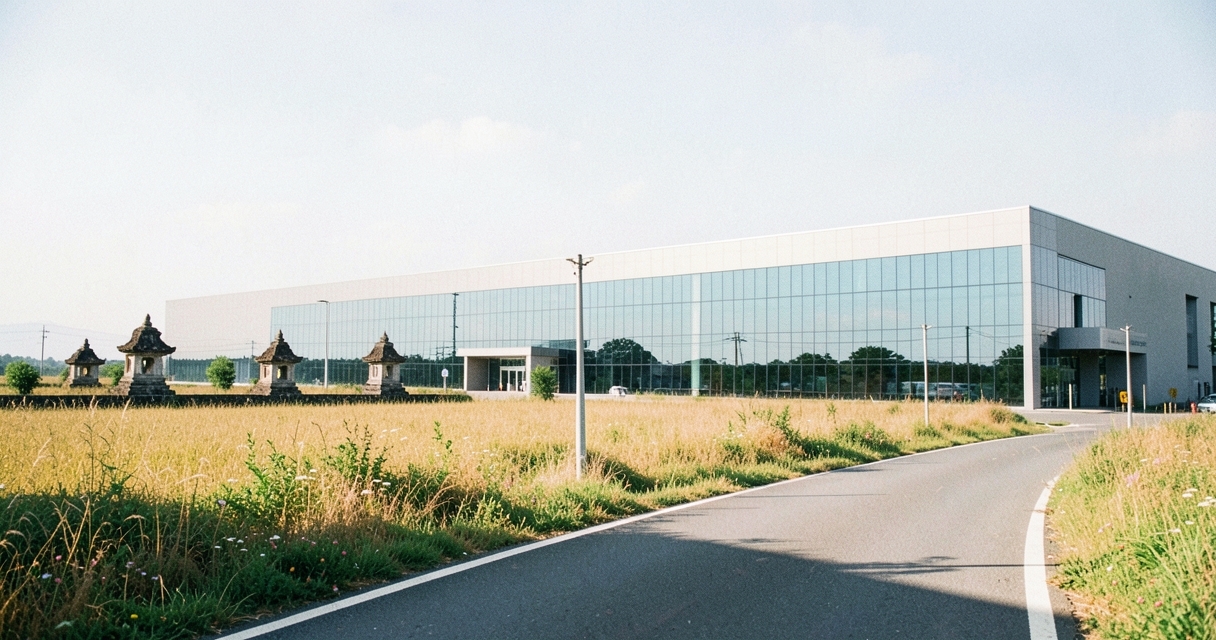
Going to Kuwana alone on a weekday sounds like maximum freedom.
Then Monday arrives and the city seems to ask one question:
“So, Nagashima again?”
Nagashima is powerful. The outlet mall, amusement park, hot spring and flower park can easily fill a first visit.
But strong attractions have a strange weakness: after enough repeat visits, you become used to their strength.
Take Nagashima out of the equation and look at Kuwana again, and two other things start appearing everywhere.
AEON.
Shrines.
Another AEON.
Another shrine.
At some point the obvious joke becomes unavoidable: if Kuwana were an Othello board, would the entire board eventually end up in those two colors?
1. Monday changes the map
Kuwana has several good history and culture stops, but Monday requires planning.
Rokkaen is normally closed on Mondays under the city ordinance. Kuwana City Museum also uses Monday as its regular closing day, and Ishidori Kaikan has a Monday closure as well.[1][2][3]
That matters because these indoor sites fit naturally into a walk through central Kuwana. When several are unavailable at once, outdoor places such as Kyuka Park and the Shichiri-no-Watashi area become more attractive, as do shrines and large commercial facilities that are less vulnerable to museum-style weekly closures.
Then you look toward the large commercial option.
Nagashima is waiting.
Of course it is.
2. Nagashima is Kuwana’s tourism gravity well
The Nagashima area bundles shopping, amusement, bathing and flowers into one highly resilient destination.
You can go there without a complicated plan. Rain does not ruin the day because shopping remains. Food is easy. If one activity fails, another is nearby.
That is why a Monday itinerary can naturally collapse toward Nagashima when central cultural facilities are closed.
But there is a difference between a place being strong and a place feeling new forever.
For repeat visitors, “Let’s just go to Jazz Dream again” eventually becomes less exciting.
The attraction did not get worse.
You simply used it a lot.
3. Is AEON Mall Kuwana actually huge?
The next obvious fallback is AEON Mall Kuwana.
Yet it does not feel as massive as some other major malls in Mie.
The official gross leasable area of AEON Mall Kuwana is about 38,000 square meters.[4]
AEON Mall Suzuka is about 70,000 square meters.[5]
Using the same metric, Kuwana is about 54 percent of Suzuka.
That does not make Kuwana a small shopping center. It simply explains why the experience can feel noticeably more compact than Suzuka.
This comparison is specifically about gross leasable area, not total floor area.
4. Why does AEON seem to be everywhere in northern Mie?
Drive around northern Mie and AEON keeps appearing.
Change direction.
Another AEON.
The joke starts to feel like the regional map generator has an unusually high AEON spawn rate.
Then history delivers an almost suspiciously perfect punch line.
One of the roots of today’s AEON, Okadaya, was founded in Yokkaichi in 1758.[6]
In 1969, Okadaya, Futagi and Shiro came together in the corporate lineage that became JUSCO and later AEON.[6]
That does not mean modern mall locations can be explained simply by “AEON started nearby.” Current store networks depend on population, roads, trade areas, land, development strategy and many other factors.
Still, as a piece of local comedy, it is excellent:
You joke that AEON is everywhere, then discover you are standing near one of its historical starting points.
5. Then come the shrines
Just when the AEON joke seems complete, Kuwana adds torii gates.
Houses.
Fields.
A torii.
A river.
A settlement.
Another torii.
The Mie Jinja Cho educational committee lists 104 shrines under its Kuwana branch, compared with 73 under Yokkaichi and 67 under Suzuka.[7]
There is an important caveat: branch areas are organizational units, not exact municipal boundaries.
So this is not evidence that Kuwana City itself contains exactly 104 shrines, and it should not be turned into a municipal ranking.
It does, however, support the impression that shrines have a strong presence around the Kuwana area.
6. Shrine history reveals an older map underneath the modern city
Individual shrine histories make the pattern more interesting.
Tado Taisha describes itself as a major shrine in northern Mie and uses the alternate name “Kita-Ise Daijingu,” showing the importance of the Tado area as a religious center.[8]
Smaller shrines often preserve much more local stories.
The history of the Shinmeisha, Agatasha and Tadosha complex in Harima associates its establishment with new-field development in 1652.[9]
Akasuka Shinmeisha records a community of migrants who engaged in fishing and enshrined a sacred object they had brought with them as their tutelary deity.[10]
In the Kisosaki area, records describe more than twenty shrines being consolidated in 1909, followed by several shrines being separated again in 1946 after requests from local worshippers.[11]
The torii gates are therefore not merely a list of tourist attractions.
They can also be read as traces of former villages, reclaimed fields, fishing communities and local social units.
A modern suburb may look continuous from a car window.
Shrines can break that landscape back into its older pieces.
7. The Kuwana Othello theory
Now the stupid theory is ready.
Imagine Kuwana as a giant Othello board.
One side is AEON.
The other side is shrines.
Find an empty square.
Flip it.
Another AEON or shrine appears.
Endgame:
The entire board is AEON and shrines.
If a fictional municipal manifesto said, “We will convert every remaining square in Kuwana into either an AEON or a shrine,” there might be a brief moment when somebody simply nodded and said, “Yes, that sounds like Kuwana.”
No such policy exists.
This is a joke.
But the joke works because it points at something real.
AEON represents the modern regional commercial sphere.
Shrines often preserve older community boundaries and histories.
Seeing both repeatedly in the same landscape is, in a strange way, seeing modern suburban life laid directly over older settlement geography.
The Othello board accidentally becomes urban history.
8. After Nagashima gets familiar, stop looking for facilities and start looking at geography
For a first visit, Nagashima remains an obvious choice.
For a repeat visit, it can be more interesting to stop asking, “What facility should I enter?”
The Shichiri-no-Watashi area preserves the memory of the maritime section of the Tokaido between Kuwana and Atsuta.[12]
Kyuka Park occupies the former core areas of Kuwana Castle and lets the old castle-town structure become part of an ordinary walk.[12]
Tado adds another face of Kuwana: a religious landscape at the edge of the mountains rather than a flat commercial city.
The questions change.
Why is the river here?
Why is this torii here?
Why does the old road run this way?
Why do modern commercial facilities cluster along that road?
Once you start reading the city that way, even a Monday museum closure can become an excuse to inspect the city itself.
9. Conclusion: on Monday, Kuwana can turn into a geography game
Try to spend a Monday in Kuwana and several cultural facilities may be closed.
Nagashima becomes the easy answer.
Repeat Nagashima enough times and it becomes familiar.
Then you start noticing the city instead.
AEON appears constantly.
So do shrines.
You investigate.
One of AEON’s historical roots is in Yokkaichi.
Shrine histories around Kuwana preserve stories of villages, reclaimed land, fishing communities, consolidation and later separation.
And somehow a throwaway line—
“If Kuwana were Othello, the whole board would become AEON and shrines”
—ends up opening a route into the commercial history and settlement history of northern Mie.
That may be what remains after you have already consumed the obvious attractions.
Instead of collecting famous places, find the city’s weird recurring patterns and ask why they exist.
Kuwana gets much more interesting when played that way.
Sources
https://www.city.kuwana.lg.jp/documents/11969/7jorei.pdf
https://www.city.kuwana.lg.jp/bunka/bunkashisetsu/hakubutsukan/
https://www.city.kuwana.lg.jp/documents/1467/sisetu20241101-1.pdf
https://www.aeonmall.com/facility/detail/3294/
https://www.aeonmall.com/facility/detail/3208/
https://www.aeon.info/ir/individual/history/
https://kyoka.mie-jinjacho.or.jp/introduction/
https://kyoka.mie-jinjacho.or.jp/shrine/%E8%B5%A4%E9%A0%88%E8%B3%80%E7%A5%9E%E6%98%8E%E7%A4%BE/
https://kyoka.mie-jinjacho.or.jp/shrine/%E8%BF%91%E6%B1%9F%E5%B3%B6%E7%A5%9E%E7%A4%BE/
https://kyoka.mie-jinjacho.or.jp/shrine/%E5%B0%8F%E5%92%8C%E6%B3%89%E7%A5%9E%E7%A4%BE/
https://www.kuwanacci.com/shinkou/kankou
Sources
- Kuwana City, Rokkaen Ordinance
- Kuwana City, Kuwana City Museum
- Kuwana City, Lifelong Learning Facility List
- AEON Mall, AEON Mall Kuwana facility information
- AEON Mall, AEON Mall Suzuka facility information
- AEON, History of AEON
- Mie Jinja Cho Educational Committee, branch listing
- Tado Taisha official website
- Mie Jinja Cho Educational Committee, Shinmeisha, Agatasha and Tadosha
- Mie Jinja Cho Educational Committee, Akasuka Shinmeisha
- Mie Jinja Cho Educational Committee, Omishima Shrine and Koizumi Shrine
- Kuwana Chamber of Commerce and Industry, Kuwana tourism guide