At 12:45 on a weekday, the usual assumption is that the lunch rush should be fading. Office workers who started lunch at noon are already thinking about getting back to work.
That assumption failed at 玄子, a soba restaurant in Toyokawa. The diner slipped into what was essentially the last available seat, the room became full, and the parking lot was packed as well.
Apparently, arriving late to avoid the lunch battle only works if everybody else does not have the same idea.
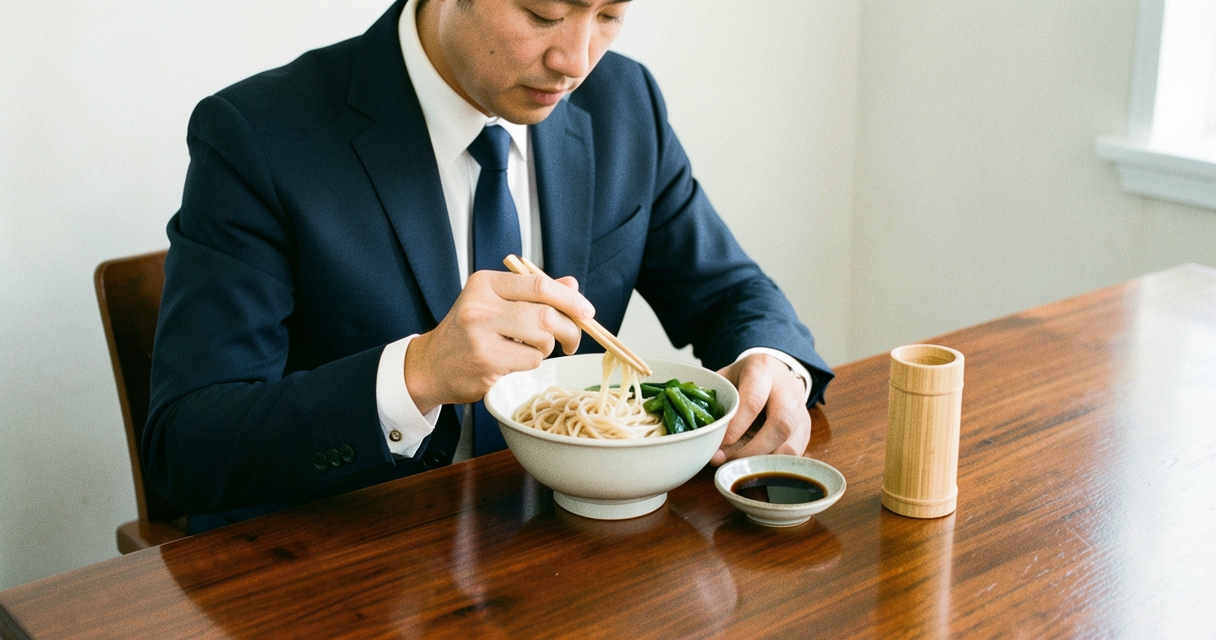
The order was the cold Tokuuchi Soba, priced at roughly ¥1,500. This was not a case of a bargain-basement lunch filling seats through price alone. After eating it, the reaction was simple: “This is not something I’d make at home.”
Cold Tokuuchi Soba at 玄子. This exact first-hand photo was explicitly approved for use in the article body.
1. Why can a restaurant still be full at 12:45?
Because the first lunch wave has not completely left when the “I’ll come later to avoid the crowd” wave arrives.
Customers seated between 12:00 and 12:20 may still be eating 30–45 minutes later. At the same time, salespeople on the road, self-employed diners, people with flexible schedules, and anyone trying to dodge the noon rush begin arriving around 12:30–13:00.
When enough people run the same crowd-avoidance algorithm, the crowd-avoidance group creates a brand-new crowd.
The packed parking lot matters too. It suggests demand from people willing to drive there, not merely accidental foot traffic.
2. Is a full house at around ¥1,500 a strong popularity signal?
Yes—strong, but not proof that the food must be excellent.
Recruit’s March 2026 survey put average weekday lunch spending among workers at ¥496 overall, while the average for meals eaten out was ¥1,338. Another 2026 survey found “under ¥500” was the largest category for office-day lunch spending, at 38.8%.
So the instinct that “lunch is often around ¥500” is not absurd when homemade food, convenience meals, cafeterias and other low-cost options are included. Eating out is a different market and costs more.
Against that background, a roughly ¥1,500 meal still filling a restaurant and its parking lot at 12:45 on a weekday is informative. It makes “people came only because it was cheap” a weak explanation.
A five-star review is an opinion. People repeatedly spending their money, time and a parking space is behavior.
3. What was the cold Tokuuchi Soba actually like?
It was not especially thick. There was an initial “this looks like super-thick konnyaku noodles” reaction, followed almost immediately by: “No, wait, it isn’t thick.”
The correction deserves to stay because it captures the first visual surprise without converting a mistaken impression into a fake fact.
Recent reviews describe the restaurant’s Tokuuchi Soba as more coarsely ground than its ordinary zaru soba. This article does not try to reverse-engineer the production method from one meal; the important part is the eating experience.
4. What stood out most? No bothersome “soba smell,” a good bite, and salt
The diner’s strongest sensory impression was that the particular soba smell they sometimes dislike was virtually absent, while the noodles had a satisfying bite.
That is a subjective observation, not a universal chemical claim about soba.
Then came the salt. Eating soba with salt was probably a first for the diner, and it worked surprisingly well.
Dipping sauce adds stock, soy sauce, sweetness and other flavors. Salt is more stripped down. It leaves the noodle’s texture and grain flavor exposed.
It sounds almost too simple, but the result was: this actually works.
Salt made the noodle’s outline feel stronger. The noodle itself, to repeat, was not thicker. We have already issued one correction notice today.
5. Why did the diner get hungrier after about three bites?
Because eating can switch appetite fully on before the stomach has filled at all.
Around the third bite, the reaction was not “my hunger is disappearing.” It was “I’m getting hungry now.”
That is a ridiculous compliment, but a useful one.
Food is normally supposed to reduce the hunger meter. Three bites of good soba somehow increased it. In a video game, that would be a bug. In a restaurant, it is upselling talent built directly into the dish.
6. Why is “I can’t make this at home” valuable?
Because dining out becomes easier to justify when the result is hard to substitute with home cooking.
Anyone can boil dried soba and pour commercial dipping sauce. What is harder is reproducing the same bite, the way the noodles work with salt, and the overall texture of this particular plate.
Viewed only as “the price of one bowl of noodles,” ¥1,500 may feel expensive. Viewed as payment for something far away from the home-kitchen substitute, the value equation changes.
Fine dining is not the only thing worth leaving home for. Food that is simply difficult to reproduce at home has its own moat.
7. Why were pumpkins being sold for ¥100 outside?
Whatever the reason, the restaurant suddenly turns into a tiny local produce stand during the ending credits.
Vegetables including pumpkins were being sold outside for ¥100.
You finish a roughly ¥1,500 soba meal, think carefully about texture and salt, conclude that you could not easily make it at home—and then step outside to see a ¥100 pumpkin.
The number of digits in the price suddenly drops.
Main story: soba restaurant. Post-credit scene: roadside farm stand. That kind of local randomness is hard to franchise.
8. Should “an empty restaurant must be bad” be reconsidered?
Yes, although crowds are still useful as a first-pass signal.
The combination here—weekday, lunchtime, roughly ¥1,500, around 12:45, full dining room and full parking lot—contains a lot of information.
But the reverse inference is much weaker. A quiet restaurant can be quiet because of poor location, awkward parking, an intimidating storefront, unusual hours, weak online discovery, slow service, or a price that does not fit local lunch demand.
So “crowded → real demand exists” is fairly strong. “Empty → bad food” is not.
A better question is: How many customers are there relative to the conditions this restaurant is operating under?
9. What current information should be checked before visiting?
Hours and closing days can change, so verify them shortly before going.
As checked on September 15, 2026, current listings describe 玄子 as a soba/tempura restaurant in Toyokawa, with lunch pricing generally in the ¥1,000–¥1,999 range, parking available, listed daytime hours of 11:00–15:00, and Thursday as the regular closing day.
That broadly fits the observed roughly ¥1,500 meal, but restaurant information is not a museum exhibit. Prices, menus, hours and holidays move.
Conclusion: once you eat it, the 12:45 full house makes more sense
What stood out was not merely that the restaurant was popular. It was the combination of signals.
A full room and parking lot at 12:45 on a weekday. Roughly ¥1,500 per lunch. Cold Tokuuchi Soba with no bothersome soba smell for this diner, a good bite, and an unexpectedly convincing salt option. Three bites that somehow made the diner hungrier. A clear feeling that this was not an easy home substitute.
Then, outside: ¥100 pumpkins.
One meal cannot prove why an entire restaurant is popular. But when real willingness to pay meets a hard-to-reproduce food experience, the crowd becomes much easier to understand.
The winner of the lunch rush is not only the restaurant that fills at noon.
It is the restaurant where the lunch battle is still happening at 12:45.
Sources
- Tabelog, 玄子 listing and reviews, checked 2026-09-15: https://tabelog.com/aichi/A2306/A230602/23037836/
- Recruit / Hot Pepper Gourmet Research Institute, worker lunch survey, March 2026: https://www.hotpepper.jp/ggs/research/article/column/20260410
- OKAN 2026 lunch survey release: https://prtimes.jp/main/html/rd/p/000000089.000018532.html