0. The conclusion — the real attraction was the chain of things that were never on the plan
The first thing that hit me in Okumikawa was Yotsuya Senmaida. It had rained, and the sound of running water was unexpectedly loud. I had come to look at terraced rice fields, but my ears were getting something closer to a waterfall experience.
At that hour there were almost no other visitors. With nobody in sight, the irrational but pleasant thought was: “For the next few minutes, these rice terraces are mine.” No property rights were actually transferred.
From there I stopped at an old-house café shortly before closing. I mentioned that I had failed to eat ayu sweetfish that day. The staff member was kind enough not only to suggest a place, but also to ask local regulars for their recommendations.
One option had already closed. Yakumoen was still possible, so I headed there.
There was one problem: my phone battery was at 1%.
The road trip suddenly became:
“Do I get the ayu first, or does Google Maps die first?”
I won. I got the ayu, I got the gohei mochi, and Yakumoen turned out to be much more memorable than a simple meal stop.
1. Yotsuya Senmaida — when nobody is around, the water reaches you before the scenery does
According to Shinshiro City, Yotsuya Senmaida is a stone-walled terraced rice field area spread across the southwest slope of Mt. Kurakake, rising from roughly 220 to 420 meters in elevation — about 200 meters of vertical difference.[1]
What stood out in person was the water.
Possibly because of the recent rain, the streams and channels were loud. With almost no visitors, there were few engines, conversations, or other competing sounds. A place I expected to “look at” became a place I mostly remember “listening to.”
There were also remarkably human-looking scarecrows. Quiet rice terraces plus realistic figures standing still in the landscape create a surprisingly efficient combination of healing and low-grade horror.
Shinshiro City itself emphasizes the abundant water from Mt. Kurakake and the stone-built terraces.[1] So the overwhelming sound of water was not a random side effect. It was arguably one of the most direct ways to experience what makes the place work.
2. The café near closing time — sometimes local regulars beat the search results
I stopped at a traditional-house café near the terraces about fifteen minutes before closing. A few customers were still there, and the room felt strongly local rather than touristy.
The conversation turned to the fact that I had missed my chance to eat ayu.
Instead of giving a single answer, the staff member asked the regulars too: where should someone go for ayu around here?
For travel, that kind of moment is absurdly useful.
Sometimes the top ten search results are less practical than one sentence from a local:
“If you’re going now, go there.”
One recommended place had already finished service, so Yakumoen became the target.
3. Yakumoen — the mystery of the missing “giant gohei mochi” ticket
I made it to Yakumoen and successfully ordered ayu. At 1% battery, that alone felt like mission accomplished.
Then I saw the sign for a large gohei mochi.
Naturally, I searched the ticket machine for “large gohei mochi.”
Nothing.
For a moment I wondered whether it was sold out or no longer available. The answer was much simpler: I just had to buy the normal “gohei mochi” ticket.
The food is giant. The ticket name does not also have to be giant.
Shitara Town’s official page describes Yakumoen’s most popular item as a handmade, waraji-sandal-sized large gohei mochi.[2] So the scale was not just my impression. “Large” is basically part of the official identity.
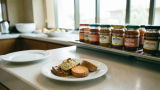
Both the ayu and the gohei mochi were excellent.
4. I bit into gohei mochi and thought, “Wait, this is rice” — that reaction is correct
The word mochi makes it easy to expect the stretchy texture of glutinous rice cake.
But when I bit into it, it was very clearly rice.
Crushed cooked rice, coated in a sweet-savory sauce and grilled.
Japan’s Ministry of Agriculture says Aichi-style gohei mochi mainly uses ordinary non-glutinous rice, miso, and soy sauce. The cooked rice is mashed, shaped around a skewer, coated with sauce, and grilled.[3]
So “rice shaped into something mochi-like” is a much better mental model than “a normal mochi with sauce.”
Did gohei mochi originate in Shinshiro? — not in Shinshiro alone
That led to the next question: “Was this invented in Shinshiro?”
Public sources do not support a clean single-city origin story.
The Ministry of Agriculture describes gohei mochi as a regional food found not only in Okumikawa in Aichi, but also across mountain areas such as Kiso and Ina in Nagano and Hida in Gifu. There are several origin stories, and it is said to have existed by the middle Edo period.[3][4]
So calling it a local specialty of Shinshiro or Okumikawa makes sense. Saying Shinshiro alone invented it and exported it outward is much harder to support.
It is better understood as a rice culture that grew across neighboring mountain regions.
5. Inside Yakumoen — a rugged logo suddenly opens into a moe universe
The food was not the only memorable part of Yakumoen.
Some of the shop’s logo and T-shirt designs looked genuinely cool — the kind of rugged branding that fits a mountain-and-river destination.
Then I looked in another direction and found girl-character merchandise.
There were also illustrations that looked AI-generated to me, although I did not verify how they were actually made. That point is an impression, not a factual claim.
And then there was “Konomi-chan.” Inside the shop, an okonomiyaki-style gohei mochi product had been turned into a girl character.
They did not stop at “Let’s put okonomiyaki toppings on gohei mochi.” They turned the product into a girl.
At that point it is no longer only product development. It is world-building.
There were character T-shirts for sale too. I did genuinely wonder how many first-time tourists go from “I have never seen this character before” to “Yes, I need the shirt.”
But sales conversion is only one metric. Memorability is another, and the character absolutely helps with that.
There are many places where you can eat ayu.
There are fewer places you remember as:
“the ayu restaurant where the giant rice skewer and the unexpected moe character share the same universe.”
6. The figure collection was already chaotic — then One Piece appeared underwater
The shop also contained figures from multiple franchises, including Chiikawa and Dragon Ball.
There did not seem to be a single curatorial theme. It felt more like layers of “things somebody likes” accumulating until the building itself became the collection.
Then came the aquarium.
Several figures that looked like One Piece characters were inside the tank.
Pirates and water are thematically compatible.
My immediate reaction, however, was less “displayed underwater” and more:
“Why have they been sunk?”
This is one of the great pleasures of eccentric local restaurants: sometimes nobody can explain the arrangement, and that is precisely why it is memorable.
7. Was I the only real customer? — meanwhile a merchandise discussion seemed to be happening beside me
At the time I visited, I appeared to be roughly the only ordinary dining customer.
There was another group, but they did not seem to order. From what I could hear, they appeared to be discussing how products should be displayed and sold, or how the shop might be improved.
They may have been staff and outside business people, but I did not verify who they were or what relationship they had. So that remains only an impression.
Still, the visual was funny:
I was eating ayu as what looked like the only customer while a possible “how do we sell more?” meeting happened nearby.
Naturally, one thought appears:
“Is this place okay?”
8. One quiet hour at 4 p.m. cannot diagnose a business — but location still matters
That thought needs a correction.
I visited after the normal lunch peak on a weekday. A place selling ayu and regional food may have radically different traffic on weekends, at noon, or during peak sightseeing seasons.
So one quiet off-peak snapshot is not evidence that the business is weak.
The more interesting question is: how much does location matter?
For everyday businesses such as supermarkets, catchment population, normal driving routes, parking, and distance from competitors strongly shape repeat visits. Even an excellent store struggles if it sits outside people’s daily movement patterns.
A regional-food restaurant can operate differently. Ayu and a famous giant gohei mochi can turn the restaurant into a destination. People may drive specifically for the product.
But destination businesses still benefit from car-oriented location quality: visibility from the road, easy entry, parking, nearby attractions, and spillover from roadside stations.
Historically, Shitara Town council materials discussed promoting Yakumoen and nearby facilities together with Roadside Station Shitara rather than treating them as isolated businesses.[5] That shows that circulation between nearby facilities has been recognized locally as part of the tourism and commercial problem.
A crude but useful model is:
sales = people passing through × awareness × entry rate × spend per customer + people who come specifically for you
Yakumoen’s ayu, enormous gohei mochi, and strange-but-memorable interior culture all strengthen that final term: a reason to come on purpose.
9. Final thought — sometimes “what on earth is this?” survives longer than a perfectly curated itinerary
The day becomes ridiculous when listed in sequence.
I had Yotsuya Senmaida almost to myself. The water was roaring. The scarecrows were unnervingly realistic. I entered an old-house café near closing. Local people helped me find ayu. I raced to Yakumoen with 1% battery. I found the ayu. I searched for a “large gohei mochi” ticket that did not exist. I bit into it and realized it was basically grilled rice. Then a rugged logo, a moe character, assorted figures, and One Piece figures underwater appeared in the same restaurant. Finally, I started thinking about location economics.
That is too much information for one meal stop.
And that is exactly why it works as a travel memory.
Okumikawa is better when you do more than look at the scenery. Go inside a shop, talk to somebody, and collect at least one “what is going on here?” moment.
References (5)
- Shinshiro City, “Yotsuya Senmaida” https://www.city.shinshiro.lg.jp/kanko/meisyo/senmaida.html
- Shitara Town, “Yakumoen” https://www.town.shitara.lg.jp/odekake/2384.html
- Ministry of Agriculture, Forestry and Fisheries, “Gohei Mochi — Aichi” https://www.maff.go.jp/j/keikaku/syokubunka/k_ryouri/search_menu/menu/goheimochi_aichi.html
- Ministry of Agriculture, Forestry and Fisheries, “Gohei Mochi — Nagano” https://www.maff.go.jp/j/keikaku/syokubunka/k_ryouri/search_menu/menu/gohei_mochi_nagano.html
- Shitara Town Council record concerning integrated promotion around Roadside Station Shitara https://www.town.shitara.lg.jp/uploaded/attachment/1596.pdf