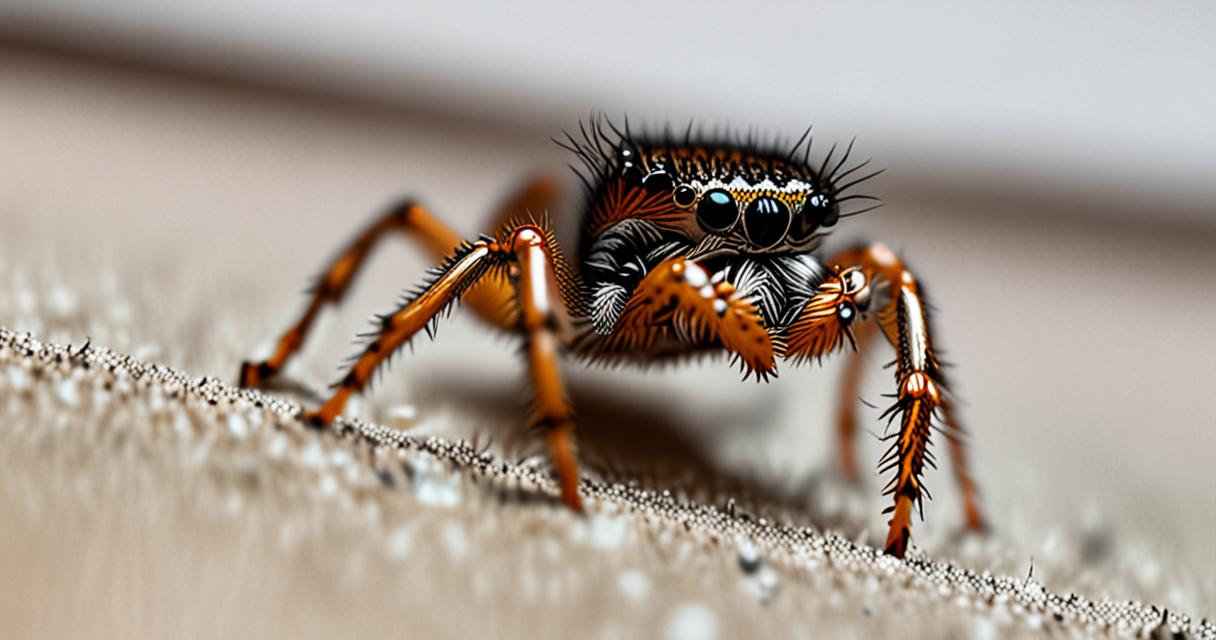
Ho ho, now look at that. There is a tiny jumping spider sitting on top of the monitor.
It was there yesterday. It is there today. Sometimes it disappears behind the screen, then pops back up along the top edge as if it pays rent.
At that point, my young friend, you do not merely “have a spider in the room.”
You have acquired a new PC peripheral.
Video output. Audio output. Pest-control output.
No USB cable. No driver updates. It walks around by itself and may occasionally remove a fly.
Marvelous technology, eh?
There is, however, one very important condition.
It must stay small.
The moment a spider the size of your palm appears on the ceiling, the phrase “but it is beneficial” loses quite a bit of persuasive power.
0. The short version: a tiny one is a security guard; a giant one is a security company that frightens the tenant
A small jumping spider on the edge of a monitor can feel like a little guard on duty.
If it catches a gnat now and then, it is practically paying rent.
But once the animal becomes palm-sized, the accounting changes.
Does it eat pests? Wonderful.
Is a ten-centimeter silhouette sitting over your bed? Grandpa is not sleeping tonight.
The key point is simple: ecological benefit and psychological cost belong in different columns.
“Useful animal” does not automatically mean “comfortable roommate.”
1. Why would a spider choose a monitor?
The “maybe it likes the warmth” idea is plausible.
A monitor can offer several attractive features from a spider’s point of view:
- some surfaces become mildly warm during use;
- edges and rear panels provide crevices and shade;
- elevated positions may offer useful travel routes and visibility;
- small insects may sometimes occur near illuminated screens;
- the rear of a monitor is often relatively undisturbed.
But we should not leap from that to “this individual definitely moved in for the heating.”
Temperature does affect jumping-spider biology. In one study of desert Habronattus species, the spiders showed a laboratory thermal preference around 37°C.
Yet those were North American desert spiders, not the unidentified household spider on somebody’s monitor.
So the careful answer is:
Warmth may matter. Height may matter. Shelter may matter. Food may matter. Several things may matter at once.
In real-estate terms, the listing reads: elevated unit, warm microclimate, good hiding places, possible food nearby, limited human disturbance.
No wonder somebody signed the lease.
2. Jumping spiders are generally hunters, not giant-web landlords
Here is the charming bit.
Most jumping spiders do not depend on large prey-catching webs. They use their excellent vision to locate prey, stalk it, and pounce.
Smithsonian material describes spiders as using a range of strategies, including active hunting, while UC IPM specifically describes jumping spiders as day-active hunters that stalk and jump on prey.
So the little spider on the monitor is less like:
“I shall build a giant automatic trap here.”
And more like:
“I shall use this as headquarters and patrol the neighborhood.”
A tiny security guard, in other words.
3. But they still use silk, old fellow
“No capture web” does not mean “no silk.”
Jumping spiders spin draglines, including during jumps, and research also describes silk retreats used for resting, moulting, egg laying, and other activities.
Some jumping spiders also show site fidelity to resting nests.
So if one spider keeps disappearing behind a monitor and returning, using the area as a regular retreat is perfectly plausible.
Congratulations.
Your monitor may now include a studio apartment for arachnids.
You bought a display. The spider found housing.
4. A tiny jumping spider can be an easy roommate — for some people
A small jumping spider has several qualities that can make coexistence relatively easy.
It does not usually cover the room in a large prey-catching web. It is small. It eats small arthropods. It moves about on its own. It occupies very little physical space.
That does not mean everybody must tolerate it.
If even a tiny spider makes you uncomfortable, removing it is a perfectly ordinary preference.
The point is not “beneficial spiders must stay.”
The point is simply that coexistence works when the perceived benefit is greater than the personal cost.
For one person: “Cute little monitor guard. Carries on. Fine.”
For another: “No, sir. Eight legs is eight legs. Out you go.”
Both are normal.
5. Then one day you wake up and there is a palm-sized spider on the ceiling
Now we reach the important chapter.
Imagine staying overnight in an old house.
You wake up. You look vaguely at the ceiling.
“Hm? Something up there?”
You focus your eyes.
Large.
You focus again.
Good heavens, VERY large.
A palm-sized spider is sitting overhead.
The same brain that calmly said, “Spiders can be useful predators,” immediately closes the science department for the evening.
Forget pest control.
Where am I supposed to sleep now?
That reaction is not logically inconsistent.
“Low physical danger” and “I can sleep comfortably under this animal” are completely different questions.
6. Could it have been a huntsman spider? Possibly. But memory alone cannot identify it
Without a photograph or specimen, we cannot identify an old sighting with certainty.
Still, in Japan, a very large roaming spider found indoors on walls or ceilings, with a leg span around the size of a hand, is consistent with a huntsman spider such as Heteropoda venatoria.
Saitama City’s Health Science Research Center describes this species as one of the largest spiders commonly found inside Japanese buildings. Its leg span can exceed 10 centimeters. It hides during the day, comes out at night, and catches insects on walls and ceilings. Its prey can include cockroaches, flies, moths, and mosquitoes.
Read only that part and you might say:
“What a splendid free pest-control contractor!”
But the same municipal page also notes that its large appearance can cause fear or discomfort.
There you have it.
Useful, yes. Frightening, also yes.
Even the public-health people understand Grandpa’s dilemma.
7. “Beneficial” and “psychologically unbearable” can both be true
This is the funniest and most useful distinction in the whole story.
Ecologically, a spider may:
- prey on insects;
- reduce some indoor arthropods;
- act as a predator of pests.
Yet from the resident’s point of view, the same animal may:
- create constant vigilance;
- make sleeping difficult;
- trigger worry about where it will move during the night;
- make a room feel unusable.
Saying “but it cannot hurt you much” does not erase those costs.
If the animal ruins your sense of comfort in your own room, that is a real household cost even if the spider is ecologically useful.
No diagnosis is required.
If the spreadsheet says:
Pest control +5
Peace of mind −80
the total is still negative.
It is like receiving a free high-end graphics card whose fan screams beside your pillow every night.
Good performance does not excuse everything.
8. Conclusion: tiny spider, peripheral; giant spider, property-management issue
So here is Grandpa’s ruling.
A small jumping spider repeatedly using a monitor may plausibly like some combination of warmth, height, shelter, low disturbance, and nearby prey. We cannot prove that warmth alone explains the choice.
Jumping spiders are active hunters rather than classic large-web trappers, though they still use silk for draglines and retreats.
That makes a recurring little monitor resident entirely believable.
And if it catches flies while it is there, then yes:
a PC peripheral with built-in pest control
is a fair joke.
But once the spider reaches palm size, a different problem appears.
The security guard has become so intimidating that the resident no longer wants to enter the room.
A creature can be useful and still be unwelcome.
So for the tiny monitor spider: “Good work today, officer.”
For the giant ceiling spider: “I respect the service, old chap. Kindly change your place of employment.”
That is a perfectly reasonable arrangement.
Sources
- Smithsonian National Museum of Natural History. “Spider Strategies.” https://naturalhistory.si.edu/visit/accessibility/audio-and-visual-description/insect-zoo-audio-description-tour
- UC Statewide IPM Program. “Spiders / Home and Landscape.” https://ipm.ucanr.edu/home-and-landscape/spiders/
- University of Minnesota Extension. “Spiders.” https://extension.umn.edu/garden-and-home/home-maintenance/household-insects/spiders
- Wolff, J. O. et al. (2021). “Hanging by a thread: unusual nocturnal resting behaviour in a jumping spider.” Frontiers in Zoology, 18. https://doi.org/10.1186/s12983-021-00410-3
- Shamble, P. S. et al. (2021). “Rapid mid-jump production of high-performance silk by jumping spiders.” Current Biology, 31(21), R1422–R1423. https://doi.org/10.1016/j.cub.2021.09.053
- Brandt, E. E. et al. (2020). “Low temperatures impact species distributions of jumping spiders across a desert elevational cline.” Journal of Insect Physiology, 122, 104037. https://doi.org/10.1016/j.jinsphys.2020.104037
- Saitama City Health Science Research Center. “Pest or beneficial creature? The large spider that lives indoors: Heteropoda venatoria.” https://www.city.saitama.lg.jp/sciencenavi/kenkou/003/p048232.html