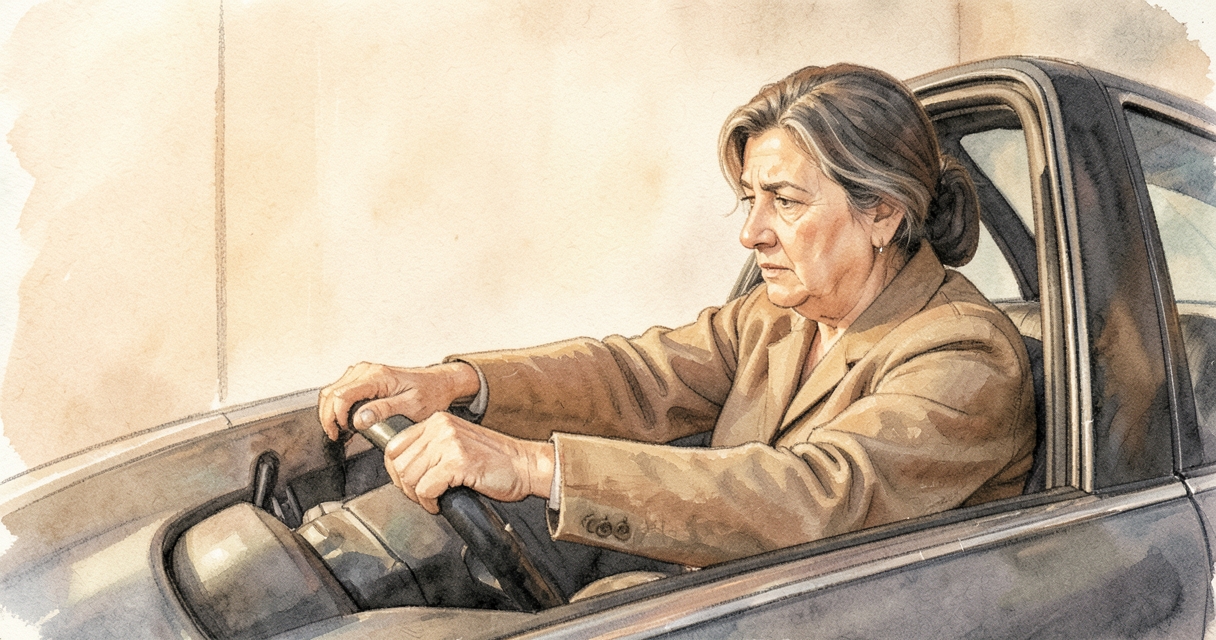
Sooner or later, every new player in Initial D THE ARCADE does this:
Red! Brake! BRAKE EVERYTHING!
The car survives the corner. The wall remains untouched. Unfortunately, so does most of your momentum.
SEGA’s official line guide really does say green = accelerator on, yellow = accelerator off, red = brake.[1] The official driving tips also tell players to brake firmly before drifting when the red corner guide appears.[2]
The missing detail is crucial: red does not mean “brake for a fixed number of seconds” or “slow to one universal speed.”
Red is not an emergency-stop button.
This guide turns that simple color code into a practical beginner method.
1. The core idea: judge the corner by how early you can get back on the throttle
Use this order:
- Red appears: use the brake.
- Remove enough speed to make the corner.
- Once the car is rotating correctly, release the brake.
- If the exit is safe, return to the throttle.
- On the next run, shorten the braking slightly.
The goal is not “never slow down.” It is to use the minimum deceleration that still lets you avoid the wall, hold the line, and accelerate early on exit.
A heroic entry that ends in a wall is still a bad accounting result.
2. Green, yellow and red describe the type of input, not a universal target speed
SEGA’s official guide gives a simple baseline:[1]
- Green: accelerator on
- Yellow: accelerator off
- Red: brake
The common mistake is turning “red = brake” into “every red corner requires the same heavy braking.” It does not.
Course layout, car, route, entry speed and vehicle attitude all change how much braking you actually need. Treat the guide as an instruction for what kind of input to consider first. Then refine how long you use that input.
3. Red-corner technique: braking is the entry job; throttle is the exit job
SEGA explicitly recommends braking firmly before drifting through a red-guided corner.[2]
For a beginner, split the corner into four phases:
Approach: see red and prepare. Do not keep full throttle and start negotiating with the laws of physics.
Initial braking: enter a speed range where the car can rotate.
Rotation: once the car points where you need it, stop holding the brake forever.
Exit: when the line is safe, get back on the accelerator.
“Use the brake” and “keep braking for ages” are not the same instruction.
4. If you slow down too much, shorten braking time before moving the braking point
If you already make the corner cleanly but feel painfully slow, change one variable first:
Start braking at the same place, but release the brake a little earlier.
A useful progression is:
- Run 1: create a safe baseline.
- Run 2: release the brake slightly earlier.
- Run 3: shorten it again if the car still has plenty of margin.
- If you hit the wall: return one step.
This is safer and more repeatable than suddenly throwing the braking point much deeper into the corner.
Some red corners may need only a brief brake input; others need substantial slowing. The color alone does not specify the duration.
5. When the car will not turn, more steering is usually not the first answer
The classic beginner combo is:
too much entry speed → car will not turn → maximum steering → still will not turn → wall.
Before adding steering, question the entry speed.
A useful rhythm is:
slow → rotate → unwind steering → accelerate.
Do not judge only the entry. Judge how quickly the car is pointed down the next straight.
Exit speed pays rent for a long time. Entry drama usually does not.
6. Which car should a beginner choose?
The official game uses vehicle strengths tied to course type—technical / high-speed—and route type such as DH / HC / AR.[3] That is why there is no single honest answer to “what is the best car everywhere?”
If you simply need a first direction, these are practical—not official tier-list—suggestions.
AE86 TRUENO
A strong choice if you want the classic Initial D experience and a car you will actually enjoy practicing with. This is not a claim that the AE86 is universally strongest.
EUNOS ROADSTER
A reasonable pick if you like a compact FR car and want to focus on line choice and rhythm. Again, “beginner-friendly” here is an editorial recommendation, not an official SEGA ranking.
RX-7 FD3S
A good candidate if you enjoy performance-focused play and want a car often associated with competitive driving. Its value still depends on the course and attribute match.
The official car list includes the AE86, FD3S and EUNOS ROADSTER among the available models.[4]
7. Tune one car before blaming the car
Playing Story Mode raises Tune Lv., which officially goes up to Lv.16.[5]
That matters. If a beginner switches cars before building one properly, it becomes difficult to tell whether a problem comes from driving, course familiarity, vehicle attributes or incomplete tuning.
A cleaner learning order is:
- Pick one car.
- Build its Tune Lv. through Story Mode.
- Repeat one course.
- Reduce brake duration corner by corner.
- Only then compare other cars and attributes.
Changing the car, course and braking point every run is not experimentation. It is a multivariable crime scene.
8. Beginner cheat sheet
Green: accelerate.
Yellow: start by lifting off the throttle.
Red: brake, but do not try to park the car.
Car will not turn: suspect excessive entry speed before adding more steering.
You make the corner easily but are slow: release the brake earlier next run.
You hit the wall: move one step back toward safety.
Car choice: one car you like + suitable attributes beats endless tier-list hopping.
Progression: tune one car first.
The real upgrade is moving from:
“Red means brake.”
to:
“For this red corner, this is the smallest amount of braking that gives me a fast exit.”
Beginners first learn to press the brake.
Faster players learn when to let it go.
Sources
- SEGA — 頭文字D THE ARCADE「ラインガイドってなに?」初心者ドライバー応援ガイド initiald.sega.jp
- SEGA — 頭文字D THE ARCADE「走り屋への道」/コーナー・ブレーキングドリフトの公式ガイド initiald.sega.jp
- SEGA — 頭文字D THE ARCADE「属性ってなに?」初心者ドライバー応援ガイド initiald.sega.jp
- SEGA — 頭文字D THE ARCADE「車種」 initiald.sega.jp
- SEGA — 頭文字D THE ARCADE「ストーリーモードで遊ぼう!」初心者ドライバー応援ガイド initiald.sega.jp