“They came to our table first. Are we number one?”
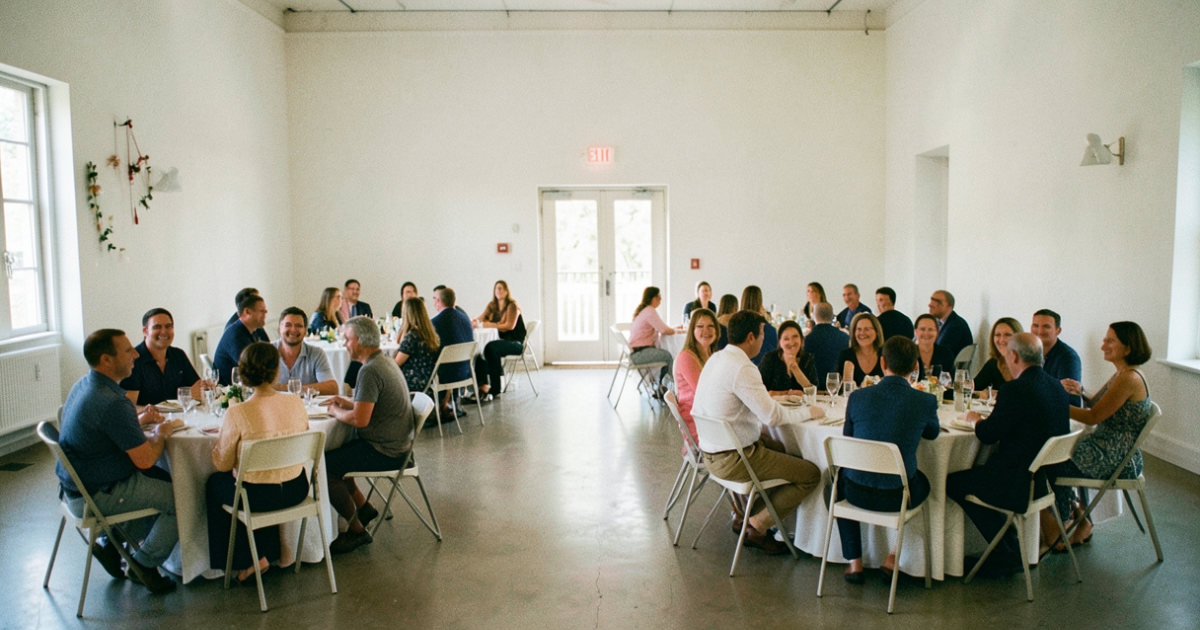
During a wedding reception, the couple may visit each table for photos, greetings, or an activity. If they come to a table near the entrance first, it is tempting to read that as a ranking.
But that single fact does not prove priority. Wedding seating has formal ideas about more and less honored positions, while the order of a table round can also depend on the entrance, the couple’s route, the room shape, and the event schedule.
If the first table is right next to the entrance, a very ordinary explanation is simply: that was the easiest place to start.
The honored seat is about hosting roles, not emotional importance
In a typical Japanese reception, tables closer to the couple’s main table are treated as more honored positions. Guests of honor and senior workplace guests are often placed toward the front, while close family members are commonly placed farther back because the family is also considered part of the hosting side.
That does not mean the parents are “less important.”
The seating system is not a ranking of affection. It is a ceremonial arrangement that distinguishes guests being honored from the family helping host the event.
Relatives can be “in the back” and still have a bad view
Real rooms are messy.
A relative table may be grouped toward the rear or side, yet the angle of the room, other tables, pillars, screens, or service paths may make the couple surprisingly hard to see.
That creates an important distinction: ceremonial position and visual quality are different variables.
A seat can be correct according to etiquette and mediocre according to sightlines.
A friend table is not a secret friendship leaderboard
Overall table placement may follow formal etiquette, but friend tables are usually much more flexible. Practical guidance commonly emphasizes grouping people who know each other, avoiding awkward combinations, and helping solo guests feel included.
If eight friends were placed in strict order from “closest friend” to “friend number eight,” the reception would start looking less like a celebration and more like an annual performance review.
Conversation quality matters.
First stop near the entrance: route logic is a strong explanation
Separate observation from inference.
Observed: the couple visited a table near the entrance first.
What that proves: only that it was first.
Reasonable inference: the table may have been the natural starting point of the route.
A table round is often tied to photos and timing. Moving physically from one neighboring table to the next is much easier than teleporting around the room according to social rank.
At that moment, wedding planning quietly turns into logistics.
Why the seating chart is harder than it looks
The planner may need to balance all of these at once:
- formal guest-of-honor placement
- family and relative placement
- friend groups
- who can comfortably talk to whom
- people who should not be seated together
- children, older guests, and mobility needs
- access to entrances and restrooms
- sightlines to the couple and screens
- service staff circulation
- the couple’s table-round route
- photography and entertainment
- fixed table capacity
Change one condition and another may break.
This is not just seat assignment. It is a constrained human-relations puzzle inside a physical room.
There is no perfect arrangement
Wedding etiquette provides a baseline, but modern receptions range from formal large events to small family meals. Some couples follow hierarchy closely; others prioritize comfort and conversation.
So the real goal is usually not to discover one mathematically perfect seating chart.
It is to find an arrangement that respects the ceremony, avoids major discomfort, supports conversation, and lets the event run smoothly.
The seating chart is one sheet of paper.
The hidden work behind it can be enormous.