Introduction
In the countryside and in areas near mountains in Japan, you sometimes hear stories like this:
"I heard a neighbor got his leg bitten by a wild boar." "The boar that showed up was huge." "How big?" "Big is big." "It was the size of a kei truck." "Like Okkoto from Princess Mononoke."
(A kei truck is a tiny Japanese pickup, about the size of a small van. Okkoto is the giant boar god in the Studio Ghibli film Princess Mononoke.)
Here your brain stops for a second. Kei truck size? Okkoto? That doesn't sound like a real boar. It sounds like a Ghibli film or a Monster Hunter game.
Of course, wild boars are dangerous. They can and do hurt people. Some are big. News reports mention boars over 100 kg, and even giants around 200 kg.
But before you take "kei truck size" as a real measurement, it helps to check. To put it precisely: the sources I checked do not show a boar the size of a kei truck. But a boar can feel that heavy and that forceful. That difference matters.
This article covers how big wild boars really are, how that compares to a kei truck, why some people exaggerate, how childhood stories stick, and a simple way to listen: believe the danger, but ask for specific numbers on the size.
How Big Are Wild Boars Really?
First, how big is a real boar?
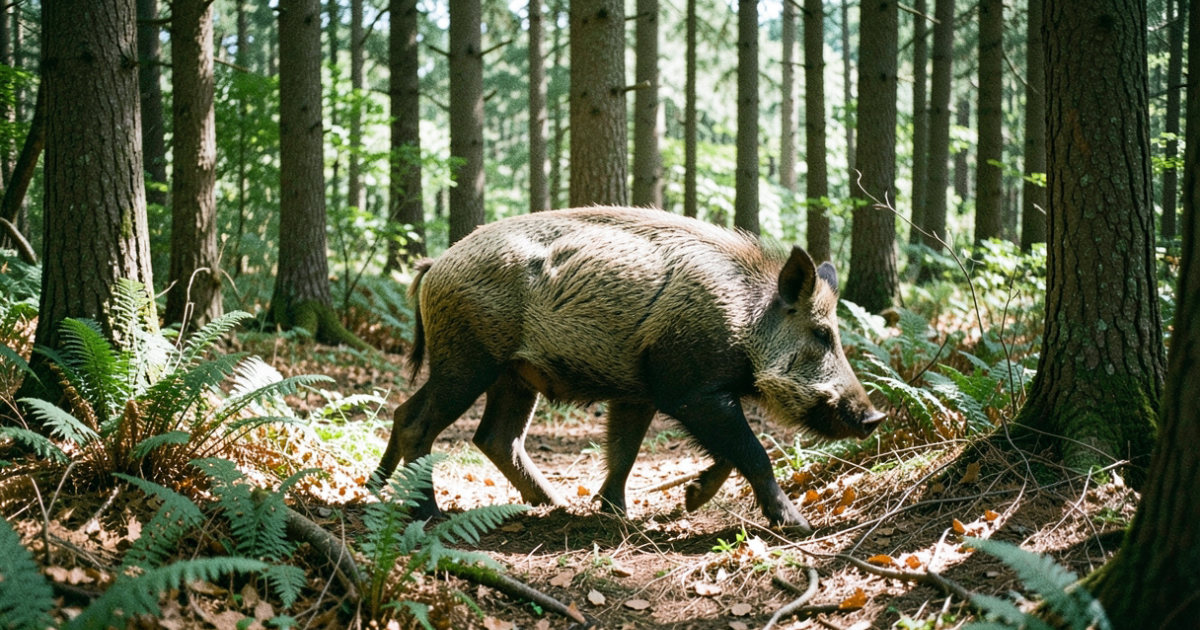
The National Institute for Environmental Studies (Japan) describes adult male Japanese boars from the Chugoku mountains as having a head-and-body length of 110 to 160 cm, a weight of 50 to 150 kg, and a shoulder height of 60 to 80 cm. Those figures describe the areas and animals listed in that source. [R1]
That is pretty big. Up close, it doesn't look like a dog or a farm pig. It's a mass of muscle that came down from the mountain. Males also have tusks, and they charge hard. If one appears on farmland, at the edge of the woods, or on a dark road, it is truly scary.
So you can believe "it was huge" and "I was scared." But jumping from there to "kei truck size" is a different claim.
Giant Boars Do Exist
Very large boars are real. For example, there is a news report of a boar caught in the mountains of Tottori Prefecture that weighed over 200 kg. [R4]
That is a real "lord of the mountain." Meeting one on a night road or in a field would feel overwhelming. At that size, it's no longer "a big dog" or "a normal pig." It has the presence of Bulldrome, the boar monster from Monster Hunter. [R7]
So there's no need to deny that giant boars exist. The question is how much extra has been added by the words used to describe them.
Kei Truck Size Is Too Much
How big is a kei truck? Under Japanese rules, a kei (light) vehicle is at most 3.4 m long, 1.48 m wide, and 2.0 m tall. A kei truck fits in those limits. [R3]
So an animal "the size of a kei truck" would be enormous. A normal Japanese boar has a head-and-body length of about 110 to 160 cm. That figure describes adults in that area and is not the maximum for every animal. Even so, compared with a kei truck that is 3.4 m long, the gap is big.
A boar that really was that size would not be a boar. It would be a disaster on wheels. Here is a fair way to sort it:
- Kei truck size as a real measurement: can't be confirmed by these sources or reports.
- Kei truck force as a feeling: I understand that.
- Danger when one charges: very real.
- Okkoto as a story: a Ghibli word sticker.
"Kei Truck Size" Often Means Force, Not Size
If you take an exaggerated story at face value, it gets confusing. But if you translate it, it's easier to understand. "It was the size of a kei truck" may really mean:
"It felt as forceful as a kei truck." "It was as scary as a kei truck coming at me." "There was no way a person could stop it." "It was as dangerous as a vehicle."
It sounds like a statement about size, but it may be about a feeling. It sounds like a measurement, but it may be about danger. It sounds like a fact, but it may be a memory that has been squeezed into one strong picture.
So, as a listener, it helps to ask specific questions:
"How many meters long was it?" "How tall?" "Do you mean the length of a truck, or how forceful it felt?" "Was it bigger than a large dog? Was it as high as a person's waist?"
Why Do Some People Exaggerate?
People who exaggerate are not always lying on purpose. They may honestly be trying to pass on how scary it was. Here are a few possible reasons a story grows.
1. They want to communicate fear instantly
"It was a big one, about 160 cm long and 70 cm tall at the shoulder" doesn't hit the listener. But "It was the size of a kei truck" gets the fear across in one go. That isn't an accurate report. It's fear packed into one phrase.
2. Perceived size and actual size mix together
How scary it felt and how big it measured should be kept apart. If you saw it from far away, in the dark, when it burst out suddenly, charged, and people around you were shouting, it's hard to judge size calmly. If you put that feeling straight into words, you get "It was huge," "like a kei truck," "the lord of the mountain."
3. The story becomes more memorable
Danger stories in rural areas tend to turn into ghost stories a little. "A boar showed up" is weaker than "Something like Okkoto showed up." This also works as a safety warning. Even with some stretching, it helps tell children and family to stay away.
4. Memory grows through retelling
Human memory is not a video recording. It is rebuilt later. In psychology, research shows that information or words that arrive afterward can mix into a memory and change the original. That research shows later information can mix in. It is not a study of this boar's witnesses. [R5]
At first it may be "It was quite big." After many retellings it can become "like a kei truck," "like Okkoto," "pretty much the lord of the mountain." But we can't tell whether that happened to the person telling this story. It may also be that, as they tell it, only a strong single picture is left.
Ghibli Word Stickers and Monster Hunter Word Stickers
Words from famous works tend to get stuck onto stories like these. The boar was huge. It was scary. It came out of the mountain. A person got hurt. It had a mysterious feel. It seemed beyond human control. Then the brain wants to stick on Okkoto from Princess Mononoke. That's what I call a Ghibli word sticker.
For people who play games, it's Bulldrome from Monster Hunter. That's a Monster Hunter word sticker.
Both are handy for passing on a feeling. "There was a very big wild animal, and it would be dangerous if it charged" is a plain explanation. "It was like Okkoto" or "It was Bulldrome" is faster. But a word sticker is not a real measurement. Okkoto is a myth-like picture. Bulldrome is a game picture. A kei truck is a vehicle picture. Judge them separately from a real boar.
Children May Store Metaphors as World Settings
This part is very important. An adult may mean it as a comparison:
"It was as big as a kei truck." "It was like Okkoto." "It's the lord of the mountain."
But a child may not be able to treat it as a comparison. If a child takes it literally, the world looks like this:
"There are boars the size of kei trucks in the mountains." "A forest god like the ones in Princess Mononoke shows up near my house." "If a grown-up says it, it must be true." "The countryside mountains might be a Monster Hunter map."
The child's mental world becomes a bit like a Ghibli film or a game. Being afraid of mountains and wild animals is not bad. For safety, it's needed. But if an impossible size gets stored as a fact about the world, it can cause confusion later. An adult's tall tale can become, for a child, a rule book for reality.
Looking at How You Take In a Story Lets You Break It Down
When you grow up and can look at how you take in stories, you can take them apart.
"Kei truck size." It may be about force, not measurement.
"Okkoto." A Ghibli word sticker. A comparison for hugeness, mystery, and fear.
"Bulldrome." A Monster Hunter word sticker. A comparison for charging power and a beast-like feel.
"Big is big." Not enough detail. It's better to ask how many centimeters, how many kilograms, and where it was seen.
"A person was bitten and hurt." Take this as danger information. Be careful about it, separately from the size.
So you learn to listen like this: believe the danger, and ask for specific numbers on the size. That is an important kind of growing up.
Accept the Danger Information, Hold the Measurements
When you hear an exaggerated story, you don't need to reject all of it. If you stop at "Kei truck size? That's a lie," you may also throw away the danger information you really need:
A boar appeared. A person was hurt. Be careful at the edge of the mountains. Nights and early mornings are dangerous. It's better not to go near one.
You should take that seriously. Meanwhile, put these on hold as expressions of feeling: kei truck size, Okkoto class, lord of the mountain, a Monster Hunter boss. Here is how to sort it.
Accept
- A boar appeared.
- A person was hurt.
- It may have been a large animal.
- It's dangerous to get close.
- Be careful near the mountain edge, fields, and night roads.
Put on hold
- Kei truck size
- Okkoto class
- How many meters long it was
- Lord of the mountain
- Forest-god level
If you can sort things like this, you are less likely to be pushed around by the story.
How to Respond to People Who Exaggerate
You don't need to deny it right away. If you say "No way, a kei truck?", the person will answer, "No, it really was huge." They may be trying to share a feeling, not a measurement. So it's better to ask:
- How long was it, really?
- Was it up to a person's waist? To the chest?
- When you say kei truck, do you mean the length or the force?
- How many people saw it?
- Is there a photo?
- Where did it appear?
- About what time?
- How serious was the injury?
- Where should people avoid going?
Questions like these separate the facts from the feelings. Accept the feeling of "It was scary." But don't adopt "kei truck size" as a measurement as it stands. That's the best way.
Rural Danger Stories Are Small Single Pictures
Danger information in rural areas often spreads like a single picture. "Don't go into the mountains" alone is weak. "A boar the size of a kei truck showed up" is strong. "There was something like Okkoto" is even stronger. In a story like this, the picture of Okkoto lands harder than "how many centimeters."
That is why exaggerated stories don't go away. It isn't all bad; they help pass on a warning. But the listener should sort out whether this is danger information or size information. A rural ghost story is not a blueprint with measurements. It's usually a single picture in the style of a Ghibli film.
Conclusion
When you hear about a "boar the size of a kei truck," check the real size and the sense of force separately.
A normal Japanese boar has a head-and-body length of about 110 to 160 cm and a shoulder height of about 60 to 80 cm. There are reports of boars over 200 kg. So giant boars do exist. But a kei truck is about 3.4 m long. If a boar were that size, it would be a mountain disaster on wheels.
So the conclusion is this: from the sources I checked, I can't say a boar is the size of a kei truck. But it can have the force of one.
People who exaggerate are not always lying on purpose. Fear, bodily feeling, warning, a wish for a good story, and the rebuilding of memory all mix into strong words. A child may store that not as a comparison but as a fact about the world, and then the mountains turn into a Ghibli film and the countryside into a Monster Hunter map.
But if you look at how you take in a story, you can take it apart. Believe the danger. Ask for specific numbers on the size. Peel off the Ghibli word sticker and look underneath. It may have become Bulldrome, but the real size is a separate question.
That is the most realistic way. Rural tall tales are not all lies. But if you believe every word, the world turns into a Ghibli film. What you need is not denial. It is taking the story apart.
References (7)
- National Institute for Environmental Studies (Japan), Invasive Species Database, "Wild boar" (Japanese): https://www.nies.go.jp/biodiversity/invasive/DB/detail/10240.html
- Ministry of the Environment (Japan), Ikilog, "Wild boar" (Japanese): https://ikilog.biodic.go.jp/Investigation?eventremarks_id=56&invReq=life&life_id=90
- Japan Light Motor Vehicle and Motorcycle Inspection Organization, "What is a light vehicle?" (Japanese): https://www.keikenkyo.or.jp/information/knowledge/what.html
- TBS NEWS DIG, "Giant wild boar over 200 kg caught" (Japanese): https://newsdig.tbs.co.jp/articles/-/200839
- Challies, D. M. et al. "A Behavioral Account of the Misinformation Effect": https://pmc.ncbi.nlm.nih.gov/articles/PMC3213001/
- Cognitive and neural mechanisms underlying false memories: https://pmc.ncbi.nlm.nih.gov/articles/PMC10567586/
- Monster Hunter Wiki, "Bulldrome": https://monsterhunter.fandom.com/wiki/Bulldrome