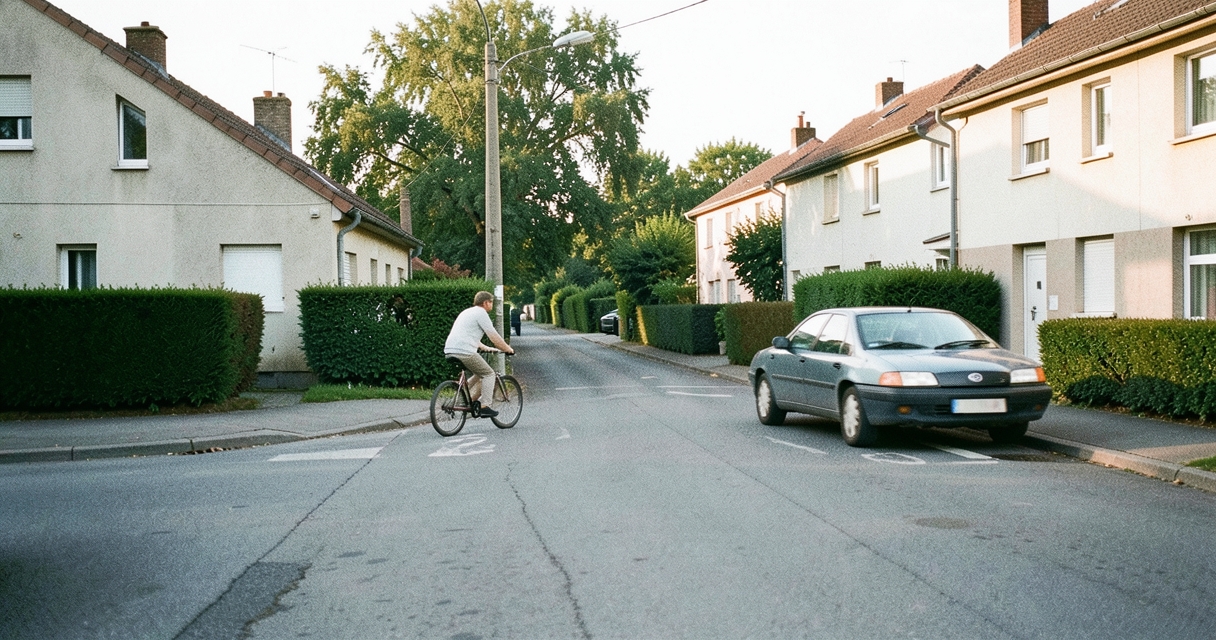
1. A place becomes a bundle of questions
Travel gets strange in a good way when you know enough to notice structure. A station, a road, a shopping street, a river, a port, a factory, even a small historical sign can become the starting point for one question: why is this here?
A person who would normally cross a station square in five minutes can suddenly spend half an hour wondering why the station sits at that exact point, why one road is unusually wide, or why an old commercial street runs in a particular direction. The route to the attraction becomes more interesting than the attraction.
Travel has not become less fun. A second game has been added: not only seeing a city, but reading the reasons that produced it.
2. Knowledge changes what becomes visible
Knowledge does more than supply facts. It changes what catches your attention.
A little geography makes slopes, rivers, and road alignments noticeable. History makes curved streets and old town centers look different. Logistics and industry make ports, warehouses, rail spurs, and factory clusters feel connected. Demography and urban planning make redevelopment, suburban retail, and transit patterns worth watching.
Knowledge therefore works not only as a stock of answers but as a machine for generating better questions. More knowledge can create more uncertainty, not less.
A 2026 review of tourism research found that curiosity has been studied as a travel motive, a situational psychological state, and a characteristic used to describe different kinds of tourists [R1]. Another 2026 study examined how curiosity and reflection relate to transformative travel and described a recurring curiosity-and-reflection cycle [R2]. This does not prove that more education automatically makes every trip better. It does show that curiosity is a serious part of how researchers think about engagement with travel.
3. Then the infinite research loop begins
The dangerous part is that research does not naturally end.
See something → ask why → search → understand part of it → notice a new inconsistency → search again.
One station can branch into opening dates, old roads, industry, migration, wartime history, disasters, redevelopment, bus networks, shopping streets, and land values. One road can lead to freight history, freight to factory location, factory location to port development. The destination becomes a giant search box.
And the real world contains more prompts than a search result. A slope that looked flat on a map, an oddly wide road, a dead rail spur, an old sign, an embankment: each physical detail creates another branch. The city starts opening more tabs than the browser.
4. Solo travel works well because coordination delay is almost zero
This style of travel fits solo travel extremely well for one simple reason: nobody has to approve the pause.
You can read a sign for fifteen minutes, skip a famous attraction for an old road, enter a small museum without warning, eat lunch late, or change the destination halfway through a search. No meeting is required.
Research on solo travel repeatedly identifies freedom, flexibility, and discovery as important motivations [R3]. For fieldwork-style travel, the ability to change the plan in real time around your own curiosity is a direct advantage.
That does not make solo travel a superior form of travel. It is simply powerful for the specific game of maximizing your own curiosity.
5. Traveling with someone is a different game, and it can be just as good
Shared travel offers something else: laughing at the same scene, eating the same food, collecting ridiculous little incidents, and later being able to say, “that place was weird.” Deep solo research cannot fully replace that.
It helps to think of the two modes this way:
- Solo travel maximizes the freedom to chase your own interests.
- Shared travel maximizes the experience of making the same time enjoyable together.
Conflict appears when one person is in fieldwork mode while the other is in attraction-collection mode. One wants to read every sign; the other wants to move on. Neither is wrong. They are optimizing different things.
6. Compatibility depends less on equal knowledge than on compatible stopping speed
Traveling with someone equally knowledgeable does not automatically solve the problem. Two informed people may care about completely different subjects, or the trip can collapse into an exhausting quiz competition.
What matters more is whether each person can tolerate the other stopping for something interesting, whether they can leave room for interests they do not share, and whether they can avoid turning their own curiosity into a command.
Matching knowledge matters less than matching how curiosity is handled. One person can inspect a bridge while the other takes photos, then they meet again for lunch. That loose coordination can work perfectly.
7. Travel expands into three phases: before, during, and after
Once travel becomes fieldwork, the trip no longer fits inside the travel dates.
Before the trip, you form a few hypotheses: Why did this city grow here? What does this port move? Why did this railway survive?
During the trip, the best material is often the mismatch between the map and reality: the hill is steeper than expected, the shopping street runs the “wrong” way, the industrial site is far larger than it looked online.
After the trip, you investigate those mismatches. That research often produces the next destination. Sometimes the main story starts after you get home.
8. How to keep infinite curiosity without trapping your companions in it
Curiosity does not need to be suppressed. On a shared trip, it simply helps to separate “I want to investigate this” from “everyone must stop while I investigate this.”
Park questions in notes for later. Build a little solo time into a shared trip. If one place genuinely deserves twenty minutes, say so in advance. Not every question must be solved on location.
This is not a way to weaken curiosity. It is a way to keep curiosity sustainable without destroying the shared experience.
9. Conclusion: the trip ends, but the search does not
As knowledge grows, travel can shift from collecting famous sights to reading an entire city. Stations, roads, factories, ports, shopping streets, and tiny signs all become entry points.
Solo travel lets you dig as deep as you want. Shared travel creates a different kind of value through shared memories. There is no need to choose one forever. They are different modes.
There is only one warning for highly curious travelers: a destination can stop being a destination and become a giant search box.
The sightseeing ends. You go home.
Then one question remains: why was that road so wide?
And late at night, another tab opens.
References
- [R1] Langmann, S., Bezemer, P.-J., Park, E., & Kim, S. (2026). Curiosity in tourism: A review and future directions. Tourism Management Perspectives, 63, 101482. DOI: 10.1016/j.tmp.2026.101482
- [R2] Shafiei, B., McLennan, C., & Mathews, S. (2026). The role of curiosity in travellers’ transformation. Journal of Hospitality and Tourism Management, 67, 101435. DOI: 10.1016/j.jhtm.2026.101435
- [R3] Bianchi, C. (2016). Solo Holiday Travellers: Motivators and Drivers of Satisfaction and Dissatisfaction. International Journal of Tourism Research, 18(2), 197–208. DOI: 10.1002/jtr.2049