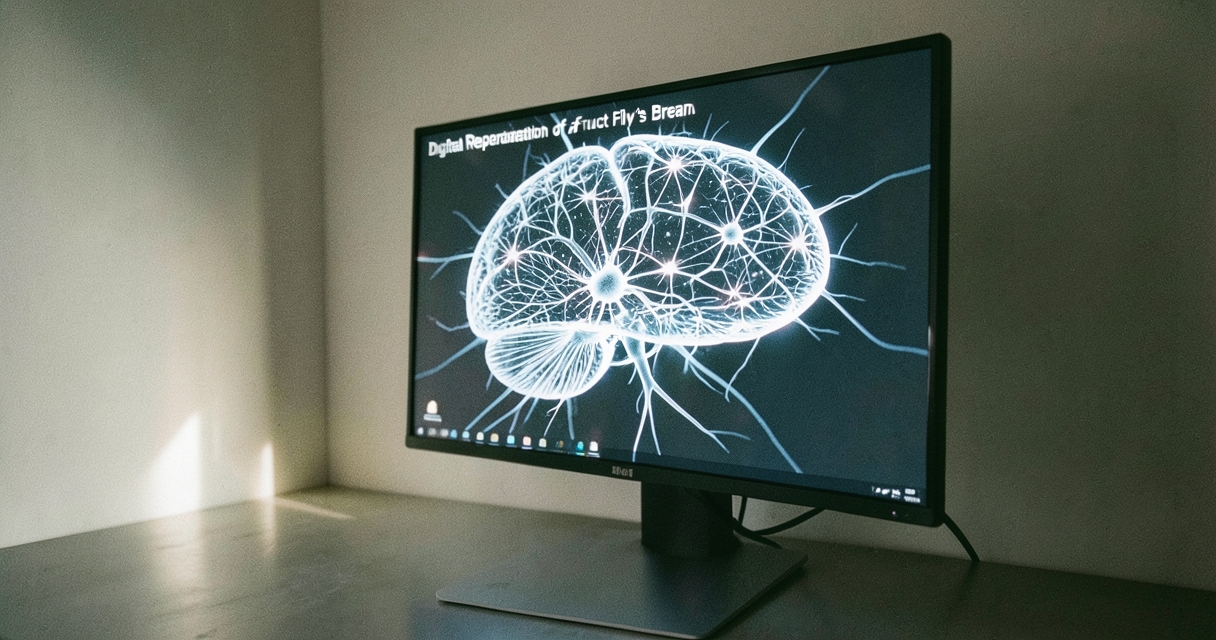
From a fruit-fly connectome in a cute 3D avatar to brains, evolution, landscapes, and the death of divine working memory
First, an important correction: this is not a story about plugging the living brain of a fruit fly directly into a 3D anime-style avatar and turning the fly itself into a cybernetic girl. If that were true, we would already be several chapters deeper into science fiction.
1. The opening joke: “My avatar became a fly”
A creator of a 3D avatar discovered that their work had been used as the virtual body for an experiment based on a fruit-fly neural network. The reaction was essentially: “I never expected it to be used like this.” The experimenter apologized for the bizarre use and thanked the creator. The creator laughed.
That response makes sense. When someone creates a 3D avatar, they might expect it to appear in VR, screenshots, streams, or user modifications. “Virtual body for a fruit-fly-derived neural model” is not normally on the roadmap.
The pleasure is not only about sales or likes. Real use proves that the work has entered someone else’s goal-directed activity. Unexpected use adds something extra: a story the creator could never have written alone. “My cute avatar is now part of a fly-brain experiment” is a rare achievement badge.
Of course, unexpected use is not automatically good. Fraud, rights violations, reputational harm, or unauthorized commercial exploitation can reverse the reaction completely. But when the use is respectful, harmless, and technically fascinating, it can feel like a second life for the work.
2. No, the living fly is not operating the avatar in real time
The recent wave of “fly brain connected to X” stories can sound unsettling. The key distinction is between manipulating a living nervous system and using a digital connectome reconstructed from biological tissue.
In September 2026, researchers from Google Research, HHMI Janelia, and collaborators published a complete synapse-resolution connectome of the adult male fruit fly central nervous system, including the brain and ventral nerve cord. The dataset contains 166,691 neurons.
Producing such a map is brutally physical. Tissue is fixed, cut into extremely thin sections, imaged with electron microscopy, and reconstructed computationally into neurons and synaptic connections. The result is an extraordinarily detailed digital wiring diagram.
The original fly is not waking up inside a computer and asking where its body went.
3. A wiring diagram is not the whole brain
This is where the story becomes much more interesting.
If the connections are known, why not simply reproduce the network and obtain the original brain function? Because connectivity is only one layer of neural operation.
Real nervous systems also depend on synaptic strengths, neurotransmitters and receptors, membrane properties, neuromodulators, gene expression, plasticity, glial cells, ongoing electrical states, and continuous feedback from sensors and the body. Digital models therefore often use simplified mathematical rules for neural firing even when their connectivity comes from real anatomy.
Human: “We mapped the wiring!”
Human: “Now simulate it!”
Human: “Why doesn’t it behave exactly like the real thing?”
Nature: “I manufacture one automatically from an egg.”
The problem is not that anatomical reconstruction is worthless or hopelessly inaccurate. Modern connectomics can resolve astonishing structural detail. The gap is between having a structural map and reproducing the full dynamics of a living nervous system.
The wiring diagram matters enormously. It is simply not identical to the brain itself.
4. Could humans eventually be digitized too?
At least one part of that road has already begun.
In 2024, a Google Research–Harvard collaboration reconstructed roughly one cubic millimeter of human temporal cortex at nanoscale resolution. That tiny fragment contained about 57,000 cells and roughly 150 million synapses. The dataset occupied about 1.4 petabytes.
One cubic millimeter: 1.4 PB.
Brain: “Tiny sample.”
Storage system: “Absolutely not tiny.”
Scaling the same approach to an entire human brain is far beyond present practical capability. More importantly, even a perfect human wiring diagram would not automatically prove that we could reconstruct a person’s memories, personality, or conscious continuity.
These are separate problems:
- mapping human neural wiring at very high resolution;
- simulating human brain function faithfully;
- reconstructing a particular person’s memories and personality;
- establishing that the person’s conscious experience continues in the simulation.
Science fiction can cross all four in one scene. Research has to cross the valleys one by one.
5. Studying artificial intelligence leads back to “the brain is absurd”
Trying to reconstruct neural circuits makes biology look more impressive, not less.
Humans need electron microscopes, enormous storage systems, machine learning, reconstruction pipelines, and human proofreading to recover a circuit. Meanwhile an organism builds its nervous system during development.
DNA does not contain a simple line-by-line list saying, “Connect neuron 12,847 to neuron 14,201.” Development emerges from gene expression, chemical gradients, cell interactions, axon guidance, activity-dependent refinement, and many other local processes.
Nature did not merely produce a finished brain. It produced a system that builds brains and another system that changes them through experience.
At that point the emotional direction flips. Instead of only asking how close computers are getting to brains, we start asking what brains have been casually doing all along.
6. Evolution looks like a gigantic search evaluated by reality itself
Evolution can be viewed, with caution, as an immense search process.
Variation appears. Organisms enter the environment. Some leave more descendants than others. More variation appears. Repeat across staggering numbers of organisms and generations.
In an engineered optimization system, humans define a fitness function. In evolution, the world itself becomes the filter: temperature, predators, food, pathogens, competitors, mates, geography, and chance.
But evolution is not a perfect optimizer. It has no foresight, no fixed global objective, and no guarantee of finding the best imaginable design. Environments change. Historical constraints, accidents, and genetic drift matter.
Evolution often produces something closer to good enough to reproduce here and now than “globally optimal engineering.”
That is why organisms contain compromises, detours, and apparent design oddities. Yet accumulated over immense time and trial counts, those local solutions can produce nervous systems, immune systems, vision, flight, and language-capable brains.
The number of experiments is doing a lot of work.
7. The disturbing part is that biology is not special in this respect
Zoom out from life and the same broad theme appears in other forms.
Cell membranes can self-assemble from molecular properties. Plants branch through local developmental rules, hormones, and responses to light and gravity. River networks emerge because water preferentially flows downhill, erosion deepens routes, and deeper routes attract more flow. Clouds and cyclones form without anyone drawing their geometry in CAD.
These phenomena are not all explained by natural selection. A river basin and a lineage of organisms follow very different mechanisms.
What they share is a structural theme: local interactions can generate large-scale order without a central controller.
This is the territory of self-organization and emergence.
Blood vessels, fungal networks, tree branches, and river systems can even show visually similar branching patterns—not because one mechanism literally copies another, but because constraints such as transporting, collecting, and spreading through space repeatedly favor related geometries.
Nature has no design meeting, yet the output keeps looking designed.
8. Even eight million gods would destroy their working memory if they micromanaged it
Imagine administering all this manually.
“Move this molecule.” “Strengthen this synapse by 0.3.” “Send this raindrop two millimeters right.” “Branch this root at the next node.”
Even if a mythology supplied millions of administrators, the ticket queue would never close.
This is not an argument against the existence of any deity. Theology can define omniscience or omnipotence in ways that are not constrained by human cognitive limits. The joke targets a different idea: a human-like central manager scaled up to run every event manually.
Nature’s apparent advantage is precisely that it does not need such a manager. Local processes run in parallel. Global structures emerge from distributed interactions.
It looks less like one enormous administrator and more like an absurdly large distributed system.
9. Then human working memory collapses
Humans cannot carry raw nature in their heads.
So we compress it.
We name things. We classify them. We draw diagrams. We write equations. We construct models. We replace billions of details with portable concepts such as “neuron,” “gene,” “ecosystem,” “river basin,” and “weather front.”
Science is, in one sense, a highly disciplined form of reality compression.
Compression loses information. A connectome is not the whole brain. A weather map is not the atmosphere. An evolutionary model is not a replay of every organism that ever lived.
But without compression, our working memory loses first.
To say that we “understand” something often means not that we possess every state of the world, but that we have a useful approximation for the question we are asking.
10. Conclusion: No one is in charge, and yet everything runs
We began with a ridiculous image: a cute 3D avatar serving as the body of a fruit-fly-derived neural model.
Follow the thread and it leads from connectomics to the limits of brain simulation, from brain development to evolution, from evolution to self-organization, from self-organization to rivers and weather, and finally to the limits of human cognition itself.
A cell does not understand that it is building a human. An animal does not try to evolve its species. A drop of water does not plan a valley.
Yet local interactions accumulate into brains, forests, river networks, ecosystems—and eventually into a species that builds electron microscopes, maps a fly’s nervous system, and tries to put that network inside a digital girl.
Nature produced a brain. That brain produced science. Science is now trying to reconstruct the machinery that produced the brain.
The recursion is getting ridiculous.
Nature has no visible administrator, yet everything somehow runs.
