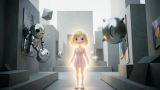
An overpowered hero, a relaxing watch, and a setting that reaches outside the universe: I went down the Wild Last Boss rabbit hole (games, the goddess, Dina, and how far the story has come)
Heads-up: this contains big spoilers from the late novel.
"Wild Last Boss Appeared!" (Yasei no Last Boss ga Arawareta!) starts out as a very easy, relaxing watch.
Rufus is strong.
Pretty much always strong.
Actually, way too strong.
When a fight starts, you're not clenching your stomach wondering "is the hero going to die here?" You're just wondering "how much power will she use to wrap this up today?"
It's a power fantasy, so my brain gets to relax.
But dig into the lore even a little, and suddenly your brain can't rest at all.
Who is Dina, really?
Why does this other world look exactly like a game?
Is the person inside Rufus really a Japanese player?
Who is Alovenus?
And what kind of world made that goddess?
Before you know it, you've gone all the way outside the universe.
The part of your brain that used to handle the fights is off duty, so all the work has landed on the part that handles lore.
1. "Just punch it and win" keeps things light, but the real story slowly becomes a problem you can't punch
The strength of a power-fantasy story is simple.
Fights are low-stress.
An enemy shows up.
Rufus is strong.
You feel safe.
Sure, a few opponents come close to her level, but the basic pleasure of the whole series is "the overwhelmingly strong one is back on the board."
Because you feel safe, you can spend your attention on things other than who wins.
"Wait, isn't that line a bit off?"
"How does this person know that?"
"Is the identity that was just revealed really the final answer?"
You start asking questions like these.
In other words, the series lowers your mental load in fights by giving you a strong hero, then fills the freed-up space with a lore mystery.
It budgets your brain really well.
2. Rufus's "something's off" radar is far too good, and Dina rigs things so that it goes off
The classic example is "photographs."
There's no concept of photographs in this world.
Libra doesn't know what they are.
Aries doesn't either.
Yet from day one, Dina understood the word "photograph" without any trouble.
Later, Rufus goes back and picks up on that tiny slip, and becomes certain: "this person doesn't make sense as a resident of this world." [1]
That's scarier than any fighting power.
Rufus's stats:
Combat: maxed out
Spotting inconsistencies: maxed out
"Doesn't that line clash with how this world works?": maxed out
But once you know the later story, this gets even more fun.
Dina didn't just make a careless slip.
Looking at the long-term plan revealed in chapter 159 of the novel, she was also deliberately steering Rufus to feel uneasy about the goddess and to work her way toward the truth herself. [2]
So it goes like this:
Rufus: "Something's wrong here."
Dina: "Yes, that's exactly what I wanted you to notice."
It's a game of a radar for oddities versus oddities planted on purpose.
3. It isn't that "the other world became a game." The game was a copy of a real other world
Here's how you understand it early on.
On Earth, there's a game called Exgate Online.
You've arrived in an other world that looks just like that game world.
So the natural reading is:
Game
↓
Becomes an other world
But in the later story, this flips.
The real Midgard exists first.
Dina knew that real world, set up a game on the Earth side, and recreated Midgard's people, history, and systems in it. [2]
So the structure is:
A real other world
↓
Copied as a game on Earth
↓
The people who played that game return to the original it was based on
It isn't "the game became real."
Reality was turned into a game-shaped textbook.
This reversal alone changes the meaning of all the game knowledge from the early episodes.
Rufus knowing the strategy info isn't "she knows the other world because it's a game." Looking back, it's closer to "she'd been studying with materials modeled on the other world."
4. Dina's goal shifts from "the goddess's avatar" to "the strategist who brings Rufus back across 200 years"
Dina wasn't fully on Rufus's side from the start.
At the beginning, she's an avatar of Alovenus.
She holds part of the goddess's soul, her memories, and her personality, and she basically thought of herself as the goddess. [2]
But through her time with Rufus and the people around her, feelings of her own grow.
Then in chapter 159 of the novel, she realizes something decisive.
I'm not Alovenus.
These feelings don't belong to the goddess.
I'm Dina.
This is the moment a being that was the goddess's terminal becomes a person in her own right. [2]
What she does from there is wild.
She protects Rufus from the goddess.
She connects things across 200 years.
She even uses the Earth side.
She passes knowledge along through a game.
She infiltrates the demon-god side too.
She doesn't let humanity be wiped out completely either.
She leaves a board set up so that when Rufus returns in the future, she can challenge the goddess again.
Calling her a strategist undersells it: she's the project manager of a 200-year project.
With memory manipulation and perception manipulation on top.
That's just overpowered.
5. Even "a former Japanese player" isn't the final answer: the hero's own sense of self is part of the trick
Early on, you assume the person inside Rufus is a Japanese male player.
She thinks so too.
In episode 51, she guesses that she's "a foreign element covering the original Rufus," and decides to go after the "original Rufus" in order to strike back at the goddess. [3]
That's already plenty entertaining.
But it gets turned over again later.
The "me" who grew up on Earth wasn't a totally unrelated Japanese person who happened to be picked, either.
Rufus's side of the plan and Dina's long-term maneuvering were tied into that very sense of self.
So the explanation
"a Japanese person entered Rufus"
isn't a complete lie.
But it's not the whole picture.
This series does that over and over.
It never throws out the first explanation.
It adds a wider one behind it.
So rather than feeling like retcons, the earlier explanations turn into "partial truths."
6. You think Alovenus is at the top, but she has a past too, and in the end it goes outside the universe
Alovenus is the creator goddess of Midgard.
She made the world, made the rules of the board, and interferes with the scenario.
You think, "Okay, this is the top."
It doesn't end there.
In the late novel, it's revealed that Alovenus also had a world she came from, and because creating life from scratch was hard, she moved living things from there into Midgard. [4]
In other words, above Midgard sits Alovenus's own past.
The story then heads to the "Ultimate Point."
The outside of the universe.
A place connected to every world and every timeline.
The novel explains it by comparing the universe to software on a computer and parallel worlds to multiple save files. [4]
Beginning:
"Reincarnated as a game character and overpowered"
Ending:
"Dealing with a creator god's origins and a multiverse from outside the universe"
How far is this going to go?
That said, it doesn't keep stacking "the god who made that god" forever. In the end it steps out to a place that binds all worlds together, which gives the story a proper ceiling.
7. Why this lore feels so good: not "what I was told before was a lie" but "correct, yet incomplete"
Layered settings can easily turn into one retcon after another if you're not careful.
"Actually, it was different."
"That was a lie too."
"And there's an even truer setting."
If it were only that, anything would go.
What makes Wild Last Boss fun is that, to a large extent,
the earlier explanation also made sense at the time.
Dina was a strategist.
But that's not all.
She was a test player.
But that's not all.
Rufus lived as a Japanese player.
But that's not all.
Alovenus is the creator god.
But she has an origin too.
The game looks just like Midgard.
Not because it ended up looking alike, but because it was made to look alike.
Instead of peeling off a layer and invalidating the earlier information, it wraps the earlier information inside and widens what it explains.
That feels great.
8. The novel is finished, but the anime is still pretty early on: real-world time is the final boss
The web novel is complete.
According to the official work information, it has 201 episodes in total, with the last update on April 15, 2019. [5]
The anime's first season, meanwhile, is 12 episodes.
Official episode 12 gets as far as around Parthenos and Vanaheim. [6]
In the web novel, around episode 51 is the turning point where Rufus doubts the goddess's scenario and makes her goal of chasing the original Rufus clear. [3]
Going purely by the ratio to roughly 190 main-story episodes, the end of season 1 is a little over a quarter.
Of course, anime episodes and web novel episodes don't match one to one, so this isn't an exact adaptation rate.
Still, the feeling is:
"So much has happened and we're still in the early part."
And as of September 29, 2026, season 2 has already begun early streaming on ABEMA and U-NEXT from September 26. Broadcast on regular TV is scheduled to start on October 3. [7][8]
So the anime has only just entered season 2.
The novel was all finished back in 2019.
The anime moves slowly in real time.
9. How far will season 2 go? The Benetnash fight is visible in the official material, but the final stopping point hasn't been announced
What's confirmed about season 2 is that the official PV and key visual present a new battle, with the clash against Benetnash front and center. [7]
So we know it will go well past season 1.
However, as of September 29, 2026, it hasn't been officially announced which novel episode the season 2 finale will reach.
This part matters.
You can estimate "it'll probably go up to this fight, so about X percent of the novel."
But it isn't confirmed.
As a rough conversational guide, if it reaches a major break around the Benetnash arc, it gets fairly close to around half of the main novel.
That's still not an official adaptation rate.
Conclusion:
Even after season 2, there will likely be a lot left before the late-game zone of Dina's truth, Alovenus, and the outside of the universe.
If you want to follow the story to the end with the anime alone, your toughest enemy may be the number of years it takes to produce, more than Alovenus.
10. The manga is well ahead of the anime: chapter 60 part 2 as of September 2026
The manga version, "Kokuyoku no Haō" (the Black-Winged Overlord), is serialized on Comic Earth Star.
The latest release confirmed on the official page is chapter 60, part 2. [9]
The top page of Comic Earth Star shows the next update as October 15, 2026. [10]
The official site confirms up to volume 11 of the collected volumes. [11]
The manga is far ahead of the anime.
There's a caveat, though.
The publisher doesn't give any "what percent of the original" conversion.
A manga chapter and a web novel episode differ in length, and the manga also restructures things.
So a figure like "the manga is exactly 80% through" isn't an official number, just a rough estimate from story position.
Even so, the choices are easy to see:
Want to know the ending right now
→ the original web novel or the novels
Want to get a long way ahead with pictures
→ the manga
Want to relax and enjoy motion, voices, and facial expressions
→ the anime
Time flows differently in each medium.
11. Conclusion: it lets the combat part of your brain rest, but never the lore part
I really like the balance of this series.
Rufus is strong.
So the fights are relaxing.
You don't get the kind of fatigue that comes from "the hero might die every time."
In exchange, the lore keeps hitting you from the side forever:
Who is Dina?
How does she know about photographs?
Was that planted too?
The origin is the other world, not the game?
Am I, the Japanese "me," part of the plan too?
Alovenus made the world?
And Alovenus has her own original world?
Outside the universe?
I thought the power fantasy was resting my brain, but a different part of my brain has switched on.
And at the center is a character like Dina: sharp, with an easy-to-read face and feelings that seem real, yet who never shows the information she holds.
No wonder it's so good.
The fights are reassuring.
The characters are cute.
The lore is a matryoshka doll.
And following the anime to the end is a fight against real-world time.
"Wild Last Boss Appeared!" turned out to be a much deeper rabbit hole than I expected.
References (11)
- Web novel chapter 38, Dina's photograph-knowledge reveal ncode.syosetu.com
- Web novel chapter 159, Dina's independence from Alovenus and the long-term plan around Lufas and Exgate Online ncode.syosetu.com
- Web novel chapter 51, Lufas begins pursuing the goddess and the "real Lufas ncode.syosetu.com
- Web novel chapter 185, Alovenus, her origin, Midgard and the "terminal point ncode.syosetu.com
- Web novel information page: complete, 201 episodes, final update 2019-04-15 ncode.syosetu.com
- TV anime official story, episode 12 lastboss-anime.com
- TV anime official season 2 broadcast/streaming announcement lastboss-anime.com
- TV anime official news index, episode 13 synopsis published 2026-09-26 lastboss-anime.com
- Comic Earth Star, manga chapter 60 part 2 comic-earthstar.com
- Comic Earth Star front page, next manga update shown as 2026-10-15 comic-earthstar.com
- Earth Star, manga volume 11 earthstar.co.jp