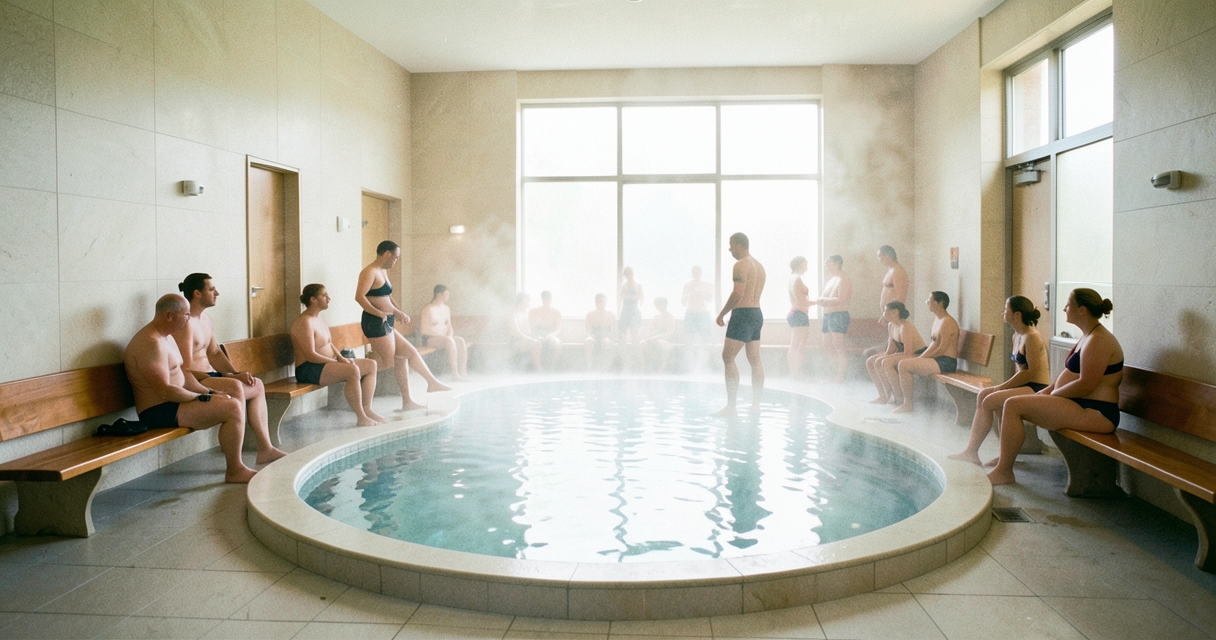
“I go to a public bath, and a couple of days later I catch a cold.”
That pattern feels suspiciously believable. A Japanese sento or spa can combine several things at once: crowds, no masks in the bathing area, indoor changing rooms, outdoor baths in cold air, saunas, and sometimes a cold plunge.
But there probably is not one villain.
The most plausible explanation is a combination of:
exposure to respiratory viruses in a crowded setting + substantial chilling + a one-to-several-day incubation period.
0. Bottom line: colds are infections, but cold exposure may still matter
Most common colds are caused by viruses. Cold air does not manufacture a virus inside your body.
So “I got chilled in the outdoor bath, therefore the cold weather created my cold” is too simple.
However, laboratory research suggests that cooling the nose can weaken some local antiviral defenses. One study found that lower nasal temperatures impaired an extracellular-vesicle-based antiviral response.
In other words:
Cold is not the pathogen, but it may make the local environment more favorable for a pathogen that is already present or has just arrived.
That is a much better model than “cold weather equals cold virus.”
1. Being naked is not why you catch a respiratory cold
A public bath can feel like maximum biological vulnerability: everybody is naked, wet, and standing close together.
But respiratory viruses usually enter through the nose, mouth, and airways, not through ordinary intact skin.
Clothes therefore are not the main shield against a common cold. If you are fully dressed but spend a long time breathing the same indoor air as many people, exposure can still happen.
Being barefoot and sharing wet surfaces is more relevant to some skin and foot infections.
For respiratory illness, the body part you should worry about is not your bare chest. It is the air going into your nose and mouth.
2. The changing room may be more suspicious than the bath
CDC guidance emphasizes that respiratory viruses spread especially well in indoor, crowded spaces, particularly where airflow is poor.
Break a public bath into zones:
- changing room: indoors, people close together
- indoor bath: masks off, prolonged stay
- sauna: small shared space
- lounge: conversation, food, longer stays
- lobby: many people coming and going
- outdoor bath: better outdoor air, but more cold exposure
That means you might blame the outdoor bath because you remember feeling cold there, even though the actual viral exposure happened 30 minutes earlier in the changing room.
When thinking about infection risk, start with people and air, not the water.
3. “It is humid, so viruses must spread more” is too simple
Bathhouses are humid, so it is tempting to imagine viruses surfing through the steam.
Real respiratory-virus transmission is more complicated. Humidity, temperature, ventilation, particle size, and the specific virus all matter. High humidity is not a universal switch that makes respiratory infection explode.
The practical variables are simpler:
How crowded is the room? How much fresh air is moving through it? How close are people? How long are you there?
The steam is visually dramatic. The shared air is usually the more important question.
4. Is “getting chilled after a bath” pure folklore?
Not completely.
A 2005 randomized experiment assigned 180 healthy adults either to have their feet chilled in cold water or to a control condition. Over the following four to five days, 13 of 90 chilled participants reported a cold versus 5 of 90 controls.
That result is interesting, but it does not prove that chilling caused a new viral infection. Some participants may already have been incubating a virus, and the outcome relied on reported symptoms.
So the fair conclusion is:
It is too strong to say chilling causes colds by itself, but it is also too strong to say cold exposure is biologically irrelevant.
Grandma’s “do not get chilled after the bath” was not a virology textbook, but it was not necessarily pure nonsense either.
5. Does a cold plunge “boost immunity”?
Cold plunges and cold showers can strongly affect the nervous and cardiovascular systems. A 2024 systematic review found measurable changes in autonomic activity and blood pressure after cold exposure.
But this equation does not work:
affects the autonomic nervous system = strengthens immunity = prevents colds.
A 2025 systematic review of 11 randomized studies involving 3,177 participants found no clear improvement in immune function immediately or one hour after cold-water immersion. It did find short-term increases in inflammatory markers.
A famous trial of 3,018 adults found 29% fewer sick-leave days among people assigned to finish showers with cold water, but the number of days they actually felt ill did not significantly decrease.
So cold water may change how people feel or function. That is not the same as proving fewer viral infections.
6. Why “two or three days later” feels so convincing
Rhinovirus, one of the most common causes of colds, has a median incubation period of about 1.9 days in a systematic review. Many cases fall roughly within the two-to-four-day range.
That makes a timeline like this entirely plausible:
Sunday: crowded public bath
Monday: nothing
Tuesday: scratchy throat
Wednesday: full runny-nose mode
But timing alone cannot prove where you caught the virus. The source could also have been a train, office, restaurant, family member, concert, or store several days earlier.
Infection-source detective work has too many suspects.
7. Test the pattern with your own data
If you truly think public baths trigger your colds, track every visit instead of only remembering the bad outcomes.
Useful fields:
| Variable | Example |
|---|---|
| Crowd level | quiet / normal / packed |
| Time inside | 60 min, 120 min |
| Sauna | yes / no |
| Cold plunge | yes / no |
| Outdoor bath | yes / no |
| Felt chilled | 0–3 |
| Cold trip home | 0–3 |
| Poor sleep | yes / no |
| Alcohol | yes / no |
| Symptoms 1–4 days later | throat, nose, cough, fever |
After 10–30 visits, compare:
- crowded versus quiet visits
- cold plunge versus no cold plunge
- strong chilling versus no chilling
- winter versus warmer months
The culprit may not be “the cold plunge.” It may be the triple combo of crowding + chilling + poor sleep.
Human memory loves “See? It happened again!” and quietly deletes the ten visits where nothing happened.
Count the denominator.
8. Final answer: public baths are not cold factories, but they are not magic safe zones either
Research does not establish a simple rule that going to a public bath causes a cold.
But several relevant conditions can overlap:
- crowded indoor spaces
- long periods without a mask
- close contact
- strong cooling in an outdoor bath or cold plunge
- a cold trip home afterward
So it is completely plausible to notice illness a few days after some bathhouse visits without the bath itself being the single cause.
Reasonable ways to reduce risk include avoiding peak crowding, not lingering unnecessarily in crowded indoor areas, stopping cold exposure when you are genuinely getting chilled, drying and warming up afterward, washing your hands, and staying away from others if you are already sick.
The public bath is supposed to be the recovery event. Adding a complimentary respiratory infection would be terrible customer service.
References (7)
- CDC. Taking Steps for Cleaner Air for Respiratory Virus Prevention. 2025. https://www.cdc.gov/respiratory-viruses/prevention/air-quality.html
- Huang D, et al. Cold exposure impairs extracellular vesicle swarm-mediated nasal antiviral immunity. J Allergy Clin Immunol. 2023. https://pubmed.ncbi.nlm.nih.gov/36494212/
- Johnson C, Eccles R. Acute cooling of the feet and the onset of common cold symptoms. Fam Pract. 2005. https://pubmed.ncbi.nlm.nih.gov/16286463/
- Cain T, et al. Effects of cold-water immersion on health and wellbeing: A systematic review and meta-analysis. PLOS ONE. 2025. https://journals.plos.org/plosone/article?id=10.1371/journal.pone.0317615
- Buijze GA, et al. The Effect of Cold Showering on Health and Work: A Randomized Controlled Trial. PLOS ONE. 2016. https://journals.plos.org/plosone/article?id=10.1371/journal.pone.0161749
- Lessler J, et al. Incubation periods of acute respiratory viral infections: a systematic review. Lancet Infect Dis. 2009. https://pmc.ncbi.nlm.nih.gov/articles/PMC4327893/
- Jdidi H, et al. The effects of cold exposure on cardiovascular and cardiac autonomic control responses in healthy individuals. J Therm Biol. 2024. https://pubmed.ncbi.nlm.nih.gov/38663342/