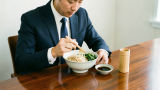
Five-second takeaway: Deep-sea fish turned out to be more than novelty food. Simmered waga had delicate white flesh; fried mehikari went from “crumbly, slightly dry, HOT!” to a lingering wave of savoriness and mild sweetness. Limited maitake mushroom rice was absurdly good too, so the missing tsubodai did not matter for long.
1. A weekday lunch, yet the fish restaurant is packed
Shogetsu in Katahara, Gamagori, was unexpectedly crowded at weekday lunchtime. The restaurant says it uses seafood landed at nearby Katahara and Nishiura ports and serves sashimi, simmered-fish sets, and dishes that change with the catch.[1][2]
In the packed room, eye contact plus a tiny nod worked as an eye-contact command to call a server. Low-bandwidth restaurant communication. Another table was even discussing artificial intelligence, but AI was not the protagonist today. Fish was.
2. The target was tsubodai, but the aquarium had issued a difficult quest
The original target was tsubodai, inspired by Takeshima Aquarium, which is known for deep-sea displays and humorous handwritten staff explanations.[3]
A 2015 feature photographed a tsubodai sign joking that it was roughly “750 times” more shockingly delicious than hokke.[4] That is obviously not scientific data. It is full-power aquarium comedy. Unfortunately, the reader is left with one mission: “If it is that good, I need to eat it.” The aquarium becomes a quest-giver.
Tsubodai was not on Shogetsu’s board that day. The restaurant itself says fish dishes vary with seasons and availability.[1][2] Hunting one species is therefore seat gacha × fish gacha: reserve successfully and the fish may be absent; confirm the fish first and the seats may disappear.
3. Then “waga” appears. Who are you?
The board offered a large line-caught waga simmered-fish set for ¥2,200.
Waga? Almost never seen at ordinary sushi places. The answer is yumekasago, a rockfish relative locally called waga in Gamagori. The city includes yumekasago (waga) among its eight “Gamagori Selected Fish.”[5] The local “Edible Aquarium” tourism project also introduces waga as a fish from deeper waters.[6]
For menu-name surprise alone, that day’s rough ranking was: waga → kuromutsu → mehikari → kinmedai. Not biological rarity, not flavor—just the “what on earth is that?” index.
4. Waga arrives looking aggressively like a whole fish, and maitake rice steals the scene
The waga arrives with head, eyes, fins, and tail.
THIS IS A FISH.
If you rarely eat whole simmered fish, you may unconsciously expect a neat portion. Instead, a complete fish-shaped object arrives. First bite: delicious. Vocabulary deleted. The soft white flesh and simmering sauce work so naturally that the “mysterious deep-sea fish” novelty becomes secondary. Several diners in the same row had ordered it too. Did everyone already know the secret waga meta?
The board also offered limited maitake mushroom rice. It was ridiculously good. Waga, maitake rice, back to waga, back to rice. The deep sea and the mountains formed an alliance. The tsubodai roll failed, but waga + maitake rice was another jackpot.
5. Stomach meter: 40%. Add fried mehikari. Sorry, madam
After the waga and rice, the subjective stomach meter was somehow only about 40 percent. So: fried mehikari, ¥950.
A neighboring diner had mentioned that on a previous visit it felt a little dry. Information received. Understood. Ordered anyway.
Sorry, madam. Fried mehikari, please.
Expectation: bite-size white-fish chunks like chicken karaage. Reality: small whole fish lined up, visually much closer to fried shishamo.
Mehikari is the local name for aomeeso (greeneye). Gamagori City gives a typical length of 15–20 cm, habitat around 200–300 m deep, and says Gamagori accounts for about 95 percent of Aichi Prefecture’s mehikari landings.[7] The bones are soft, so whole-fish frying is a classic preparation.[8]
First fish: good. And yes, a slight dry sensation makes sense—but this is freshly fried, so the inside remains much fluffier than deli food. The sequence is:
crumbly → slightly dry → HOT! → …really good.
Then the second and third fish taste even better. Savory flavor remains after swallowing; the next fish adds fat, salt, toasted aroma, and a subtle sweetness from the flesh. “Good” becomes “very good,” then “Why does this get better the more I eat?”
“Slightly dry in places” and “seriously delicious” can both be true. The neighboring diner is acquitted. Mehikari is acquitted too.
6. Are all deep-sea fish delicious? No. But Gamagori has real winners
Deep-sea fish often suggest bizarre shapes and aquarium curiosities before dinner. In Gamagori, however, mehikari, nigisu, mutsu, kinmedai, waga and other deep-water fish are openly promoted as food.[8][6]
The Gamagori tourism association says all four Aichi offshore bottom-trawl vessels that catch deep-sea fish are based in Gamagori ports and that more than 90 percent of the prefecture’s deep-sea-fish landings occur there.[9]
That does not mean every deep-sea species tastes good; fat, texture and cooking suitability differ by species. But this lunch produced strong results: waga for soft simmered white flesh; mehikari for whole-fried aroma and lingering savoriness; maitake rice for entering the MVP race despite not being a fish. The deep-sea gacha has a suspiciously good expected value.
7. The aquarium becomes a three-dimensional menu—and the “tsubodai-checking lady” appears
Thinking “that looks delicious” at Takeshima Aquarium is oddly compatible with Gamagori’s tourism design. The city’s “Edible Aquarium” concept explicitly connects places to learn about fish, eat them, and buy them.[6]
See it at the aquarium → learn the name → meet it in a restaurant → eat it → return to the aquarium thinking, “Oh, you are the tasty one.”
The aquarium becomes a three-dimensional menu. Terrible news for the fish.
For a serious tsubodai hunt, the practical plan is to secure a visit, check the catch shortly beforehand, and keep strong backups such as waga, mutsu, or mehikari.[1][2] Call too often, however, and a kitchen nickname may spawn: “Did the tsubodai person call today?” Final evolution: the tsubodai-checking lady. You may become the rare local specimen before finding the rare fish.
And if fried mehikari becomes your ideal drinking snack, another boss appears: procurement. It is a local specialty, not a fish guaranteed at equal freshness everywhere. Once you learn a delicious thing, sourcing becomes the next job.
8. Conclusion: the deep sea was an underexplored seafood counter
No tsubodai.
Instead:
unknown waga → whole simmered fish → delicious → absurd maitake rice → 40% stomach → fried mehikari → crumbly/dry/hot → lingering savoriness and sweetness → better with every fish.
Deep-sea fish are not merely “weird animals eaten for the story.” Genuinely delicious fish hide behind unfamiliar names.
Once you learn that, the aquarium changes too.
Not: “What an unusual fish.”
But: “Would that work simmered?”
Terrible for the fish’s dignity. Probably correct for Gamagori.
Sources
- 松月 公式メニュー / Shogetsu official menu gamagori-shogetsu.com
- 松月 公式サイト / Shogetsu official site gamagori-shogetsu.com
- 蒲郡市「こんな水族館です」竹島水族館 city.gamagori.lg.jp
- デイリーポータルZ「まずい魚展に行って旨い魚を食べた」(2015) dailyportalz.jp
- 蒲郡市「蒲郡うまい地魚グルメガイド/がまごおり撰魚」 city.gamagori.lg.jp
- 蒲郡市観光協会「まちじゅう食べる水族館」 gamagori.jp
- 蒲郡市「蒲郡メヒカリ」 / Gamagori City: Mehikari city.gamagori.lg.jp
- 蒲郡市観光協会「魚の美味しいまち、がまごおり」 gamagori.jp
- 蒲郡市観光協会「蒲郡の名産品」 gamagori.jp