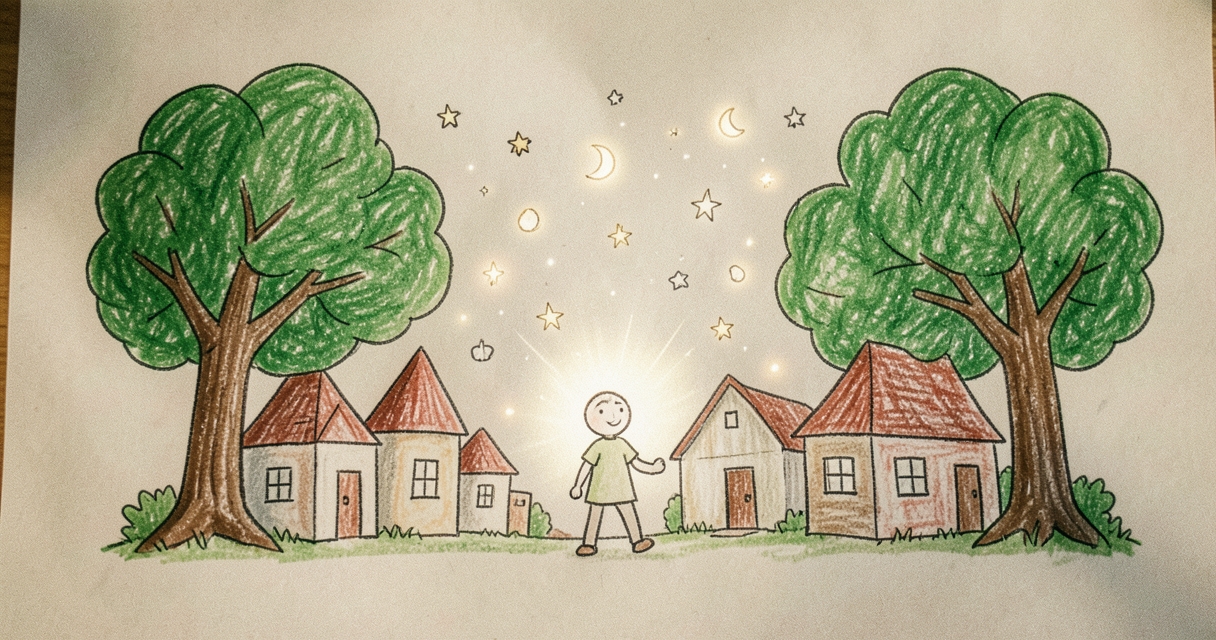
Verso's doodle became a universe: the Paintress, Maelle, disappearing petals, and the wild idea that reality might be another painting.
Full spoilers for both endings. We distinguish story facts, developer sources, interpretations, and explicitly invented comic dialogue. The jokes are not actual game quotes.
01. Throw out one old drawing, end an entire universe
Lumière and the Continent in Clair Obscur: Expedition 33 exist inside a Canvas created by the real Verso as a child. Decades of expeditions and relationships take place inside what an outsider might dismiss as a childhood drawing. [1][2]
For most people, decluttering old drawings is harmless. This one has houses, societies, people who fall in love, and people terrified of death. Outside it is a keepsake; inside it is the only reality anyone has ever known.
Imaginary comments: Verso: "Time to throw away my old sketches." / Esquie: "THAT'S MY HOUSE!" / Citizen: "Don't call the apocalypse 'decluttering'." / Canvas: "Save changes?" / Everyone: "YES! YES! YES!" 🌹
02. Originals, painted doubles, and a fragment of a soul
The real Dessendre family includes Renoir, Aline, Clea, Alicia, and Verso. Real Verso died rescuing Alicia from a fire, which left her badly burned. Maelle is the actual Alicia who entered the painting and acquired a different appearance and life—not an unrelated copy. [1][2]
The adult Verso inside the painting is an independent painted person based on the dead brother. The small boy painting at the end is tied to the real Verso's surviving soul fragment. They should not be confused. Aline is the Paintress, the real Renoir intervenes as the Curator, and Gustave, Lune, Sciel, Esquie and many others live in the painted world.
"How many Renoirs are there?" / "Please distinguish the real father from the painted father." / "I came for boss fights, not a family-tree exam."
03. There is magic OUTSIDE the Canvas too?
Yes. The Dessendres' exterior world is not ordinary historical France. Painters can create worlds in canvases, enter them and alter creations. Chroma is important to sustaining those works. [1][2]
Another faction called the Writers is linked to the fire. The game does not establish how many people have Painter powers, whether anyone can learn them, or whether ready-made universes are sold to ordinary consumers. Other Painters existing is not the same as mass-market world creation.
Child: "I painted an amusement park in art class!" / Parent: "Wonderful!" / Bystander: "That's a worrying amount of divine power for homework."
Combat techniques used by expeditioners inside the Canvas should also be distinguished from the Painters' ability to edit the world itself.
04. Who painted Esquie? Adults renovated a child's playground
Esquie and the Gestrals are associated with the real Verso's childhood imagination. Aline later entered the Canvas and added Lumière, its inhabitants and versions of her family. Renoir and Clea also interfered for their own reasons. [1][2]
So neither "Aline created everything from scratch" nor "the child Verso drew every single rock" is right. His playground became a collaborative, contested artwork overwritten by adult grief. We do not know the author of every detail.
The official December 2025 update Verso's Drafts evokes childhood with flower fields, a giant toy box and a Gestral fairground. [3][4]
Verso: "My secret playground!" / Mom: "I built a city." / Dad: "We should discuss demolition." / Citizens: "HOLD A PUBLIC HEARING FIRST!"
05. Faceless figures, Alicia's burns, and Gustave's familiar face
The giant Paintress is Aline; the Curator is connected to real Renoir. Both can appear faceless or distorted, but human appearances also occur. There is no confirmed universal rule that every outside visitor must become faceless. Magical strain as the reason remains an interpretation. Alicia's scars are from the real fire, while Maelle's different appearance comes from being remade inside the Canvas. [1][2]
Gustave looking like Renoir does not establish a blood relation or that he is young Renoir. There is, however, a production connection: Maxence Cazorla performed the motion work for Gustave, Verso and Renoir, deliberately differentiating their body language despite similar facial models. [5]
06. Numbers and petals: beat the boss, disable world protection
The expeditioners initially believe the Paintress writes numbers and causes the deadly annual Gommage. The revelation reverses it: real Renoir drives the erasures while Aline tries to hold them back. The number is not simply Mom announcing whom she will kill. [1][2]
People dissolve into beautiful flowerlike petals, a lovely effect hiding something horrifying. Defeating the supposed villain removes a force protecting the world. We should not invent a definitive official chart for every petal color.
Expedition: "Boss defeated!" / World: "Protection service discontinued." / Citizen: "WHAT?" / Petals: "🌹🌹🌹" / Everyone: "WHERE IS THE MANUAL?"
07. Verso's ending: the family heals, the world dies
The boy's soul fragment keeps painting and sustaining the Canvas. Painted adult Verso wants to release him and clashes with Maelle. Choose Verso and Maelle returns to reality; the boy stops painting; the Canvas and all its residents disappear. [1][2]
The Dessendres can begin to face Verso's death and move forward. But for Lune, Sciel and Esquie this is the end of their entire universe. A hopeful family epilogue and the destruction of countless lived experiences happen at the same time.
Family: "We can finally move on." / Esquie: "Wonderful! What about me?" / World: "Save file deleted." / Esquie: "WHEE—WAIT, NOOOO!"
08. Maelle's ending: everyone is back, but at whose expense?
Choose Maelle and the Canvas survives. Gustave and other dead people are repainted. It looks like the happiest ending, but adult Verso's wish to be released is overruled, the child continues painting, and Maelle shows signs of deterioration from spending too long inside. [1][2]
Her friends and memories are real to her; calling her a villain who simply runs away from reality ignores that. Yet love does not grant permission to disregard somebody else's wish to stop. The creators intended the two endings to be understood together, not as one officially correct choice. [6][7]
Maelle: "Everyone's back!" / Citizens: "Our savior!" / Verso: "Does my opinion count?" / Ending: "Everyone-wins button unavailable."
09. Why not put the painting safely in a cupboard?
Take the family outside. Store the artwork. Let Esquie live. Simple, right?
But the Canvas is sustained by the remaining piece of the boy's soul, and he wants to stop painting. Framing the picture does not automatically free him. [1][2]
Could another Painter maintain it? Could his soul leave while the world remained? Could its inhabitants move to another Canvas? The game does not establish these as workable solutions, but neither does it strictly prove every conceivable alternative impossible. There is no playable third ending.
Does ownership of a canvas imply the moral right to delete living people who think, love and fear? Aline's grief, Verso's autonomy, Maelle's choices and the residents' future all count.
Artist: "It's my old drawing." / Citizens: "It has a resident population now." / Artist: "My doodle needs a demolition permit?!"
10. What if THEIR reality is also somebody's painting?
Speculation, not canon: suppose the Dessendres' supposedly real world is a Canvas inside an even larger Canvas. The people deciding whether to delete a world suddenly face deletion themselves.
Outer Painter: "Time to clear my old sketchbook." / Renoir: "No! My family lives here!" / Outer Painter: "There were families in your painting too." / Everyone: "NOOOO!" 🎨
This resembles the simulation argument. Philosopher Nick Bostrom's 2003 paper sets out three alternatives: civilizations never advance enough; they advance but rarely create ancestor simulations; or we very probably live in a simulation. That does not prove the third option. [8] In 2016 Elon Musk used advances in video games to argue that the chance we inhabit base reality might be one in billions. This is not a measured probability. [9]
No confirmed game lore says the Dessendres' exterior reality is painted. It is a thought experiment, but a powerful reversal:
Verso: "I'm the creator. I can delete it." / Higher creator: "Agreed. I'll delete your world." / Verso: "But I'M ALIVE!" / Esquie: "THAT'S WHAT I SAID!"
It is no longer merely a childhood picture too good to throw away. It has become a world full of lives that cannot be settled by the artist's ownership alone.
References (9)
- GamesRadar+, "Clair Obscur: Expedition 33 endings and story explained," 2025 gamesradar.com
- Destructoid, "Clair Obscur: Expedition 33 ending, explained," 2025 destructoid.com
- Sandfall Interactive creative director Guillaume Broche, "New Clair Obscur: Expedition 33 content available today, including Verso’s Drafts level," PlayStation Blog, 2025-12-11 blog.playstation.com
- Xbox Wire, Sandfall Interactive’s December 2025 content update and Verso's Drafts details, 2025-12-11 news.xbox.com
- Il Fatto Quotidiano, interview with performance-capture actor Maxence Cazorla, 2025-12-29 ilfattoquotidiano.it
- PC Gamer, interview with director Guillaume Broche about both endings, 2025 pcgamer.com
- Game File, interview with lead writer Jennifer Svedberg-Yen discussing the two endings, 2026 gamefile.news
- Nick Bostrom, "Are You Living in a Computer Simulation?", The Philosophical Quarterly 53(211), 243–255, 2003. ; DOI: 10.1111/1467-9213.00309 simulation-argument.com
- TechCrunch, reporting Elon Musk's 2016 Code Conference "base reality" comment, 2016-06-24 techcrunch.com