I kept hearing “shaved ice,” walked back to the shop I had ignored in the morning, and nearly ended up feeding Shirokuma to a polar bear
While walking around Kagoshima, I heard one nearby table say “shaved ice.”
Then another table said “shaved ice” too.
A person I had met recently had also mentioned shaved ice when talking about Kagoshima.
At that point, the mental search engine finally kicked in.
“Kagoshima… shaved ice… oh. Shirokuma.”
The answer was one of Kagoshima’s most famous desserts.
The funny part was that I had already walked past Tenmonkan Mujyaki, a shop strongly associated with Shirokuma, earlier that morning.
I completely ignored it.
The reason was simple: it was around 9 a.m.
As of October 4, 2026, the Tenmonkan main shop opens at 11 a.m. Walking past at 9 and seeing little activity was completely normal.[1]
Travel is full of moments where a meaningless detail from a few hours earlier suddenly becomes foreshadowing.
1. What exactly is Kagoshima Shirokuma?
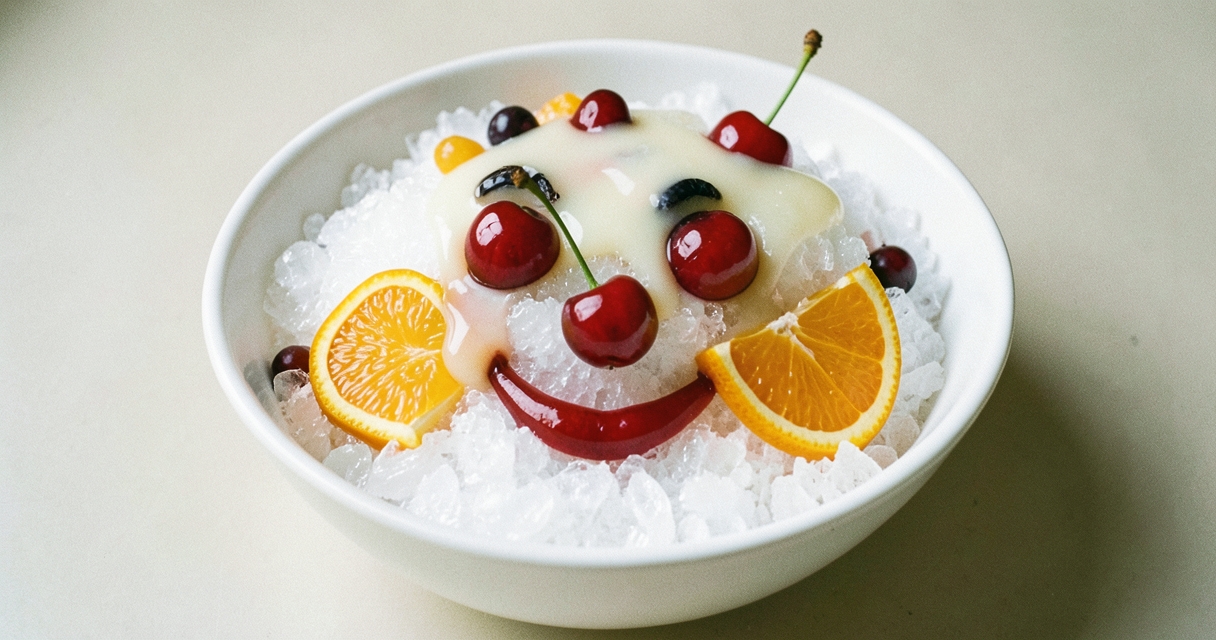
Shirokuma is Kagoshima-style shaved ice topped with a milky syrup, fruit and beans.
Tenmonkan Mujyaki describes its version as finely shaved ice with house-made milk syrup and toppings such as mandarin orange, peach, raisins, cherries and beans.[2]
The first reaction for many visitors from elsewhere in Japan is probably:
“This looks exactly like the Shirokuma ice dessert from the supermarket.”
It really does.
But the chronology is roughly the opposite of how many people discover it.
Kagoshima’s local shaved-ice culture came first, and packaged cups and bars followed later.
Seika Foods says it began factory production around the late 1960s to early 1970s, while Marunaga says it launched a Shirokuma product in 1972.[3][4]
So:
Local Shirokuma first. Freezer aisle Shirokuma later.
The order in which we personally discover something is not the same as historical order.
2. From above, the fruit makes a smiling face. Honestly, it looks a little more like a clown than a polar bear
Tenmonkan Mujyaki says its own Shirokuma was developed in 1947 and went on sale in 1949.
It also says the name came from the way the cherry, angelica and raisins on the early version looked like a polar bear’s face when viewed from above.[2]
And when you actually look down at it, the fruit does form something like eyes and a mouth.
It is definitely a face.
My immediate reaction, though, was:
“Polar bear? This is kind of a smiling clown.”
The red cherry and colorful fruit make the face look oddly cheerful.
Learning the origin story first makes the visual even funnier: “Ah, I see the polar bear… wait, is that a clown?”
Most importantly, it tastes good.
The sweet milk works well with the cold ice, and the fruit adds enough acidity to keep it from becoming one-note.
The face may lean clown, but the flavor wins.
3. The “original Shirokuma” story is too complicated for one absolute sentence
The history is not perfectly simple.
Tenmonkan Mujyaki says its version was created in 1947 and sold from 1949.[2]
Seika Foods, however, presents another account: a cotton shop in Kagoshima may have served condensed-milk shaved ice around 1932–1933 as a summer side business.[3]
Japan’s Ministry of Agriculture, Forestry and Fisheries summarizes the dish more cautiously, saying it is generally said to have originated at a long-running restaurant founded in the Showa 20s.[5]
So the safer wording is:
“Mujyaki’s version was developed in 1947 and sold from 1949; broader Shirokuma origin stories vary.”
Tourism words like “original” sometimes come with surprisingly long footnotes.
That footnote is part of the fun.
4. Walking past at 9 a.m. was not a failure of observation
When you return later, the shop has enough polar-bear imagery that you wonder how anyone could miss it.
Mujyaki’s own site says the entrance has both a large polar bear model and a taxidermy polar bear.[6]
In other words:
polar bear, polar bear, and more polar bear.
So the thought “I would have noticed this if it had been out” was perfectly reasonable.
Pass at 9. Shop opens at 11. Hear people talking about shaved ice around lunch. Remember Shirokuma. Walk back to the place you passed in the morning.
It feels like a game where a locked door from the opening section becomes the afternoon quest marker.
5. Why did the words “shaved ice” suddenly seem to be everywhere?
At first, it was just background conversation.
One table: “shaved ice.” Another table: “shaved ice.”
But once “maybe they mean Shirokuma” entered my head, the same words became impossible to ignore.
Humans are good at noticing information once it becomes meaningful.
Learn a place name and suddenly you see it on every sign. Learn one local food and suddenly everyone seems to be ordering it. Learn one dialect phrase and your ears start catching it.
The city did not suddenly change.
The search filter in my own head changed.
This time the keyword was “shaved ice.”
Selective hearing can be surprisingly useful on vacation.
6. After lunch and about 15 km on foot, “Baby size + chair” is a strong combination
As of October 4, 2026, the standard Shirokuma at Mujyaki is ¥950 for Regular and ¥700 for Baby.[7]
The shop describes the sizes roughly as:
- Regular: 1–2 servings
- Baby: about 1 serving
On this day, lunch had already been substantial and the walking distance was around 15 km.
At that point, your feet are no longer asking for “the next attraction.”
They are asking for a chair.
That is where the Baby size makes sense.
You still get the famous local dessert. It is cold. It is sweet. You can sit down. It is lighter than the Regular.
It becomes less of a dessert stop and more of a resupply station.
Finding out that you can sit down and eat inside, rather than only take it away, matters a lot after that much walking.
During busy periods, guests are seated in arrival order and table reservations are generally not accepted.[9]
7. The queue completed the mystery of all those “shaved ice” conversations
When I returned, there was a line.
That tied together every clue from the morning.
Nearby tables: “shaved ice.” A recent acquaintance: “shaved ice in Kagoshima.” I wanted to visit at least one famous place. Back at the shop: queue.
Yes. Everyone apparently meant Shirokuma.
The main store also sells portable Handy Shirokuma and take-home products.[6][8]
But after 15 km, “eat while walking” stops sounding convenient.
It starts sounding like an extra mission.
What matters is the chair.
8. Travel stereotypes are funny as jokes and terrible as statistics
At one point, a nearby couple had an unusually short exchange.
The husband-like voice went:
“Huh?” “Water.”
Almost command-line communication.
A traveler can easily see one scene like that and think, “That fits my image of Kyushu perfectly.”
But one couple is not regional data.
Sample size: one.
What is actually interesting is the traveler’s own brain. Moments that match an existing image are easier to remember.
So the fair joke is:
“Observed one ultra-short-command husband in the wild.”
That is a travel anecdote, not sociology.
9. The final scene: trying to feed Shirokuma to a polar bear
Then comes the entrance.
There is a polar bear taxidermy display.
There is Shirokuma shaved ice in your hand.
And then the bad idea arrives naturally:
try to feed Shirokuma to the polar bear.
A visitor came to “eat Shirokuma” and ended up trying to make a polar bear “eat Shirokuma.”
The sentence has too many bears.
And because Mujyaki officially says the entrance has both a model and a taxidermy specimen, this is not a dessert-induced hallucination.[6]
An article that began as “What is Kagoshima’s famous shaved ice?” somehow ends with a near-cannibal visual gag.
Years later, the strongest memory may not be the milk or the fruit.
It may be:
“Right. I tried to feed Shirokuma to the stuffed polar bear.”
Conclusion: the supermarket gives you the flavor; Kagoshima gives you the whole story
If you already know packaged Shirokuma, the local dessert may look strangely familiar.
“I know this.”
But eating it in Kagoshima adds the context.
You walk past the shop before opening. Later, you keep hearing “shaved ice.” You realize what everyone means. You return to the famous shop. You queue. You order Baby. From above, the fruit makes a smiling face. It looks a little more clown than polar bear. But it tastes good. You sit down and rest your legs. You notice the polar bear taxidermy. You consider feeding Shirokuma to Shirokuma.
A supermarket can sell the dessert. The destination adds the story.
That story is often the real reason local food becomes more memorable when you eat it where it comes from.
References (9)
- https://mujyaki.co.jp/business-information/ mujyaki.co.jp
- https://mujyaki.co.jp/about/ mujyaki.co.jp
- https://www.seikafoods.jp/shirokuma/ seikafoods.jp
- https://www.marunaga.com/product/shirokuma/ marunaga.com
- https://www.maff.go.jp/j/keikaku/syokubunka/k_ryouri/search_menu/menu/shirokuma_kagoshima.html maff.go.jp
- https://mujyaki.co.jp/honten1f/ mujyaki.co.jp
- https://mujyaki.co.jp/menu/ mujyaki.co.jp
- https://mujyaki.co.jp/menuguide/ mujyaki.co.jp
- https://mujyaki.co.jp/mujyaki-information/ mujyaki.co.jp