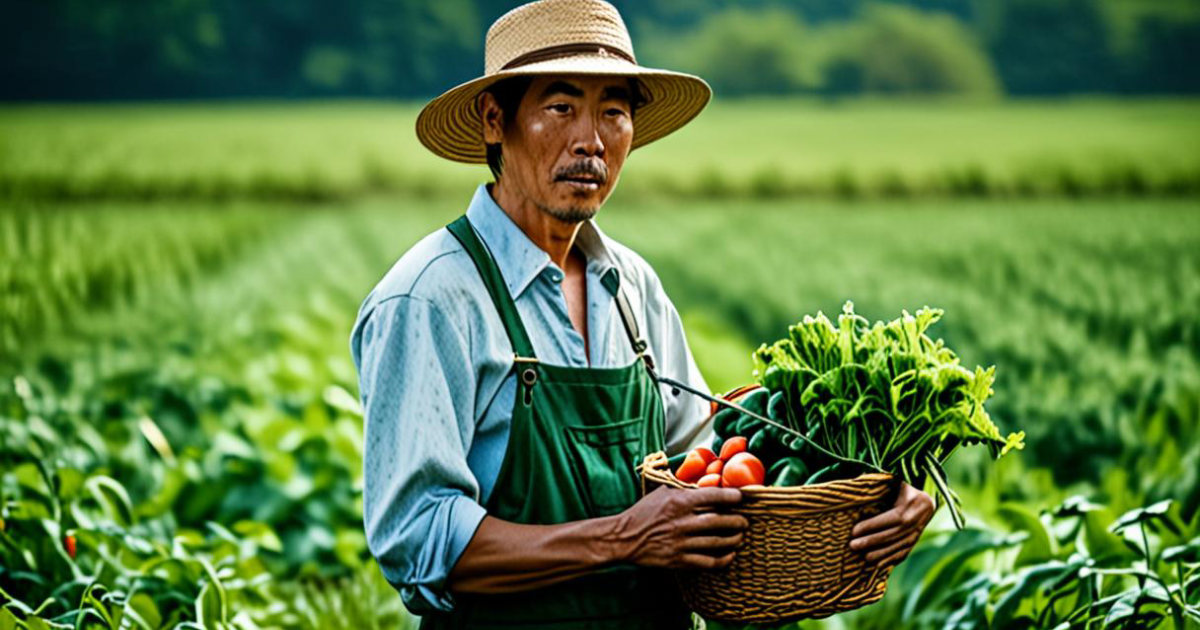
A headline says ¥20 million a year is no rarity for mandarin growers. Japan's 2024 fruit-farm statistics paint a more complicated picture: ¥8.47 million in gross farm receipts but only ¥2.361 million in farm income per operation. Before trading the office for an orchard, check where the money goes.
0. Mandarin trees do not actually grow banknotes
“¥20 million a year is common!” makes a hillside orchard look like a money-printing machine. Then the machine invoices arrive, followed by harvest crews, fuel, boxes and freight. Suddenly the banknotes are made of receipts.
The first question is what “income” means: gross sales, farm income after operating costs, income shared across a family, or one person's after-tax cash? And “common” requires a distribution: how many farmers earn that amount out of how many?
1. The national 2024 figures: ¥8.47m in, ¥6.11m out
For fruit-growing farm operations across Japan in 2024, per operation, the agriculture ministry reports [1]:
| Annual measure | Amount |
|---|---|
| Gross agricultural receipts, including certain payments | ¥8.470 million |
| Operating expenses | ¥6.109 million |
| Agricultural income | ¥2.361 million |
| Income relative to receipts | 27.9% |
About 72% went to operating costs. This is not a salary survey of full-time mandarin growers. It includes different fruits and farm sizes, including part-time operations. The ¥4.942m income average for agriculture-as-main-business operations across all products concerns a different population [2].
2. The machinery is expensive; the oranges still won't walk downhill
Within the typical fruit-farm cost structure, packing, freight and selling fees came to ¥1.355m; wages for hired workers ¥871,000; crop-protection costs ¥563,000; repairs ¥329,000 [1]. Fertilizer, fuel and investments add to the bill.
Some citrus terraces are so steep that small trucks cannot enter. The ministry notes that pruning, thinning and harvesting remain labor-intensive [3]. Sadly, the mandarins have not received the software update that lets them march downhill and board the delivery truck.
3. Land, depreciation and the missing cash
Renting land creates regular rent; purchasing it consumes capital, but the purchase price is not simply an annual operating expense. Long-lived machinery and greenhouses are usually deducted over their useful lives through depreciation [9].
That creates a crucial difference between accounting income and cash flow. Depreciation is already included in the cost figures, while repayment of equipment-loan principal is generally not an operating expense. Replacement machinery also needs funding. Do not subtract depreciation twice; do not assume the reported profit is sitting in the bank.
4. The whole family's effort is hiding behind one farm-income number
A family-run orchard may depend on spouses, parents and grown children working long hours. Some unpaid family labor will not appear as hired wages. Thus ¥2.361m per farm does not equal ¥2.361m salary per worker.
For a fair comparison with employment, find the number of workers, the family's total hours, seasonal labor costs and time off. Mandarins do not put their ripening on hold for a public holiday.
5. How much is actually left after taxes and insurance?
Agricultural income is before personal taxes and social-insurance contributions. The standard Japanese national pension premium for fiscal 2026 is ¥17,920 a month, or ¥215,040 per year [8]. Health-insurance premiums and taxes depend on household composition, municipality and deductions.
Take an imaginary single self-employed farmer earning ¥2.361m in farm income. Deduct around ¥215,000 in pension payments, assume ¥300,000 in health insurance and assume ¥196,000 in personal taxes. The remainder is roughly ¥1.65m per year, or ¥138,000 a month.
This is only an arithmetic illustration. The assumed insurance and tax amounts are not measured national averages or a personalized tax calculation. A different farm or household could have a very different result. Loan principal and equipment replacement still need separate cash-flow analysis [9,10].
6. Premium mandarins: don't divide one variety's sales target into an annual salary
Premium Japanese citrus is a real market. In 2025, one agricultural cooperative announced a ¥370m sales target for the Kitahara Wase early mandarin variety, involving 246 producers, about 47 hectares and 830 tonnes [7].
¥370m divided by 246 is about ¥1.5m per producer, but this is merely one variety's planned gross sales divided equally. Individual farm sizes and other crops differ. It is neither annual total revenue nor personal profit and cannot disprove the headline.
A farm selling ¥20m with a 70% cost ratio retains ¥6m in farm income. A farm earning ¥20m in income would be a radically different business. The definition comes first.
7. Premium strawberries have premium bills
Researchers used 2024 bookkeeping data from 348 strawberry-only growers, together with national yield and wholesale-price figures, to estimate a 10-are (1,000m²) model [4]. The result: ¥4.993m in sales, ¥3.083m in production costs, and ¥1.910m difference.
Packing, freight and fees accounted for ¥812,000; materials ¥467,000; energy ¥428,000; depreciation ¥417,000; hired labor ¥391,000. The ¥1.91m is a model difference per 10 ares, not a farmer's annual take-home salary. A premium price doesn't persuade the greenhouse heater to work for free.
8. Pick-your-own strawberries: the visitors harvest; the owner still runs a business
A historical Shizuoka model based on 2008–2010 conditions, with two hypothetical 20-are operations, found the following [5]:
| Scenario | Wholesale/market | Pick-your-own |
|---|---|---|
| Annual sales | ¥9.93m | ¥11.06m |
| Expenses | ¥5.90m | ¥4.83m |
| Farm income | ¥4.03m | ¥6.23m |
| Total labor hours | 3,085 | 2,463 |
The tourism case assumed 7,000 visitors paying ¥1,220 each, plus suitable local conditions. It is not today's national average. Visitors doing the picking can reduce some harvest and packing work, but someone must handle bookings, restrooms, parking and exactly enough ripe berries.
“All you can eat” refers to the customer offer, not unlimited farmer profit.
9. High-income orchards exist. Nine questions separate success from clickbait.
A distinct 2025 sample of 3,677 fruit-farm bookkeeping-software users reported average household agricultural income of around ¥5.50m, including specified family wages. The figures were about ¥5.48m for citrus, ¥6.99m for Japanese pears, ¥8.45m for Japanese plums (ume) and ¥5.77m for apples [6]. This is not a random sample of every farm, and its year, population and income definition differ from the 2024 national figure.
Before choosing farming, ask: (1) revenue or income? (2) how many workers and hours? (3) land and loans? (4) machinery replacement? (5) packing and transport? (6) bad-harvest liquidity? (7) buyers for lower-grade fruit? (8) genuine tourist demand and capacity? (9) cash left after personal taxes, insurance, loan payments and reserves?
Fruit may be sweet while the balance sheet is sour. Before buying a tractor over a ¥20m headline, ask what that ¥20m actually measures.
References (10)
- [1] Source 1: https://www.maff.go.jp/j/tokei/kouhyou/noukei/einou/pdf/einou_24.pdf
- [2] Source 2: https://www.maff.go.jp/j/wpaper/w_maff/r7/r7_h/trend/part1/chap3/c3_1_00.html
- [3] Source 3: https://www.maff.go.jp/j/council/seisaku/kazyu/r06_01_kazyubukai/report.html
- [4] Source 4: https://nougyorieki-lab.or.jp/kind/14942/
- [5] Source 5: https://www.pref.shizuoka.jp/_res/projects/default_project/_page_/001/058/833/13-ichigokeieisisann.pdf
- [6] Source 6: https://nougyorieki-lab.or.jp/kind/16003/
- [7] Source 7: https://www.minamickg-fk-ja.or.jp/archives/13843.html
- [8] Source 8: https://www.nenkin.go.jp/service/kokunen/hokenryo/hokenryo.html
- [9] Source 9: https://www.nta.go.jp/taxes/shiraberu/taxanswer/shotoku/2100.htm
- [10] Source 10: https://www.nta.go.jp/taxes/shiraberu/shinkoku/tebiki/2025/03/order2/3-2_01.htm