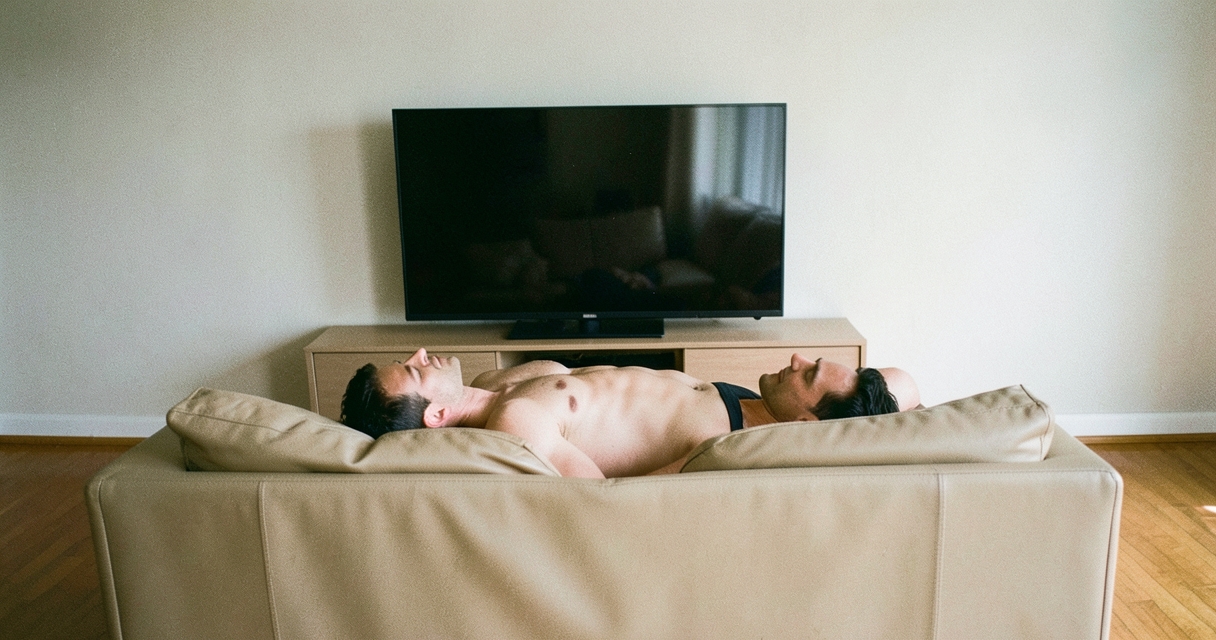
Put the stream on a 50-inch television and the premise immediately looks strange.
A mostly motionless adult man fills the screen: torso, stomach, muscles. He shifts a little. He closes his eyes. To someone walking into the room with no context, the natural reaction is basically: “What are you watching?” It is too human to be an aquarium camera, yet too uneventful to look like ordinary television. In one anonymous real-life viewing scene, a friend who did not know the backstory switched it off almost immediately.
The man on screen, however, was not simply relaxing in front of a camera.
He was Daisuke Hori, head of the Japan Short Sleeper Training Association, who has publicly said that he has lived for years on roughly 30 minutes of sleep a day. On September 9, 2026, at 8 p.m., he began a roughly week-long continuous livestream intended to show that lifestyle in public.[1][2]
The reason the stream became fascinating was larger than the question “Does he really sleep only 30 minutes?”
A sleep-verification project gradually turned into a giant internet field study in which tens of thousands of people watched one adult man for signs of sleep.
Sleep science, experimental design, internet memes, commercial accountability and accidental livestream chaos all ended up on the same screen.
Health note: This article does not recommend extreme sleep restriction. A livestream cannot diagnose Hori’s health, and an individual mistake cannot be attributed to sleep loss without evidence.
1. What actually happened: a week of broadcasting a claimed 17-year routine
Hori leads an organization that publicly offers a sleep-improvement program.[2] He has also said that he has maintained a roughly 30-minute daily sleep schedule for about 17 years.
The September livestream emerged in the context of demands that the claim be demonstrated publicly.
Almost immediately, however, the stream stopped looking like a passive broadcast of an ordinary routine.
- On day two, Hori spent about 27 minutes with his eyes closed during a treatment session and was reported to be snoring. He later described the episode as roughly ten bouts of microsleep. The first day reportedly reached about 30,000 concurrent viewers at one point.[1]
- On day four, during a massage, his face was off camera and the audio was muted for periods totaling close to an hour. Viewers argued over whether he might have slept; staff also displayed an explanation that the camera angle could change because of the venue.[3]
- On September 14, Hori said he would begin using short naps during the remaining period and acknowledged that he had become too fixated on the “30-minute” condition.[4]
- A Reiwa no Tora episode released on September 14 had been recorded before the livestream. In it, Hori had already said that he expected to stop using the “30-minute sleep” label around October. That matters: the statement was not simply a retreat invented after several days of livestream pressure.[5]
- Early on September 15, many viewers reported that part of his lower body was accidentally visible while he was preparing to bathe. That stream became unavailable, while the channel and a later live session remained accessible.[6]
At that point, this was no longer a quiet experiment in watching a sleep schedule.
Something kept happening, and neither the audience nor the subject knew what the next incident would be.
That is unusually powerful live entertainment.
2. The phrase “one-week challenge” is funny when the lifestyle is supposed to be normal
The cleanest joke is linguistic.
If this has been an everyday routine for 17 years, why does one week sound like a “challenge”?
Imagine someone saying, “I have eaten breakfast every day for 17 years,” then announcing a “seven-day breakfast challenge.” The wording itself feels odd.
That is not a logical disproof.
The difficult part may be the continuous public surveillance, not the sleep schedule. Living with cameras, comments and public scrutiny for a week is obviously different from ordinary life.
So “he called it a challenge, therefore he normally does not do it” would be bad reasoning.
But as rhetoric, the contradiction is still hilarious.
To Hori, the sleep pattern is presented as routine. To viewers, the stream can look like an endurance event. The comedy lives in the gap between those two frames.
3. When tens of thousands take shifts watching, even “nothing happening” becomes an event
In an ordinary livestream, inactivity is boring.
Here, inactivity is precisely when the audience starts paying attention.
He stops moving.
His eyes close.
He does not answer.
He leaves the frame.
The sound disappears.
The chat immediately asks: “Was that sleep?”
Reports put the first-day peak at roughly 30,000 concurrent viewers, and the stream continued to attract very large live audiences. Some real-time viewer reports on September 15 described a figure just under 40,000, but concurrent counts constantly change, so “tens of thousands” is the safer description.[1][7]
This creates a ridiculous form of distributed surveillance.
One viewer goes to the bathroom; another keeps watching. One viewer falls asleep; thousands of others remain awake.
The man on screen may be claiming 30 minutes of sleep, but the monitoring system itself is running three shifts, 24 hours a day.
The internet has accidentally overstaffed the inspection department.
There is an important limit, however. A crowd staring at video is not an electroencephalogram. Closed eyes do not by themselves reveal sleep stage, and speculation about off-camera periods is not medical measurement.
Crowds can increase the number of observations. They do not magically increase the precision of the instrument.
4. On a giant television, “sleep verification” becomes “adult-human husbandry cam”
This stream has a special visual problem.
On a phone, it looks like a trending livestream.
On a giant television, the context starts to dissolve.
Now an adult man’s torso and stomach occupy most of the living-room screen. If he is sitting still, the television supplies almost no explanation for why anyone should be looking at him.
“Is this an aquarium seal cam?”
“No, that is a person.”
“Why are you watching him?”
“To see whether he falls asleep.”
The explanation does not really improve the situation.
That is part of the meme power.
Television normally uses narration, captions, editing and camera changes to keep answering one question: “Why should I watch this moment?”
A raw endurance livestream often does not.
Remove one layer of context and the grand experiment suddenly becomes a room full of people conducting communal observation of one adult male specimen.
Sometimes the internet gets funnier not by adding meaning, but by stripping meaning away.
5. The key question is not merely whether someone stays awake, but whether they function normally
If the claim being evaluated is that very short sleep is compatible with normal health and daily performance, then “not being in bed” is not enough.
Attention matters.
Reaction time matters.
Judgment matters.
Work and exercise performance matter.
Emotional regulation matters.
And, of course, the amount and structure of actual sleep matter.
A serious scientific test would need more than a camera: objective sleep measurement, repeated cognitive tasks, reaction-time tests and comparison with well-rested baselines.
For that reason, this livestream alone cannot scientifically prove a 17-year sleep history. It also cannot, by itself, completely disprove that history.
But the stream still contains useful evidence.
The audience was not merely looking for a person who avoided lying in bed. It was looking for a person who could live normally while sleeping only about 30 minutes.
If the spectacle begins to resemble a fight against sleep, the meaning of the experiment changes.
6. Sleep research explains why “I feel fine” is not enough
For healthy adults, the American Academy of Sleep Medicine and the Sleep Research Society recommend seven or more hours of sleep per night on a regular basis.[8]
Natural short sleepers do exist.
Research at the University of California, San Francisco has described familial natural short sleepers who function well on roughly four to six hours a night, with genetic factors under study.[9]
Four to six hours, however, is not the same claim as 30 minutes.
A classic chronic sleep-restriction experiment found that objective neurobehavioral performance worsened cumulatively, while participants’ subjective sense of sleepiness did not deteriorate at the same rate. In plain language: people can become impaired without fully appreciating how impaired they have become.[10]
A 2025 scoping review of sleep deprivation and decision-making likewise found impairment in many of the included studies, with increased risky decisions reported in several contexts, while also emphasizing that results differ by task and individual.[11]
The safe conclusion is general:
A person saying “I’m fine” does not prove that their performance is unchanged.
It would still be inappropriate to look at Hori’s expression, anger, mistakes or speech and diagnose each one as a symptom of sleep deprivation.
7. The bathing accident is not, by itself, proof that sleep loss caused impaired judgment
Early on September 15, reports spread that part of Hori’s lower body had appeared on camera during a bathing sequence. The livestream disappeared shortly afterward, while later streaming activity continued.[6]
The obvious internet reaction was to ask whether reduced attention or grogginess had contributed.
Sleep loss can affect attention and decision-making in general.[11]
But one extra causal step would be unjustified.
“The broadcasting mistake happened” and “sleep deprivation caused the broadcasting mistake” are two different claims.
Well-rested streamers can also forget cameras, clothing or settings.
The accident feels narratively perfect only because it occurred inside a stream whose central argument involved sleep and alertness.
That is irony, not a medical diagnosis.
There is also no reason to redistribute the explicit footage itself. Describing the incident is sufficient; copying someone’s accidental nudity adds nothing to the analysis.
8. If someone says “the internet is not fun anymore,” this is the counterexample
One reason the modern internet can feel dull is that online content has become extremely competent.
Hooks are optimized.
Climaxes are planned.
Statements are engineered for clips.
Even outrage can feel formatted in advance.
This week-long stream works in the opposite direction.
Nobody has the full script.
Hori does not know exactly what the next hour will contain. The viewers do not know whether they are about to watch nothing happen for forty minutes or see another argument, nap, disappearance from frame or technical mistake.
That uncertainty turns ordinary moments into plot.
The internet stops being merely a place where finished “content” is consumed and becomes a place where an event happens and thousands of people manufacture its meaning together in real time.
That feels much closer to the older, messier internet.
And this is not purely voyeurism. Hori’s organization sells sleep-related programs, and reporting around the stream has discussed a 150,000-yen course.[2][12]
So the audience’s scrutiny also contains a legitimate consumer question: when a health-adjacent service is sold using a striking personal claim, what evidence supports the claim?
Comedy and accountability are sharing the same camera frame.
9. The accidental masterpiece may be a lesson about why sleep matters
As of September 15, the week-long stream had not reached its scheduled finish on September 16.[5]
So the final verdict on the project should not be written early.
But one distinction is already hard to miss:
More waking hours are not automatically more high-quality hours.
Cutting sleep increases available clock time on paper.
If the additional time is then spent fighting sleepiness, recovering attention or preventing mistakes, the value of those extra hours becomes a different question.
That is why the stream has become such a memorable piece of sleep education, whether or not that was its intended function.
A physician can say “sleep matters” a hundred times.
Tens of thousands of people watching a week-long livestream and repeatedly asking
“Did he just fall asleep?”
“Why did he stop moving?”
“Wait, now there are naps?”
creates a completely different kind of lesson.
The project set out to make a radical sleep claim visible.
It may ultimately be remembered as one of the internet’s largest accidental sleep-science field trips — complete with the moment when a giant television turns into an inexplicable adult-man observation monitor.
Sources
- ユーチュラ, 2026-09-10 — 「1週間ライブ2日目 ショートスリーパー堀大輔、整体の施術中に27分間眠る 『マイクロスリープが10回ぐらい入ってた』と説明」。9月9日20時開始、施術中約27分、本人説明、初日一時約3万人同時視聴を確認。 yutura.net
- 一般社団法人 日本ショートスリーパー育成協会 公式サイト — 代表理事が堀大輔氏であること、睡眠改善プログラムを事業として提供していることを確認。 short-sleeper.or.jp
- ユーチュラ, 2026-09-13 — 「ショートスリーパー堀大輔、マッサージ店で1時間近く顔を映さずミュートのまま施術」。顔が映らず音声ミュートの時間、スタッフ側の画角説明を確認。 yutura.net
- ユーチュラ, 2026-09-14 — 「1週間ライブ5日目 ショートスリーパー堀大輔、仮眠を取り入れると宣言」。残り期間の短い仮眠導入と、30分条件へこだわりすぎた旨の本人説明を確認。 yutura.net
- ユーチュラ, 2026-09-14 — 「ショートスリーパー堀大輔、1週間ライブに挑む前から『30分睡眠』返上を決めていた」。ライブ前収録の番組で、10月ごろに30分睡眠の看板を下ろす考えを述べていたことを確認。 yutura.net
- 2026-09-15当日情報整理(二次資料) — 入浴時の意図しない下半身映り込み、当該配信が一時見えなくなったこと、その後チャンネルと新しい配信枠が確認されたことを整理。YouTube側の警告・収益化措置等は未確認として扱う。 kyooyan.net
- ライブドアニュース, 2026-09-15 — 「ナダルはモノマネ、粗品は“監視”…『1日30分睡眠』堀大輔氏を見張る熱狂、テレビが追いつけないネットミームの力」。大規模なネット監視・ミーム化、仮眠導入をめぐる当日状況の補助資料。 news.livedoor.com
- American Academy of Sleep Medicine / Sleep Research Society — 健康な成人は定期的に一晩7時間以上眠ることを推奨する共同コンセンサス。 aasm.org
- University of California, San Francisco — 生まれつき短時間睡眠で足りる人について、典型的に一晩4〜6時間で十分に休息できる家族性自然短時間睡眠者と遺伝的研究を紹介。 ucsf.edu
- Van Dongen HP et al. (2003), Sleep 26(2):117-126 — 慢性的な睡眠制限で客観的な神経行動成績が累積悪化し、主観的な眠気とのずれが生じ得ることを示した実験。 pubmed.ncbi.nlm.nih.gov
- Agyapong-Opoku F et al. (2025), Behavioral Sciences 15(6):823 — 睡眠不足と意思決定を扱った25研究・2276人のスコーピングレビュー。多くの研究で意思決定低下を認める一方、課題・個人差による不一致も整理。 pmc.ncbi.nlm.nih.gov
- ユーチュラ, 2026-09-14 — 「1週間ライブ5日目 ドラゴン細井に詰められ…」。報道上、15万円の睡眠講座が議論の対象になったこと、配信上の説明責任をめぐるやり取りの補助資料。 yutura.net