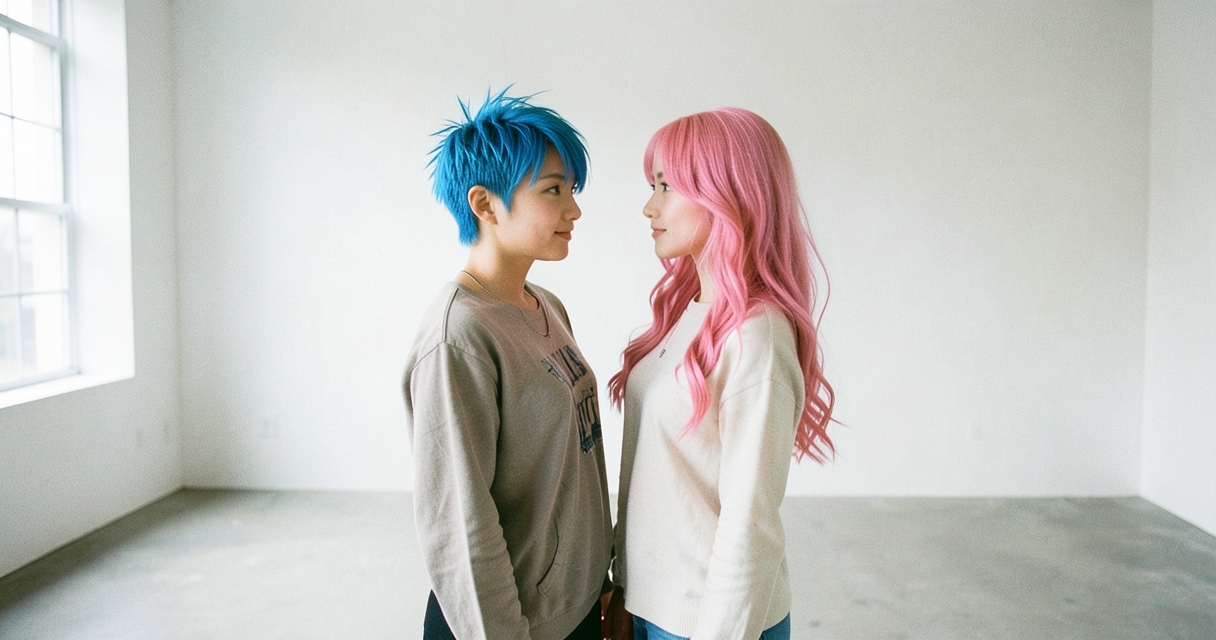
Real hair color does not work like mixing paint into purple
Anime occasionally gives us siblings whose hair colors appear to belong to entirely different families.
One is pink. The other is blue.
That raises a surprisingly good chain of questions. Are they dyeing it? If real genetics worked on those colors, would red plus blue make purple? If a black-haired person and a blond person had children, could one sibling be blond while another had very dark hair? And, inevitably, can nature produce a Super Saiyan?
The last question escalates quickly, but all of them point to the same principle:
Human hair color is not a paint mixture. It is a polygenic trait produced by biological control of the type, amount, and distribution of melanin.
In the Lucky Star spin-off The Miyakawa Family's Hunger, Hinata Miyakawa and Hikage Miyakawa are officially described as sisters.[1] Their visual designs use dramatically different hair colors. The KADOKAWA description checked for this article does not explain the contrast as hair dye, so the safest interpretation is simple: this is character design, not a genetics lesson.
1. Humans do not normally grow hair containing a blue pigment
Natural human hair color is driven mainly by melanin.
Two forms matter most:
- eumelanin, associated mainly with black and brown coloration;
- pheomelanin, associated mainly with red and yellow coloration.
MedlinePlus Genetics explains that black hair generally contains a large amount of eumelanin, brown hair less, blond hair very little, and red hair a relatively high contribution of pheomelanin.[2][3]
So natural blue hair is not the result of a person producing a special reservoir of blue melanin.
Very dark hair can look bluish under certain lighting because of reflection and surrounding colors. That is different from naturally growing saturated anime-blue hair.
The same applies to hot pink. Natural red hair exists; fluorescent pink hair is another matter.
2. Genes are not RGB sliders
"Red-haired parent plus blue-haired parent equals purple-haired child" makes sense in a paint program.
Human inheritance does not open that dialog box.
Many genetic variants influence pigment production, pigment-cell biology, and the amount and ratio of melanins. MC1R is one well-known gene, but it is only part of the system.[2][3]
A 2018 Nature Genetics meta-analysis involving almost 300,000 participants of European ancestry identified 123 autosomal loci and one X-chromosome locus significantly associated with hair color.[4][5]
In other words, hair color is not a simple game in which a single "black gene" fights a single "blond gene."
The familiar one-gene dominant-versus-recessive classroom model is far too small for the real trait.
3. What happens when a dark-haired person and a blond person have children?
There is no single guaranteed answer.
Children receive different combinations of many relevant variants from the same two parents. Depending on those parental genotypes and the family's ancestry, siblings may end up with hair that is:
- blond;
- light brown;
- medium brown;
- dark brown;
- or, in some genetic backgrounds, very dark.
The important point is that there is no universal chart saying "one dark-haired parent means all dark-haired children" or "one blond parent means exactly half blond children."
Siblings are not manufactured by averaging their parents' color values.
4. Could one brother be blond and his sister have very dark hair?
Yes, that can happen.
The probability depends heavily on the exact variants carried by the parents and on ancestry, so it would be wrong to assign one universal percentage.
But siblings can inherit sufficiently different combinations for one to be much lighter than another. Differences can also widen with age.
A family is not an RPG crafting screen in which a level-10 dark-hair parent and a level-2 blond parent automatically generate level-6 brown-haired children.
5. Hair color can change while the person grows up
Age adds another complication.
MedlinePlus notes that, especially among people of European ancestry, blond children often develop darker hair by their teenage years.[2]
Research on the hair-follicle pigmentation system likewise describes progressive darkening from childhood through adolescence and young adulthood in many people.[6]
So a photo timeline can look like this:
Age 5: almost Super Saiyan. Age 15: dark blond. Age 25: brown.
The transformation did not "wear off."
The follicle's pigment production changed with development.
6. So can blue plus red ever become purple through inheritance?
Not in the paint-mixing sense.
The normal human system does not contain a "blue-hair gene" producing blue pigment that then mixes with a red-hair pigment.
Instead, ordinary natural hair colors emerge mainly from differences in eumelanin and pheomelanin.[2][3]
Opening a color wheel, selecting both parents' hair colors, and clicking the midpoint will therefore not predict the child's hair.
Genetics has no eyedropper tool.
7. Why does anime make siblings look so different, then?
Because hair color is also graphic design.
In animation, a hair color can help:
- identify a character instantly;
- separate personalities;
- create readable color blocks in a crowded frame;
- make merchandise and illustrations easy to recognize.
That gives artists freedom to use blue, green, purple, and pink even though ordinary human pigmentation cannot generate those saturated hues.
Some series make siblings visually similar. Others deliberately push them apart.
Real inheritance optimizes nothing for audience recognition. Character design absolutely can.
Anime hair follicles apparently employ an art director.
8. Can humans at least become Super Saiyans in hair color?
Only in the least exciting scientific sense.
Natural very light blond and platinum-blond hair exists, especially in some children.
But the real-world version has limitations:
- it does not glow;
- it does not stand up because of ki;
- no aura appears;
- combat power does not increase;
- anger does not threaten nearby planets.
The technically defensible diagnosis is therefore:
Super Saiyan hair, only.
If someone's hair suddenly stands up, test static electricity, styling product, and bed hair before testing combat ancestry.
9. A quick reality check
| Intuition | Reality |
|---|---|
| Dark hair × blond = all brown-haired children | Not necessarily |
| Dark hair is controlled by one dominant gene | Hair color is polygenic |
| Blue × red = purple child | Natural inheritance is not color mixing |
| Siblings should have nearly identical hair | They can inherit different combinations |
| Blond hair stays the same for life | It can darken with age |
| Blond means Super Saiyan | Hair only, at best |
Conclusion
When anime shows one sister with blue hair and another with pink hair, "what happened to genetics?" is a perfectly reasonable reaction.
For ordinary natural human pigmentation, saturated blue and pink are already outside the usual biological palette.
But the opposite assumption is also wrong: real siblings do not have to share the same hair color.
Human hair color is a complex polygenic trait, siblings can inherit substantially different combinations, and hair can change with age.
So the two-part answer is simple:
Anime blue-and-pink siblings are mostly character design.
Real blond-and-dark-haired siblings are entirely within the territory of genetics.
And if a platinum-blond child looks like a Super Saiyan, enjoy the resemblance. No power-level scanner is required.
References (6)
- KADOKAWA, 宮河家の空腹 (1) kadokawa.co.jp
- MedlinePlus Genetics, Is hair color determined by genetics? medlineplus.gov
- MedlinePlus Genetics, MC1R gene medlineplus.gov
- Hysi PG et al. Nature Genetics 2018 / PubMed pubmed.ncbi.nlm.nih.gov
- Hysi PG et al. full text / PMC pmc.ncbi.nlm.nih.gov
- Tobin DJ. Aging of the Hair Follicle Pigmentation System / PMC pmc.ncbi.nlm.nih.gov
