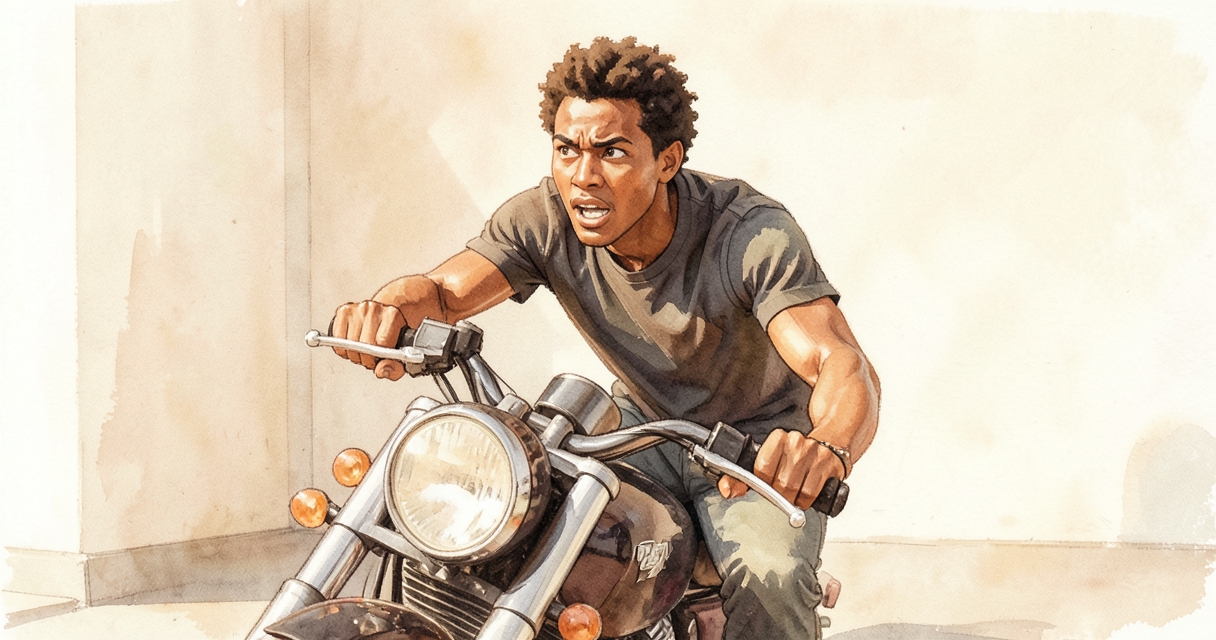
1. The short answer: “Can I survive 90 minutes?” can turn into “This is actually fine”
The first time you ride pillion on a motorcycle, your brain may assign itself one job: do not fall off.
So you squeeze the rider or the grab rail as if grip strength were the only thing separating you from the road. Every lean feels suspicious. If an oncoming motorcyclist waves, you may notice it but have absolutely no spare hand for motorcycle diplomacy.
Then something changes. After you become familiar with acceleration, braking and leaning, the bike stops feeling like a machine that is constantly trying to throw you away. You realize that you do not need to fight every movement.
Honda’s official riding guide tells passengers to relax the shoulders and elbows and maintain a natural position that moves with the rider.[1] That is almost the opposite of the beginner instinct to lock every muscle.
The biggest enemy on a first tandem ride may therefore be neither wind nor cornering. It may be 100-percent emergency grip mode.
2. Why doesn’t leaning in a corner automatically make you fall?
A motorcycle must lean into a turn. At a given speed and corner radius, the motorcycle-rider-passenger system settles at a lean angle that balances gravity with the acceleration needed to turn.
For a passenger, that means the goal is not to keep the upper body rigidly vertical while the motorcycle leans underneath.
Honda explains that cornering becomes more stable when the passenger leans inward together with the rider.[1] The Motorcycle Safety Foundation likewise advises passengers to look over the rider’s shoulder in the direction of the turn and avoid sudden movements.[6]
For a beginner, “leaning” visually resembles “falling.” After experiencing it a few times, the distinction becomes clearer: controlled lean is how a two-wheeler turns.
That does not mean more lean is always better. Excessive speed, abrupt inputs, poor road conditions and extreme lean angles remain dangerous. Entering a corner at an appropriate speed is fundamental.
A useful rule is simple: do not fight the bike, do not make sudden independent movements, and move naturally with the rider.
3. Shaky hands after holding a 500 mL bottle? You may have spent too much grip strength
A surprisingly common first-ride discovery happens after getting off the motorcycle: “Why are my forearms this tired?”
Imagine holding a 500 mL bottle and seeing your hand tremble slightly. You did not lift a heavy weight. You may simply have kept the forearm muscles contracted for a long time because your brain kept sending the command “hold on harder.”
Honda’s recommended passenger posture explicitly says to relax the shoulders and elbows and to grip the rider lightly with the knees.[1] MSF recommends holding the rider’s waist or hips, or the motorcycle’s passenger hand-holds, while avoiding sudden body movements.[6]
Normal physiological tremor can also become more visible with fatigue, stress, anxiety or excitement.[7] So a sequence of “first ride + extreme gripping + shaky hands afterward” is plausible without implying a disease.
Still, persistent or severe tremor at rest, numbness, weakness, significant pain, repeated episodes or worsening symptoms should not automatically be blamed on motorcycle fatigue. Those deserve medical assessment.[7]
The target is not to hold at maximum force continuously. It is to remain stable while keeping enough reserve to react when necessary.
4. An oncoming rider waves. The passenger has no available bandwidth
Motorcyclists sometimes wave or make a small hand gesture to riders coming the other way. In Japan, this informal greeting is often nicknamed “Yae.”
For a first-time passenger, the internal conversation can be ridiculous:
“They waved.”
“Should I wave back?”
“Absolutely not. This hand is currently classified as life-support equipment.”
International relations suspended.
That is fine. A passenger does not need to return the gesture. Sudden turning, arm movement or weight transfer can disturb the rider, and MSF explicitly advises passengers to avoid sudden movement.[6]
Let the rider respond if it is safe. The passenger’s first job is to stay predictable.
5. Can a passenger handle 90 minutes? The real limit may be the forearms, neck, back and attention
A person who feels exhausted after the first few minutes may assume a 90-minute ride is impossible. Sometimes the early fatigue drops sharply once the fear-driven tension disappears.
But relaxing the hands does not make endurance unlimited. A passenger still faces wind, helmet weight, posture control, acceleration and braking. The neck, back, inner thighs and forearms can all become tired.
Honda’s tandem training material treats route planning and rest breaks as specific passenger-comfort issues.[2]
For longer rides, the sensible strategy is to keep the shoulders and elbows relaxed, keep both feet stable on the passenger pegs, use the knees without crushing the rider, brace appropriately for acceleration and braking, and stop for a break if fatigue builds. If the passenger becomes sleepy or cannot maintain posture and attention, the ride should pause.
Tandem riding becomes much easier when it stops being “survive using only my arms” and becomes “share the motorcycle’s movement with my whole body.”
6. What does “tandem” mean, and is motorcycle two-up riding legal in Japan?
“Tandem” literally refers to things arranged one behind another. In motorcycle language, it commonly means riding two-up: one rider operating the motorcycle and one passenger behind.
In Japan, carrying a passenger is not inherently illegal. It is an explicitly regulated form of motorcycle use.
As of September 2026, ordinary-road two-up riding generally requires an eligible motorcycle with passenger equipment and a rider who has held the relevant motorcycle licence for at least one year.[3][4]
Expressways impose stricter conditions: the motorcycle must be over 125 cc, the rider generally must be at least 20 years old and have at least three years of motorcycle-licence history, and some road sections prohibit two-up motorcycles.[4][5]
There is an important post-2025 trap: engine displacement alone no longer tells you whether two-up riding is allowed. Japan’s new-standard Class 1 mopeds can have engines above 50 cc and up to 125 cc if output is limited to 4.0 kW or less. They remain subject to Class 1 moped traffic rules, including the prohibition on carrying a passenger.[3]
So check the legal vehicle category, seating capacity, passenger equipment, licence history and road type—not just the number printed next to “cc.”
7. What if you want to pay for the experience? Japan has no simple short-ride market price
After a fun first ride, a reasonable thought is: “Could I just pay a professional to take me as a passenger for 30 or 60 minutes?”
In Japan, there is no broadly established consumer market with a standard short-distance motorcycle-taxi fare comparable to countries where motorcycle taxis are a routine transport service.
Japan’s second-class driver-licence categories include ordinary, medium, large, large-special and towing licences, but not a second-class motorcycle licence.[9] Paid passenger transport is also regulated under the Road Transport Act.[8] In other words, legal private tandem riding does not automatically mean somebody may charge fares and operate a motorcycle taxi.
Paid products that accept tandem passengers do exist, but they are usually tours or events rather than “one-hour rides.” Published 2026 examples include ¥450,800 for a non-driving tandem participant on a 14-day MOTO TOURS JAPAN KYOTO package,[11] and ¥379,000 for a tandem participant on a seven-day Kanto tour.[12]
Those prices include the structure of a travel package—lodging, itinerary elements, guiding and other services. They are not a benchmark for the value of sitting on the rear seat for one hour. Dividing them by 60 minutes would be an act of violence against economics.
Bridgestone’s BATTLAX FUN & RIDE MEETING also lists limited tandem rides with professional riders for eligible participants at some events.[10] Again, that is an event experience, not a permanent city motorcycle-taxi counter.
So if the goal is simply to experience tandem riding safely, an opportunity to ride with a trusted, legally eligible and experienced acquaintance on a properly equipped motorcycle can be unusually valuable.
8. Final verdict: the first tandem ride was never supposed to be a grip-strength competition
Before a first ride, the logic looks terrifyingly simple:
Two wheels. No protective cage. The machine leans. Surely I fall.
So the passenger locks the arms, refuses to release either hand, ignores friendly waves and may discover afterward that even a small bottle makes the forearms shake.
Then the system starts to make sense. Motorcycles lean to turn. The passenger moves naturally with the rider. The shoulders and elbows do not need to stay rigid. The feet, knees and torso contribute to stability, and acceleration or braking is handled deliberately rather than with permanent panic tension.
That is how “90 minutes sounds impossible” becomes “I could probably do this.”
Legally, tandem riding is normal in Japan when the rider, motorcycle and road meet the required conditions. Class 1 mopeds—including the new-standard models—cannot carry a passenger, and expressways add stricter requirements. Paid short tandem services, meanwhile, do not have a simple standard market price; the visible commercial options are mostly tours and events.
The most useful discovery is therefore almost embarrassingly simple:
You may not have needed maximum grip to avoid falling. You were using maximum grip because you were afraid of falling.
The moment that fear becomes controlled excitement is one of the experiences that only the passenger seat can really teach.