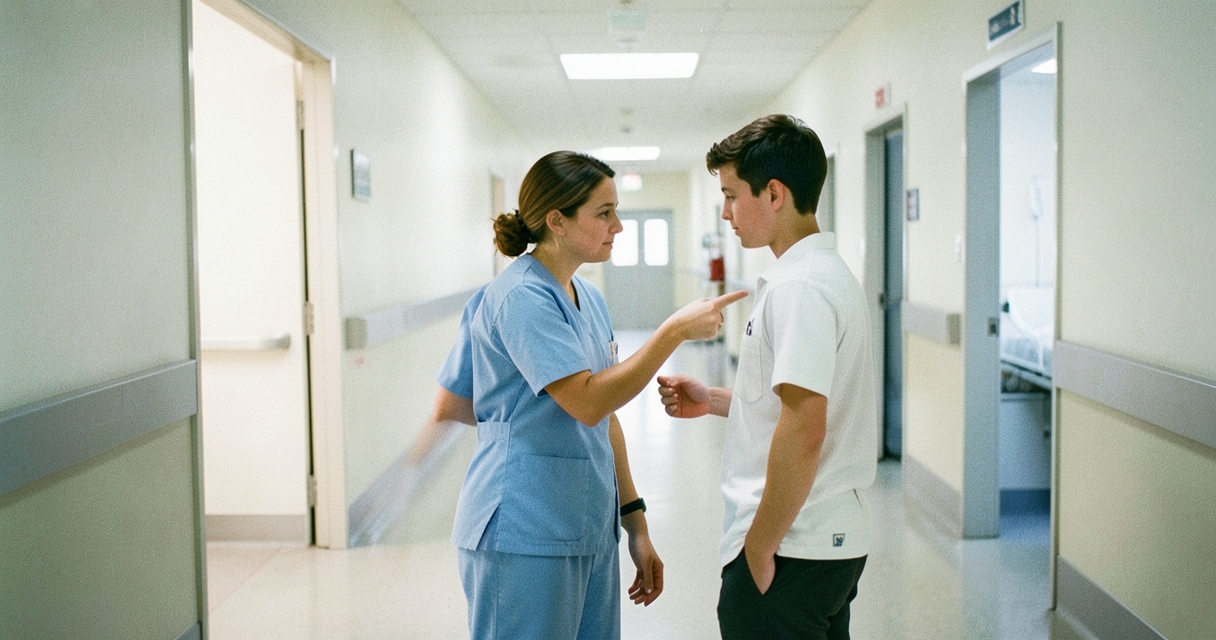
There is a compact medical-workplace meme that goes roughly like this:
“Resident doctor cliché: a nurse nearing 30 is strangely nice to you.”
It barely explains itself, yet the implication is easy to decode. The joke assumes that a nurse around 30 sees a young resident doctor as a promising marriage prospect, so she becomes extra kind. Meanwhile, the resident’s internal romantic comedy has already started episode two: “Wait… is she only this nice to me?”
Reality is slower.
Bottom line: kindness is observable. Romantic interest is still an inference.
A hospital ward contains many non-romantic explanations for kindness: she may simply be kind, she may be helping a newcomer, preventing errors, sharing local knowledge, or keeping the team running. The nurses’ station is not a dating-app interface.
1. Why “around 30”? The stereotype does more work than the number itself
The choice of “nearly 30” is part of the joke.
According to Japan’s 2025 vital statistics, the average age at first marriage was 31.0 for husbands and 29.7 for wives. That makes “around 30” an easy cultural cue for marriage in Japan.
But that statistic does not mean women around 30 are desperate to marry. An average age at first marriage is a population statistic, not a personal urgency meter. It certainly does not show that nurses around 30 are nicer to residents because they are looking for husbands.
The meme compresses a chain of associations:
around 30 → probably thinking about marriage → young doctor looks like a good prospect → maybe that is why she is nice
The engine of the joke is a social stereotype, not evidence.
2. Why someone only a few years older can feel like an “older sister”: experience can outweigh age
This is where the distinctive onee-san, or capable older-sister, vibe appears.
A resident and a nurse around 30 may be close in chronological age. On the ward, however, the perceived gap can become much larger because one person is new to the local system while the other knows the map.
A resident may hold a medical license and still need to learn how this particular ward works: whom to ask, where things are, what the local routines are, and what is normal for a particular patient. A nurse who has worked there for years may possess exactly that local, operational and interpersonal knowledge.
So the scene becomes:
Nurse: “That’s over here.”
Resident: “Thank you…”
Nurse: “This patient is usually like this.”
Resident: “Older sister…”
A three-year age gap can feel much larger when the experience gap is substantial. Sometimes “older sister” is not produced by the birth register. It is produced by knowing how the ward actually works.
3. Experienced nurses supporting residents is well explained by research
This part has evidence behind it.
A 2026 scoping review in Advances in Health Sciences Education examined 22 publications on collaboration and learning between resident doctors and experienced nurses.
The review found that collaboration and mentoring from experienced nurses can help residents develop local knowledge, communication, confidence, and constructive interprofessional relationships. It also notes that nurses can provide continuity in workplaces where residents rotate, making them accessible sources of practical support and learning.
So before interpreting careful help as “romance!”, there is a powerful competing hypothesis:
education, teamwork, patient safety, and local knowledge.
Importantly, this was not a romance review. It discussed factors such as age and gender in interprofessional relationships, but it did not show that nurses nearing 30 become romantically nicer to residents. Connecting those dots would turn a health-professions education paper into a romantic comedy without the authors’ permission.
4. Why “nice = attracted” is unreliable: too many hypotheses fit the same observation
One act of kindness is difficult to interpret because many causes can produce it:
- she is kind to everyone;
- the ward has a culture of supporting newcomers;
- she is anticipating risks for patient safety;
- the resident does not yet know local routines;
- she wants good teamwork;
- she simply finds the colleague easy to work with;
- and yes, personal attraction is also possible.
All of these can be true explanations.
If “she explained something,” “she smiled,” or “she helped me when I was stuck” automatically counts as romantic proof, the ward’s entire educational function becomes a dating simulator.
She showed you where the IV supplies are. That is not necessarily foreshadowing for a marriage certificate.
She asked, “Are you okay?” That is not automatically coded confession dialogue.
Receive kindness as kindness first. Anything beyond that needs more information.
5. If you are trying to infer attraction, look at differences from baseline rather than the absolute amount of kindness
There is no definitive sign of romantic interest. Still, some information is more informative than a single helpful interaction.
The useful question is not merely “Was she nice?” but “Is this different from how she normally treats other people?”
Potentially more informative patterns include:
- whether she treats other residents the same way;
- whether she initiates continuing contact outside work;
- whether she voluntarily suggests meeting one-on-one for non-work reasons;
- whether mutual personal disclosure increases;
- whether both people create contact that is unnecessary for work.
A cluster of such patterns can weaken the “just professional kindness” explanation. Even then, friendship remains another possibility.
One smile should not be assigned 100 points out of 100 on the Romance Evidence Scale.
6. Ward Bayesian inference: do not jump from “nice” to 100% romance probability
This whole meme works surprisingly well as a joke about Bayesian reasoning.
You begin with a hypothesis: perhaps she is interested. Then you observe kindness. But kindness also occurs frequently when there is no romantic interest, so the evidence is weak on its own.
The internal rom-com algorithm, however, goes:
nice → only to me? → maybe? → search wedding venues
Several calculations have vanished.
A less exciting update is:
nice → could easily be professional → compare with baseline → look for voluntary off-duty contact → still uncertain
Boring? Very. More realistic? Usually.
7. The funniest reversal: perhaps you are not being flirted with; perhaps you are being monitored
The richest version of the joke is the one in which the resident and nurse are living in entirely different genres.
Resident’s internal monologue: “Why is she so nice to me? Could it be…?”
Nurse’s internal monologue: “This new doctor still doesn’t know the ward flow. I should keep an eye on him so nothing goes wrong.”
For the resident, it is a romance event.
For the nurse, it is risk management.
The same kindness becomes romantic comedy on one side and safety management on the other. That mismatch is the joke.
It also fits the 2026 review’s description of supportive communication from experienced nurses helping early-career doctors gain confidence and practice more effectively and safely.
So the “older-sister” aura may be less about romantic coding and more about an experienced professional supporting a newcomer.
That still qualifies as a powerful older-sister vibe.
8. So is “a nurse nearing 30 is strangely nice to residents” actually true?
Split the claim into pieces:
“Experienced nurses sometimes support resident doctors.” → Yes. This is well explained in the literature.
“Around 30 is a culturally legible marriage-related number in Japan.” → Understandable. The 2025 average age at first marriage for wives was 29.7.
“Nurses nearing 30 are extra kind because they are targeting residents as marriage partners.” → No supporting evidence was identified for that generalization.
“This particular person’s kindness means personal attraction.” → You cannot tell from kindness alone.
The meme is therefore best read as a compressed mixture of:
a real senior-junior workplace dynamic × a marriage-age stereotype × the universal human tendency to think “wait, are they especially nice to me?”
The older-sister vibe is plausible.
The attraction verdict is still under review.
And if you start seeing floating heart effects over the nurses’ station, sleep deprivation may deserve consideration before destiny.
Sources
- Japan Ministry of Health, Labour and Welfare, 2025 Vital Statistics provisional annual report. Average age at first marriage: husbands 31.0, wives 29.7. This is demographic context, not evidence of individual marriage urgency or nurses’ romantic motives. https://www.mhlw.go.jp/toukei/saikin/hw/jinkou/geppo/nengai25/dl/gaikyouR7.pdf
- Creese J, Oli RU, Wang W. “Factors influencing workplace collaboration and learning between resident doctors and senior nurses: a scoping review.” Advances in Health Sciences Education. Published 30 June 2026. Review of 22 publications on collaboration, learning and mentoring. https://link.springer.com/article/10.1007/s10459-026-10557-5
- Japan Ministry of Health, Labour and Welfare, official portal for the physician clinical training system, including information posted 4 September 2026. https://www.mhlw.go.jp/stf/seisakunitsuite/bunya/kenkou_iryou/iryou/rinsyo/index.html