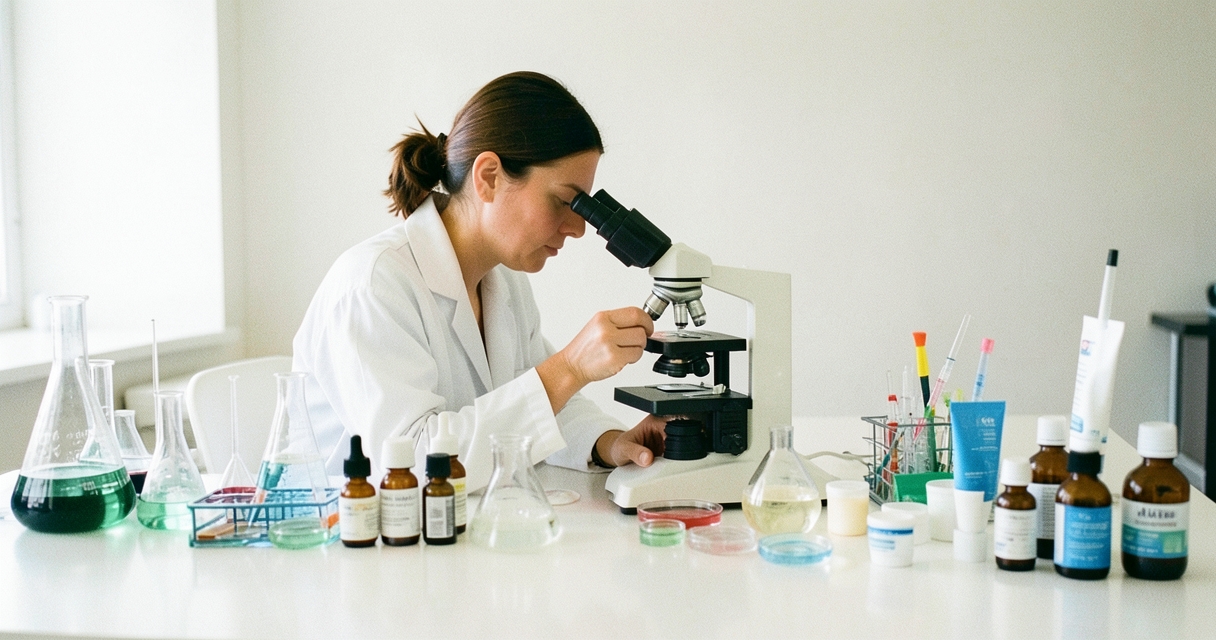
1. A free facial accidentally became an evidence review
A facial can produce a surprising amount of advice: pollen may irritate the skin, direct fan air may dry the face, moisturize quickly after washing, use emulsion and cream to keep moisture in, apply cleansing oil to dry skin, stop retinol if the skin is irritated, sleep and stress show up on the skin, and perhaps the famous “11 p.m. to 2 a.m. skin golden time.”
The interesting part begins after the treatment, when those claims are checked against dermatology guidance and clinical research.
Some survive almost intact.
Some recommend a useful behavior but explain it with the wrong mechanism.
Some are memorable salon stories that go one step beyond what research can actually support.
That does not make professional estheticians useless. They have something research papers do not: repeated close observation of real clients and their routines. Research has something salon experience does not: control groups, measurement, reproducibility, and a way to separate correlation from causation.
The strongest combination is simple:
Use professional observation to generate hypotheses, then use science to decide how much weight to give them.
2. Four things with relatively strong support
Sun protection
This is one of the clearest wins. In a randomized trial, people assigned to regular sunscreen use showed less progression of skin aging over about 4.5 years than those using sunscreen at their discretion.[1]
Before buying ten anti-aging serums, reduce chronic ultraviolet exposure.
Boring, but central.
Moisturizing
For dry or irritated skin, applying moisturizer soon after washing and using thicker creams or ointments when needed is standard dermatologic advice.[2]
The salon phrase “lock the moisture in” is not a precise physiological definition, but it is a useful behavioral shortcut.
Gentle cleansing
More cleansing is not automatically better. Aggressive washing and friction can strip lipids from the outer skin barrier and increase irritation.
Face washing is not strength training. Pressing harder earns no bonus points.
Retinoids
Vitamin A derivatives are among the better-studied anti-aging topicals. A systematic review of randomized trials supports topical tretinoin for signs of photoaging.[3] A controlled trial of a 0.1% retinol moisturizer also reported improvements in multiple measures of photodamage.[4]
But efficacy and tolerability are different questions.
3. Emulsion plus cream: reasonable, not mandatory
The goal of moisturizing is not to complete a product checklist. The goal is to keep the skin comfortable and reduce excessive water loss.
Lighter emulsions may be enough for some people. Thicker creams are usually more useful when dryness is stronger.[2]
So the practical rule is:
- if one light moisturizer is enough, stop there;
- if the skin still feels tight, add a cream;
- if one cream works well by itself, an emulsion is not a compulsory prerequisite.
Timing matters more than the number of bottles. Moisturizing before freshly washed skin becomes completely dry is sensible.
4. Cleansing oil works, but “once a week” and “opening pores” are different claims
A clinical trial comparing methods for sunscreen removal found cleansing oil particularly effective for waterproof sunscreen.[5]
That supports its actual job: removing oily and water-resistant material.
It does not establish a universal rule that everyone needs cleansing oil once every week.
Frequency should follow what is on the skin, the formulation, and individual tolerance.
Using many cleansing oils or balms on a dry face before showering is also reasonable because some formulas work best before substantial water is added. But products specifically designed for wet hands exist, so the package instructions still win.
And pores do not behave like tiny doors that literally swing open and shut. Heat, sebum, plugs, and the surrounding skin can change how visible pores look, but “the pores opened in the shower, so cleansing stopped working” is an oversimplified mechanism.
A useful pattern appears here:
The behavior may be good even when the story used to explain it is not necessary.
5. Pollen can irritate skin; sunscreen is not a hay-fever drug
Airborne contact dermatitis from Japanese cedar pollen has been documented, including facial and neck symptoms.[6]
So seasonal facial itching, redness, or irritation can genuinely be related to pollen.
But that does not turn sunscreen into a treatment for allergic rhinitis or conjunctivitis.
Sun protection reduces ultraviolet exposure. A topical film may also reduce direct contact with particles in some situations, but that is not the same as preventing “pollen allergy” as a whole.
The careful version is:
- ultraviolet protection matters for photoaging;
- pollen can worsen skin inflammation;
- protecting an irritated skin barrier during pollen season makes sense;
- sunscreen should not be described as a treatment for hay fever.
6. “Tired skin” is a useful phrase, not a medical diagnosis
“Tired skin” can describe a real appearance: dryness, redness, rough texture, dullness, or tired-looking eye areas.
It is not a formal diagnosis.
Human research has found that psychological stress can delay skin-barrier recovery.[7] Strong sleep restriction has also delayed barrier restoration and wound healing in experimental settings.[8]
So stress and inadequate sleep can matter.
The leap to “you were not asleep between 11 p.m. and 2 a.m., therefore your skin could not recover” is much weaker.
Sleep duration, quality, regularity, and circadian timing matter, but there is no strong clinical rule that three specific clock hours determine whether skin repairs itself.
If someone sleeps a reasonable amount yet has irritated skin, direct causes such as retinoids, dryness, pollen, friction, or cleansers deserve attention too.
7. Retinol is real enough to irritate you
Retinol is not merely marketing. It is also not harmless magic.
Retinoids commonly cause redness, dryness, stinging, and peeling. Those reactions do not automatically mean a true allergy; irritant dermatitis is common.
If the skin is already inflamed, pushing through because “anti-aging is good” can be counterproductive.
A more sensible approach is:
- pause until the skin settles;
- if restarting, use a lower concentration, smaller amount, and lower frequency;
- moisturize adequately;
- avoid stacking strong exfoliants on the same night;
- protect the skin from ultraviolet exposure during the day.
If marked swelling, severe itching, or recurrent eczema appears, stop self-experimentation and seek dermatologic evaluation.
Retinol is not the villain. Ignoring dose and skin condition is.
8. Acne is not a one-dimensional oil problem
Acne involves several interacting processes: sebum, follicular plugging, inflammation, microbes in the follicle, hormones, cosmetics, and barrier condition.
This is why “you have acne, therefore remove all oil” is too crude.
Dermatology guidance commonly includes moisturizer during acne treatment because excessive dryness and irritation can make treatment difficult to tolerate.[9]
The opposite claim is also too crude: treatments that reduce sebum are not automatically wrong just because dry skin can be acne-prone.
The useful rule is not “oil on” versus “oil off.”
It is: do not reduce acne to one number on a sebum meter.
9. Skin analysis is a dashboard, not a blood test
Camera- or sensor-based skin analysis can be useful when it tracks the same person over time.
Change one routine, wait, and compare.
That can help identify whether dryness, texture, visible pores, or redness are changing.
But an image of the skin cannot by itself establish zinc deficiency, vitamin B1 deficiency, a specific pollen allergy, or psychological stress as the cause.
Treat skin analysis as a map of visible or model-estimated skin characteristics, not a laboratory diagnosis.
That also means personalized-product recommendations can be separated from the analysis itself. A person can take “my skin currently looks dry and reactive” as a specification and shop for a simple fragrance-free moisturizer elsewhere.
Analysis is one decision.
Buying the recommended line is another.
10. Zinc, vitamin B1, and the “too much ejaculation ruins your skin” myth
True zinc deficiency can affect skin and wound healing, and zinc is an essential nutrient.[10]
Semen also contains zinc. In a controlled metabolic study, seminal zinc loss under the normal-zinc condition was about 6.29 micromoles per ejaculation.[11]
But those two true facts do not prove the popular chain:
frequent ejaculation → zinc depletion → bad skin.
High-quality human evidence establishing that causal chain is lacking.
Vitamin B1 deficiency is also real, but a facial image is not a diagnostic test for body thiamine status.[12]
If nutrition is genuinely concerning, evaluate diet first and use medical testing when appropriate. Do not respond to a cosmetic suggestion by megadosing supplements. The NIH adult upper intake level for zinc is 40 mg per day; prolonged high intake can interfere with copper absorption.[10]
It would be unfortunate to create a new deficiency while trying to cosmetically fix an imagined one.
11. Sort the advice by evidence strength
Strongly supported or well grounded
- regular ultraviolet protection for photoaging prevention;[1]
- moisturization and prompt post-wash moisturizing for dry skin;[2]
- minimizing friction and excessive cleansing;
- cleansing oil for difficult waterproof sunscreen in appropriate cases;[5]
- pollen as a possible trigger of skin inflammation;[6]
- effects of stress and strong sleep restriction on skin-barrier recovery;[7][8]
- retinoids for photoaging, with irritation as a known tradeoff;[4][3]
- moisturizer as part of tolerable acne care.[9]
Reasonable but context dependent
- layering an emulsion and cream;
- using cleanser both morning and night;
- applying cleansing oil to a dry face;
- wearing sunscreen indoors;
- avoiding continuous fan air on the face;
- changing products based on repeated skin measurements;
- increasing barrier care during pollen season.
Too strong when stated as universal scientific facts
- skin only repairs properly between 11 p.m. and 2 a.m.;
- pores literally open in the shower and prevent cleansing;
- young people get “surface” spots while older people get spots “from inside”;
- sunscreen prevents hay fever;
- everyone needs both emulsion and cream;
- everyone should use cleansing oil once a week;
- a facial scan can diagnose zinc or B1 deficiency or a specific allergy;
- frequent masturbation causes zinc depletion and therefore skin problems.
Many beauty myths are powerful because the first half is true. The mistake happens when a plausible mechanism is stretched one step beyond the evidence.
12. A research-first minimal routine
Morning
- Lukewarm water or a gentle cleanser according to skin condition.
- A simple fragrance-free moisturizer.
- Add cream if needed.
- Broad-spectrum sunscreen.
Evening
- Use an appropriate remover when makeup or difficult sunscreen is present.
- Use a gentle cleanser if needed.
- Moisturize promptly.
- Add cream when dryness requires it.
After the skin becomes stable
If retinol is still desired, reintroduce it slowly at low concentration, small amount, and low frequency.
Do not add five new products at once.
Changing one variable at a time is itself a form of measurement.
13. The professional and the research paper are good at different things
A skilled esthetician can notice routine errors, identify visible dryness, ask how products are actually being used, and turn abstract advice into a routine someone will follow.
Research can test whether the explanation is causal, compare alternatives, quantify benefits and harms, and prevent “I see this all the time” from becoming an unjustified universal rule.
The ideal loop is:
professional observation → hypothesis → evidence check → low-risk personal trial → follow-up observation.
An esthetician is not a randomized trial.
A randomized trial will not touch your face and say, “This area seems dry.”
Use both.
A free facial can leave the skin smoother and accidentally send someone home with an entire research project.
Not a bad return on one afternoon.
Sources
- Hughes MCB, Williams GM, Baker P, Green AC. “Sunscreen and prevention of skin aging: a randomized trial.” Annals of Internal Medicine. 2013;158(11):781-790. PMID 23732711 pubmed.ncbi.nlm.nih.gov
- American Academy of Dermatology. “Dermatologists’ top tips for relieving dry skin. aad.org
- Sitohang IBS, Makes WI, Sandora N, Suryanegara J. “Topical tretinoin for treating photoaging: A systematic review of randomized controlled trials.” International Journal of Women’s Dermatology. 2022;8(1):e003. PMID 35620028 pubmed.ncbi.nlm.nih.gov
- Tucker-Samaras S, et al. “A stabilized 0.1% retinol facial moisturizer improves the appearance of photodamaged skin in an eight-week, double-blind, vehicle-controlled study.” Journal of Drugs in Dermatology. 2009;8(10):932-936. PMID 19852122 pubmed.ncbi.nlm.nih.gov
- Chen W, He M, Xie L, Li L. “The optimal cleansing method for the removal of sunscreen: Water, cleanser or cleansing oil?” Journal of Cosmetic Dermatology. 2020;19(1):180-184. PMID 31157512 pubmed.ncbi.nlm.nih.gov
- Airborne contact dermatitis due to Japanese cedar pollen.” Contact Dermatitis. PMID 17343624 pubmed.ncbi.nlm.nih.gov
- Altemus M, Rao B, Dhabhar FS, Ding W, Granstein RD. “Stress-induced changes in skin barrier function in healthy women.” Journal of Investigative Dermatology. 2001;117(2):309-317. PMID 11511309 pubmed.ncbi.nlm.nih.gov
- Smith TJ, et al. “Impact of sleep restriction on local immune response and skin barrier restoration with and without multinutrient nutrition intervention.” Journal of Applied Physiology. 2018;124(1):190-200. PMID 28912361 pubmed.ncbi.nlm.nih.gov
- American Academy of Dermatology. “Moisturizer: Why you may need it if you have acne. aad.org
- NIH Office of Dietary Supplements. “Zinc — Health Professional Fact Sheet. ods.od.nih.gov
- Hunt CD, Johnson PE, Herbel J, Mullen LK. “Effects of dietary zinc depletion on seminal volume and zinc loss, serum testosterone concentrations, and sperm morphology in young men.” American Journal of Clinical Nutrition. 1992;56(1):148-157. PMID 1609752 pubmed.ncbi.nlm.nih.gov
- NIH Office of Dietary Supplements. “Thiamin — Health Professional Fact Sheet. ods.od.nih.gov